Business process outsourcing financial model, built free.
A three-statement Excel model for a business process outsourcing, built from your own figures and checked to balance.
- Free account
- No card
- Usually ready within the hour
We use generative AI in parts of our process, so mistakes can occur. Every model should be checked by a person before it is relied on. Read more
Runs clients' back- and middle-office processes (finance and accounting, HR, procurement, claims, collections) under multi-year contracts priced per FTE, per transaction or fixed fee.
In short
- 01
Three linked statements
Income statement, balance sheet and cash flow, linked in every period.
- 02
Valued two ways
Discounted cash flow and trading multiples, side by side.
- 03
Monthly to annual
Monthly, quarterly, half-yearly or annual periods, for up to 30 years.
- 04
Checked every period
A Checks sheet shows the balance sheet balances and the cash reconciles.
The sample, as Excel draws it.
Built by the same system and checks as yours: its structure and its inputs, ready for your own figures.
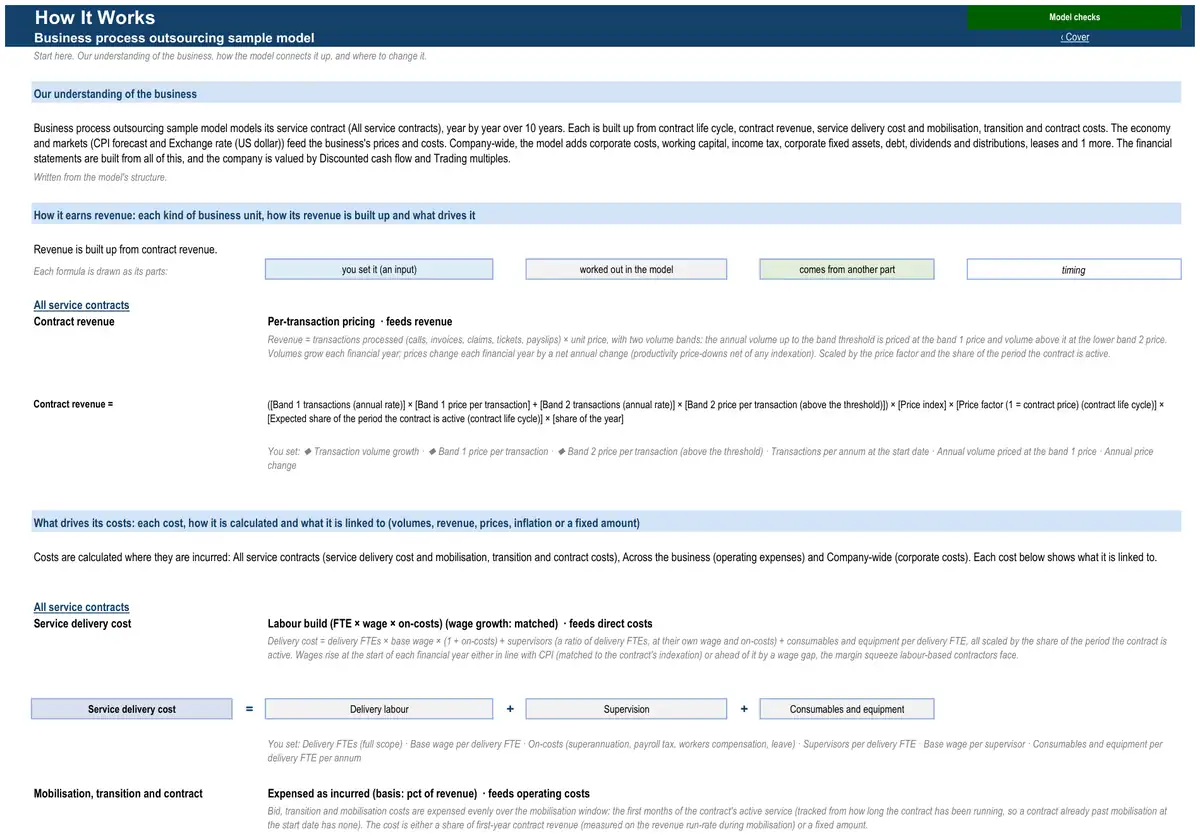
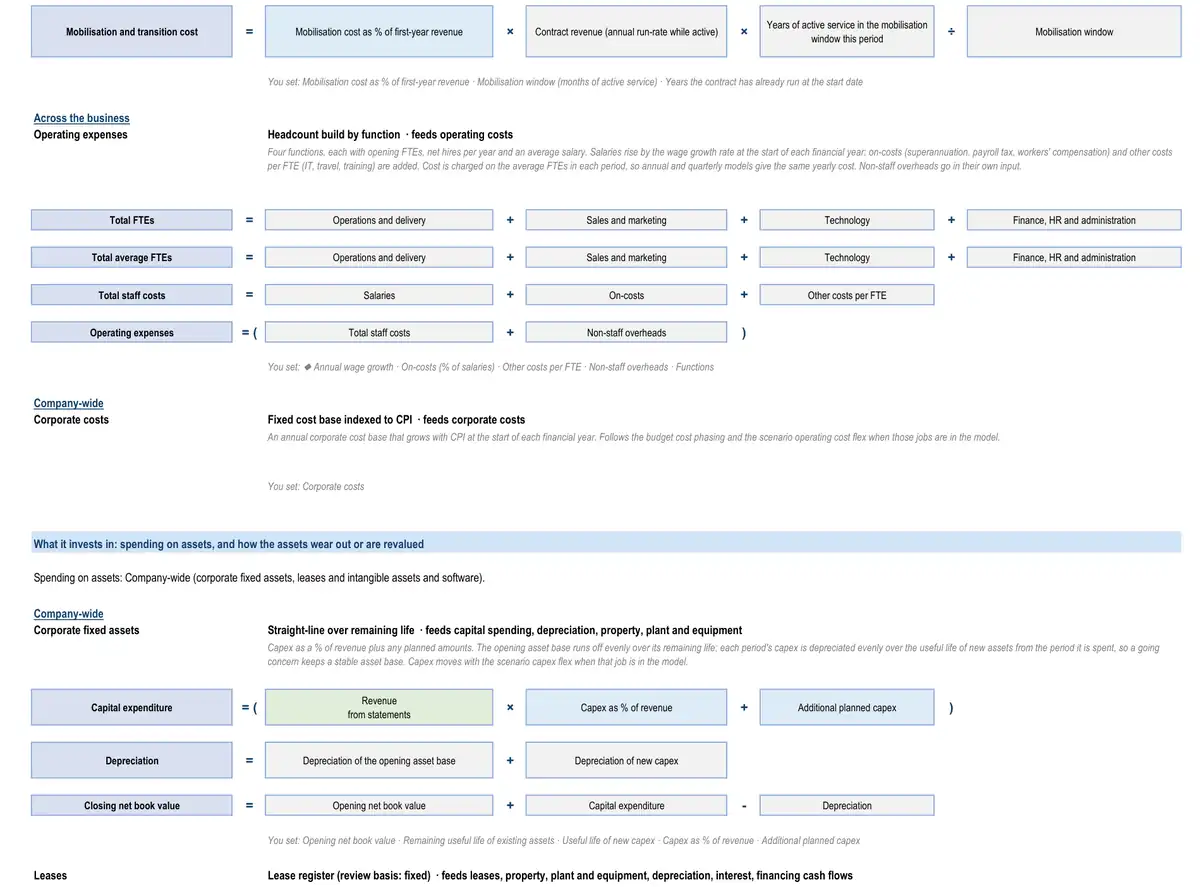
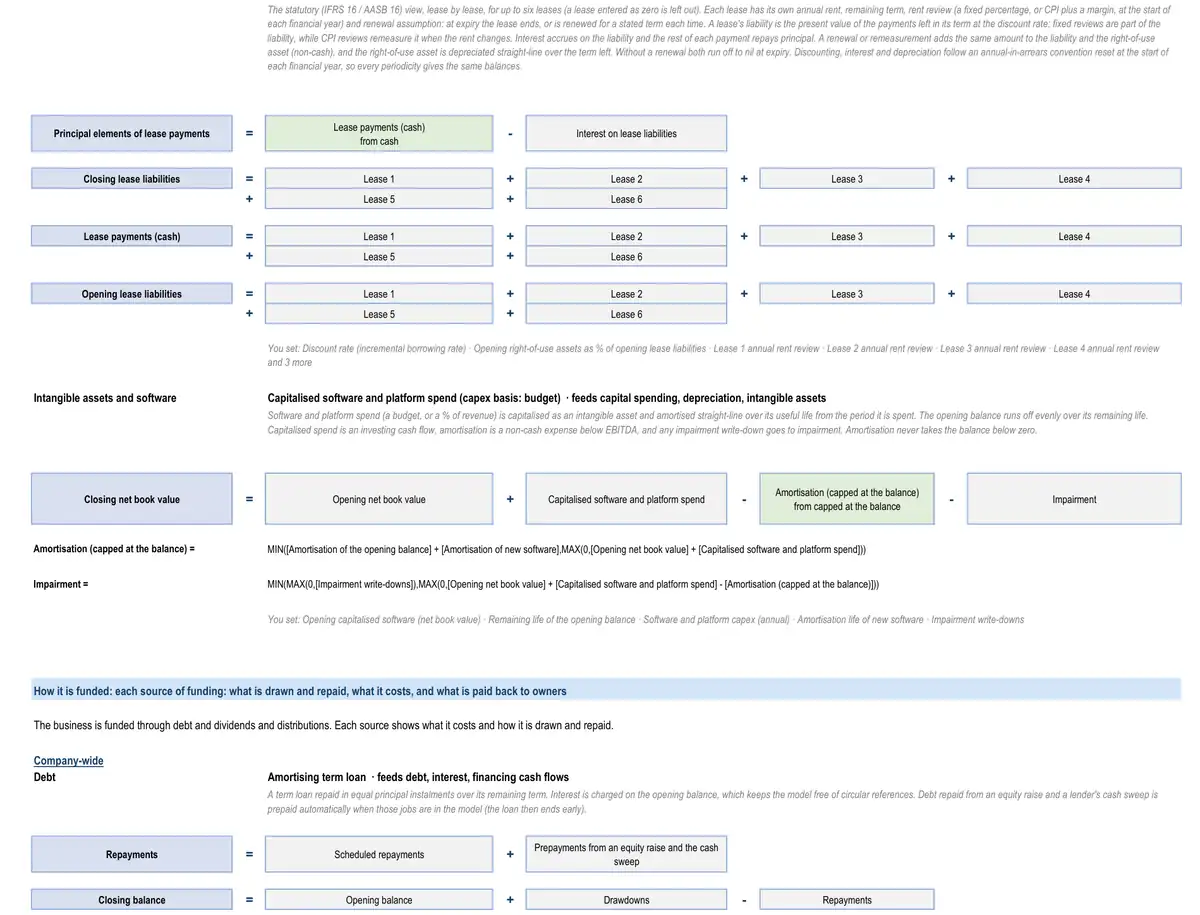
The sample describes no real business. Yours is calibrated to your own figures, so its results are your business’s.
How the model works for a business process outsourcing.
- How it earns revenue1 partsContract revenue
- What drives its costs3 formulasService delivery cost · All service contractsService delivery costDelivery labourSupervisionConsumables and equipmentMobilisation, transition and contract costs · All service contractsMobilisation and transition costMobilisation cost as % of first-year revenueContract revenue (annual run-rate while active)Years of active service in the mobilisation window this periodMobilisation windowOperating expenses · Across the businessTotal FTEsOperations and deliverySales and marketingTechnologyFinance, HR and administration
- What it invests in3 formulasCorporate fixed assetsCapital expenditureRevenuefrom statementsCapex as % of revenueAdditional planned capexCorporate fixed assetsDepreciationDepreciation of the opening asset baseDepreciation of new capexCorporate fixed assetsClosing net book valueOpening net book valueCapital expenditureDepreciation
- How it is funded3 formulasDebtRepaymentsScheduled repaymentsPrepayments from an equity raise and the cash sweepDebtClosing balanceOpening balanceDrawdownsRepaymentsDebtInterest expenseOpening balanceAll-in interest rateshare of the year
- How profit becomes cash3 formulasWorking capitalTrade receivablesRevenuefrom statementsDebtor daysDays in periodWorking capitalInventoryDirect costs (positive)from statementsInventory daysDays in periodWorking capitalTrade payablesCash operating costs (positive)from statementsCreditor daysDays in period
20 parts, each one tested.
Every part is a tested building block with its own checks: yours is put together from the ones your business needs.
- CPI forecastConsensus curve with long-run anchor
- Exchange rate (US dollar)Exchange rate by financial year
- Operating expensesHeadcount build by function
- Corporate costsFixed cost base indexed to CPI
- Working capitalFull working capital
- Income taxCorporate rate with tax losses
- Corporate fixed assetsStraight-line over remaining life
- DebtAmortising term loan
- Dividends and distributionsPayout of net profit
- Discounted cash flow valuationDCF on free cash flow to the firm
- Multiples valuationEV / EBITDA multiple
- LeasesLease register
- Key-metric summaryLast-twelve-month and run-rate metrics
- Discount rate (WACC)CAPM at target gearing
- Terminal valuePerpetuity growth on normalised cash flow
- Intangible assets and softwareCapitalised software and platform spend
- Contract life cycleProbability-weighted renewalWhether and how much of a contract is active in each period — term, renewal, option years, rebid or award probability.
- Contract revenuePer-transaction pricingRevenue from an outsourced service contract under its pricing mechanism, scaled by how much of the contract is active.
- Service delivery costLabour build (FTE × wage × on-costs)Direct cost of delivering a contract — labour, subcontractors, materials and consumables.
- Mobilisation, transition and contract costsExpensed as incurredOne-off costs to win and start a contract — transition, mobilisation equipment — and provisions for loss-making contracts.
The numbers it tracks.
- 01contracted revenue
- 02renewal rate
- 03delivery FTEs
- 04offshore share
- 05contract margin
- 06EBITDA margin
What it is used for.
- Operating forecastGuide · Financial projections
- Budget and rolling forecastGuide · Cash flow forecast
- ValuationGuide · DCF valuation model
- Lending and credit analysisGuide · Three-statement model
- Leveraged buyout (private equity)Guide · Financial modelling services
- Merger or acquisition (strategic)Guide · Financial modelling services
More in people and outsourcing.
- Recruitment agency financial model
- Labour hire company financial model
- Payroll and HR services financial model
- Contact centre operator financial model
Looking for a business process outsourcing financial model template? Ours arrives built for your business, with your figures in it.
Running a small business? Read what goes into a small business financial model.
See a finished model, sheet by sheetThe sample is built on illustrative figures and describes no real business. Models are calculations prepared from the information you provide. They are not financial advice and must be independently verified. See our terms.