Registered training organisation (RTO) financial model, built free.
A three-statement Excel model for a vocational training provider (RTO), built from your own figures and checked to balance.
- Free account
- No card
- Usually ready within the hour
We use generative AI in parts of our process, so mistakes can occur. Every model should be checked by a person before it is relied on. Read more
Registered training organisations delivering nationally recognised qualifications, apprenticeships and short courses, funded by government-subsidised places paid per nominal hour or milestone, student loans, employers and fee-paying students.
In short
- 01
Three linked statements
Income statement, balance sheet and cash flow, linked in every period.
- 02
Valued two ways
Discounted cash flow and trading multiples, side by side.
- 03
Monthly to annual
Monthly, quarterly, half-yearly or annual periods, for up to 30 years.
- 04
Checked every period
A Checks sheet shows the balance sheet balances and the cash reconciles.
The sample, as Excel draws it.
Built by the same system and checks as yours, on illustrative figures: every sheet as Excel draws it, or live.
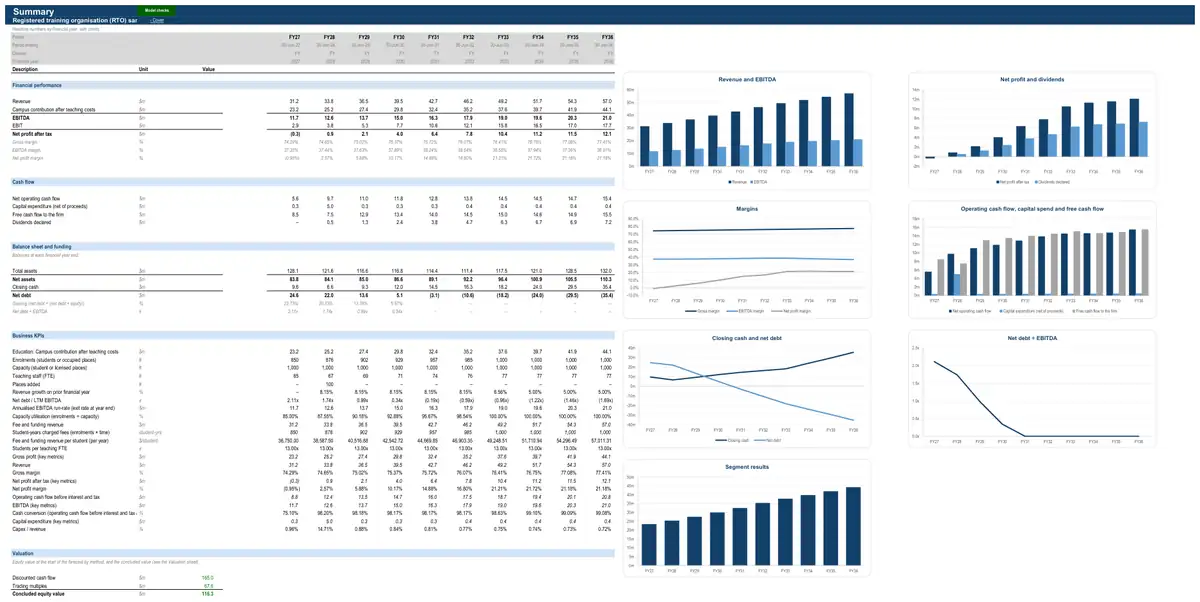
Illustrative figures: the sample describes no real business. The live preview shows values; your model’s Excel file has every formula.
How the model works for a registered training organisation (RTO).
- How it earns revenue1 formulaTuition fees and per-student funding · All campusesFee revenueFees at the daily feeLess discounts and fee relief
- What drives its costs3 formulasTeaching and educator staff · All campusesTeaching staff costTeaching salariesOn-costsOperating expenses · Across the businessTotal FTEsOperations and deliverySales and marketingTechnologyFinance, HR and administrationOperating expenses · Across the businessTotal average FTEsOperations and deliverySales and marketingTechnologyFinance, HR and administration
- What it invests in3 formulasCampus capacity, capex and depreciation · All campusesCampus capexExpansion capexMaintenance capexCampus capacity, capex and depreciation · All campusesCampus depreciationDepreciation of existing buildings and equipmentDepreciation of new buildings and capexCampus capacity, capex and depreciation · All campusesCampus assets (net book value)Opening net book valueCampus capexCampus depreciation
- How it is funded3 formulasDebtRepaymentsScheduled repaymentsPrepayments from an equity raise and the cash sweepDebtClosing balanceOpening balanceDrawdownsRepaymentsDebtInterest expenseOpening balanceAll-in interest rateshare of the year
- How profit becomes cash3 formulasWorking capitalTrade receivablesRevenuefrom statementsDebtor daysDays in periodWorking capitalInventoryDirect costs (positive)from statementsInventory daysDays in periodWorking capitalTrade payablesCash operating costs (positive)from statementsCreditor daysDays in period
18 parts, each one tested.
Every part is a tested building block with its own checks: yours is put together from the ones your business needs.
- CPI forecastConsensus curve with long-run anchor
- Operating expensesHeadcount build by function
- Corporate costsFixed cost base indexed to CPI
- Working capitalFull working capital
- Income taxCorporate rate with tax losses
- DebtAmortising term loan
- Dividends and distributionsPayout of net profit
- Discounted cash flow valuationDCF on free cash flow to the firm
- Multiples valuationEV / EBITDA multiple
- LeasesLease register
- Key-metric summaryLast-twelve-month and run-rate metrics
- Discount rate (WACC)CAPM at target gearing
- Terminal valuePerpetuity growth on normalised cash flow
- Intangible assets and softwareRegister of acquired intangibles
- EnrolmentsEnrolments × growthStudents or children enrolled at an education site, as headcount or full-time equivalents.
- Tuition fees and per-student fundingDaily fee × attendance daysTuition and childcare fees and government per-student funding earned from enrolments, and fees received in advance.
- Teaching and educator staffStudent to staff ratioTeachers, academics or educators required for enrolments, and their cost.
- Campus capacity, capex and depreciationCapex per new placeCapital spending on buildings and capacity for an education site, with depreciation and net book value.
The numbers it tracks.
- 01enrolments and completions
- 02funded nominal hours
- 03revenue per student
- 04trainer utilisation
- 05EBITDA margin
What it is used for.
- Operating forecastGuide · Financial projections
- Budget and rolling forecastGuide · Cash flow forecast
- ValuationGuide · DCF valuation model
- Lending and credit analysisGuide · Three-statement model
- Merger or acquisition (strategic)Guide · Financial modelling services
- Scenarios and sensitivities
More in education and childcare.
- School operator financial model
- University and higher education provider financial model
- Childcare centre financial model
- Education testing provider financial model
Looking for a registered training organisation (RTO) financial model template? Ours arrives built for your business, with your figures in it.
Running a small business? Read what goes into a small business financial model.
See a finished model, sheet by sheetThe sample is built on illustrative figures and describes no real business. Models are calculations prepared from the information you provide. They are not financial advice and must be independently verified. See our terms.