Plasma therapies company financial model, built free.
A three-statement Excel model for a plasma-derived therapies company, built from your own figures and checked to balance.
- Free account
- No card
- Usually ready within the hour
We use generative AI in parts of our process, so mistakes can occur. Every model should be checked by a person before it is relied on. Read more
Collects human plasma through its own donor centres, fractionates it into immunoglobulins, albumin and specialty proteins, and sells them worldwide; plasma supply and its cost per litre drive volume and margin.
In short
- 01
Three linked statements
Income statement, balance sheet and cash flow, linked in every period.
- 02
Valued two ways
Discounted cash flow and trading multiples, side by side.
- 03
Monthly to annual
Monthly, quarterly, half-yearly or annual periods, for up to 30 years.
- 04
Checked every period
A Checks sheet shows the balance sheet balances and the cash reconciles.
The sample, as Excel draws it.
Built by the same system and checks as yours: its structure and its inputs, ready for your own figures.
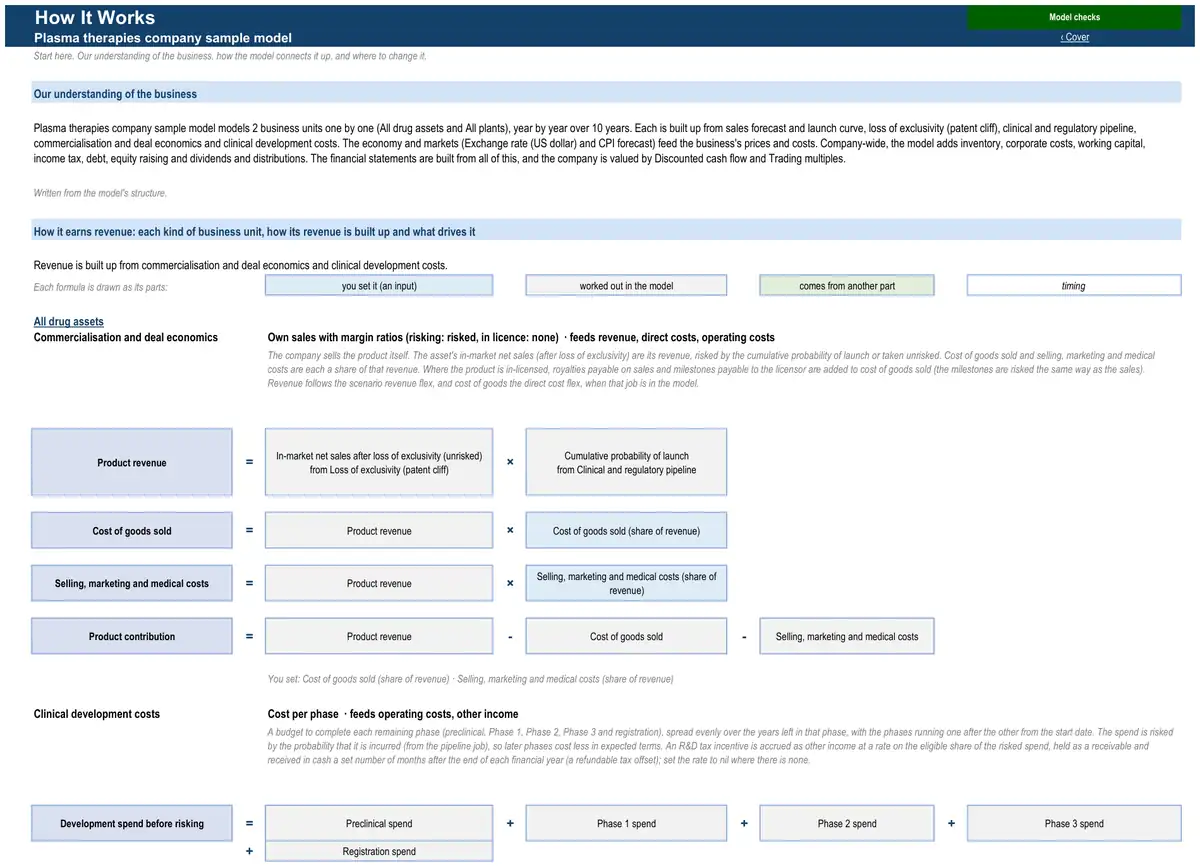
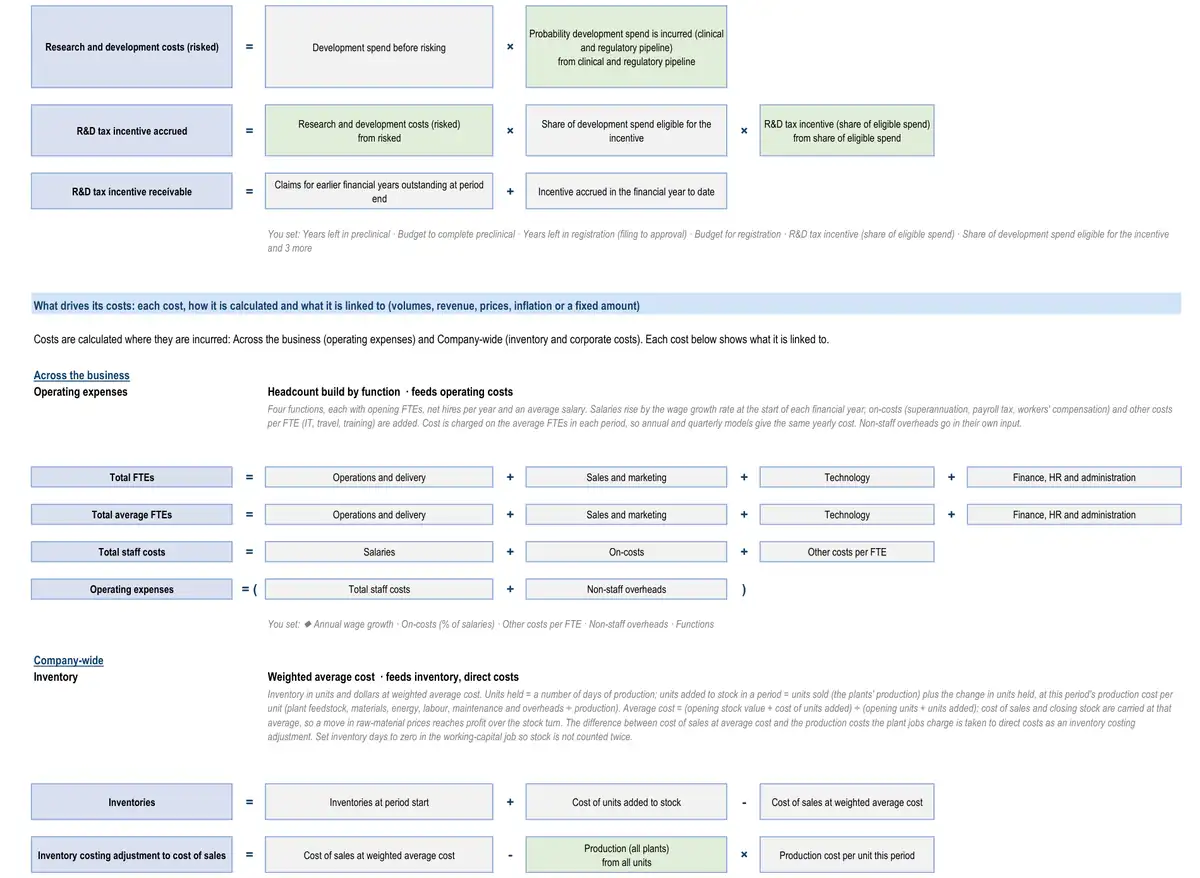
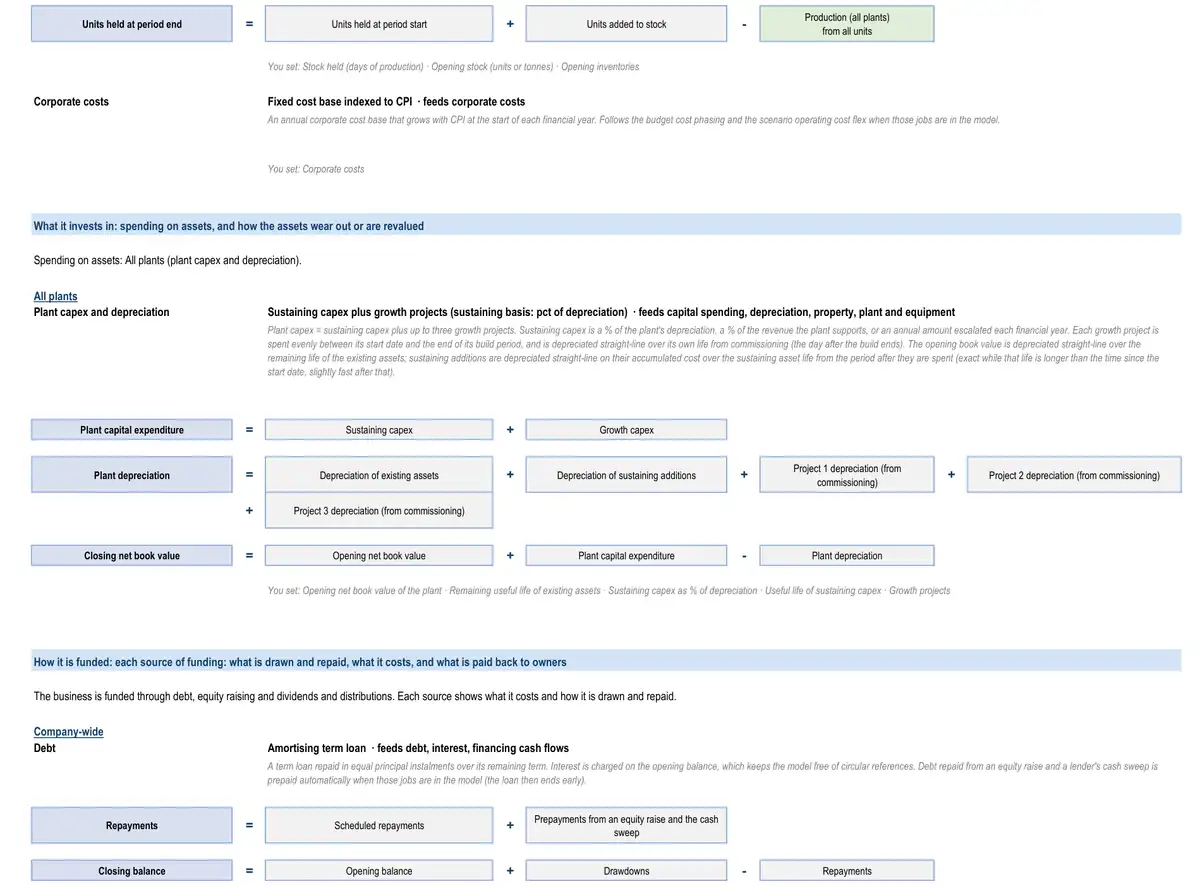
The sample describes no real business. Yours is calibrated to your own figures, so its results are your business’s.
How the model works for a plasma therapies company.
- How it earns revenue3 formulasCommercialisation and deal economics · All drug assetsProduct revenueIn-market net sales after loss of exclusivity (unrisked)from loss of exclusivity (patent cliff)Cumulative probability of launchfrom clinical and regulatory pipelineCommercialisation and deal economics · All drug assetsCost of goods soldProduct revenueCost of goods sold (share of revenue)Commercialisation and deal economics · All drug assetsSelling, marketing and medical costsProduct revenueSelling, marketing and medical costs (share of revenue)
- What drives its costs3 formulasOperating expenses · Across the businessTotal FTEsOperations and deliverySales and marketingTechnologyFinance, HR and administrationOperating expenses · Across the businessTotal average FTEsOperations and deliverySales and marketingTechnologyFinance, HR and administrationOperating expenses · Across the businessTotal staff costsSalariesOn-costsOther costs per FTE
- What it invests in3 formulasPlant capex and depreciation · All plantsPlant capital expenditureSustaining capexGrowth capexPlant capex and depreciation · All plantsPlant depreciationDepreciation of existing assetsDepreciation of sustaining additionsProject 1 depreciation (from commissioning)Project 2 depreciation (from commissioning)Project 3 depreciation (from commissioning)Plant capex and depreciation · All plantsClosing net book valueOpening net book valuePlant capital expenditurePlant depreciation
- How it is funded3 formulasDebtRepaymentsScheduled repaymentsPrepayments from an equity raise and the cash sweepDebtClosing balanceOpening balanceDrawdownsRepaymentsDebtInterest expenseOpening balanceAll-in interest rateshare of the year
- How profit becomes cash3 formulasWorking capitalTrade receivablesRevenuefrom statementsDebtor daysDays in periodWorking capitalInventoryDirect costs (positive)from statementsInventory daysDays in periodWorking capitalTrade payablesCash operating costs (positive)from statementsCreditor daysDays in period
21 parts, each one tested.
Every part is a tested building block with its own checks: yours is put together from the ones your business needs.
- Exchange rate (US dollar)Exchange rate by financial year
- Operating expensesHeadcount build by function
- Corporate costsFixed cost base indexed to CPI
- Working capitalFull working capital
- Income taxCorporate rate with tax losses
- DebtAmortising term loan
- Equity raisingDistribution reinvestment plan
- Dividends and distributionsPayout of net profit
- Discounted cash flow valuationDCF on free cash flow to the firm
- Multiples valuationEV / EBITDA multiple
- InventoryWeighted average cost
- Key-metric summaryLast-twelve-month and run-rate metrics
- Case selectionStackable stress toggles
- CPI forecastCPI glide path
- Clinical and regulatory pipelinePhase durations and benchmark probabilitiesPhase timing, regulatory milestones and the probability that each asset reaches market.
- Sales forecast and launch curveIn-market product trendIn-market net sales of each asset before loss of exclusivity and before risking.
- Loss of exclusivity (patent cliff)Erosion curve after expiryErosion of in-market sales after patents and regulatory exclusivity expire and generics or biosimilars enter.
- Commercialisation and deal economicsOwn sales with margin ratiosHow each asset's sales reach the company — own product sales with their costs, or upfront, milestone, royalty and profit-share income from partners.
- Clinical development costsCost per phaseResearch, clinical trial, manufacturing-development and regulatory costs for each asset, and any R&D tax incentive earned on them.
- Capacity and productionOperating days × daily rate
- Plant capex and depreciationSustaining capex plus growth projects
The numbers it tracks.
- 01collection centres
- 02litres collected
- 03cost per litre
- 04grams sold by product
- 05gross margin
- 06inventory days
- 07EBIT
What it is used for.
- Scenarios and sensitivities
More in pharma, biotech and medical devices.
- Pharmaceutical company financial model
- Clinical-stage biotech financial model
- Generic pharmaceutical company financial model
- Medical device company financial model
- Medical consumables manufacturer financial model
- Life science tools company financial model
- Animal health company financial model
- Contract research organisation (CRO) financial model
- CDMO financial model
- Pharmaceutical royalty investor financial model
Looking for a plasma therapies company financial model template? Ours arrives built for your business, with your figures in it.
Running a small business? Read what goes into a small business financial model.
See a finished model, sheet by sheetThe sample is built on illustrative figures and describes no real business. Models are calculations prepared from the information you provide. They are not financial advice and must be independently verified. See our terms.