EPC contractor financial model, built free.
A three-statement Excel model for an engineering, procurement and construction (EPC) contractor, built from your own figures and checked to balance.
- Free account
- No card
- Usually ready within the hour
We use generative AI in parts of our process, so mistakes can occur. Every model should be checked by a person before it is relied on. Read more
Delivers process plants, energy, LNG, mining and industrial facilities on lump-sum turnkey or reimbursable contracts, carrying procurement pass-through, performance guarantees, liquidated damages and milestone-based cash flows.
In short
- 01
Three linked statements
Income statement, balance sheet and cash flow, linked in every period.
- 02
Valued two ways
Discounted cash flow and trading multiples, side by side.
- 03
Monthly to annual
Monthly, quarterly, half-yearly or annual periods, for up to 30 years.
- 04
Checked every period
A Checks sheet shows the balance sheet balances and the cash reconciles.
The sample, as Excel draws it.
Built by the same system and checks as yours: its structure and its inputs, ready for your own figures.
The sample describes no real business. Yours is calibrated to your own figures, so its results are your business’s.
How the model works for an EPC contractor.
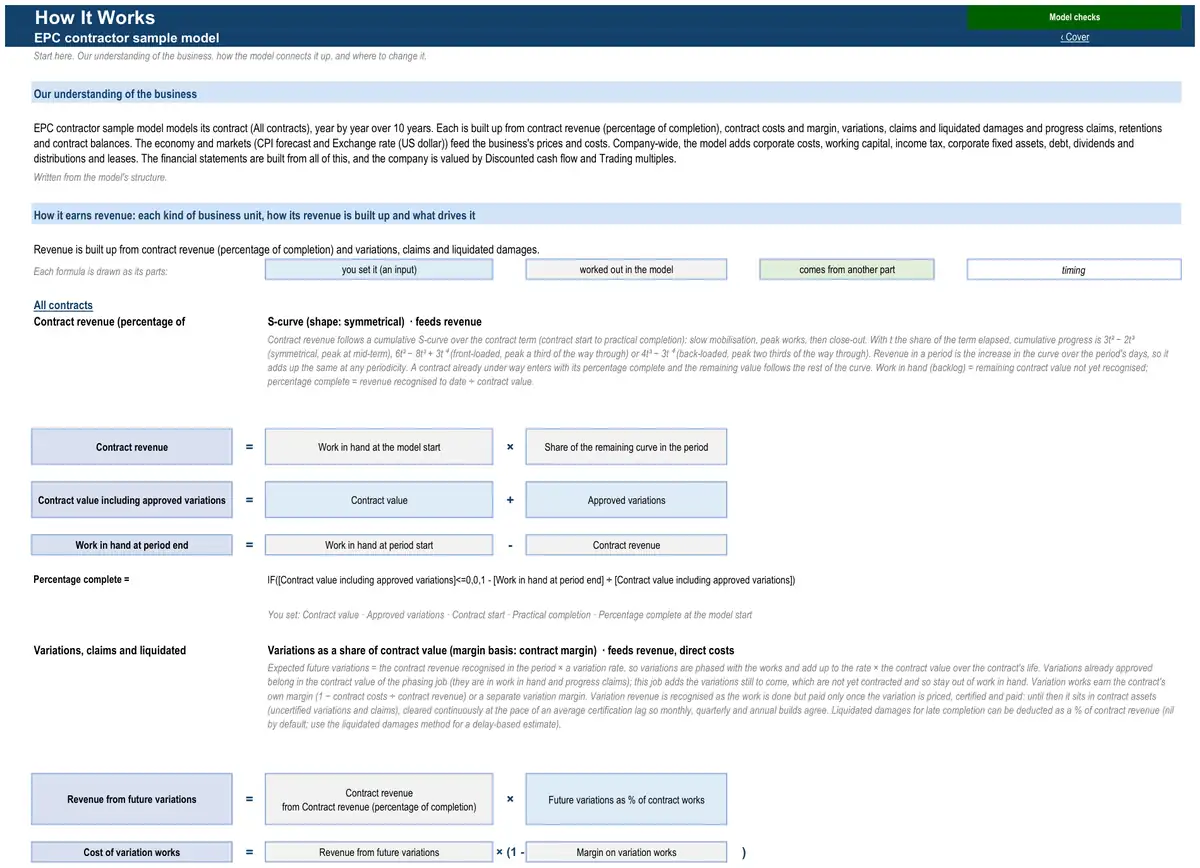
- How it earns revenue3 formulasContract revenue (percentage of completion) · All contractsContract revenueWork in hand at the model startShare of the remaining curve in the periodContract revenue (percentage of completion) · All contractsContract value including approved variationsContract valueApproved variationsContract revenue (percentage of completion) · All contractsWork in hand at period endWork in hand at period startContract revenue
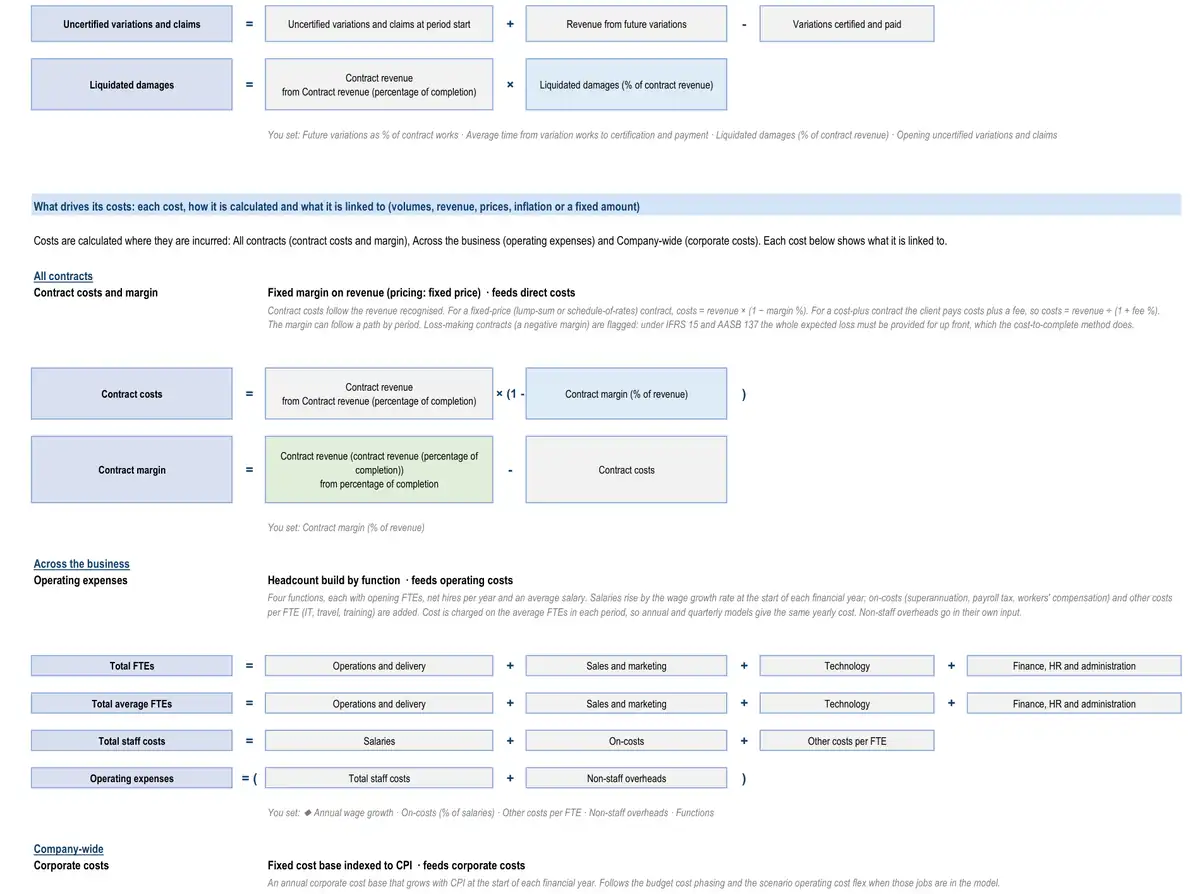
- What drives its costs3 formulasContract costs and margin · All contractsContract costsContract revenuefrom contract revenue (percentage of completion)Contract margin (% of revenue)Contract costs and margin · All contractsContract marginContract revenue (contract revenue (percentage of completion))from percentage of completionContract costsOperating expenses · Across the businessTotal FTEsOperations and deliverySales and marketingTechnologyFinance, HR and administration
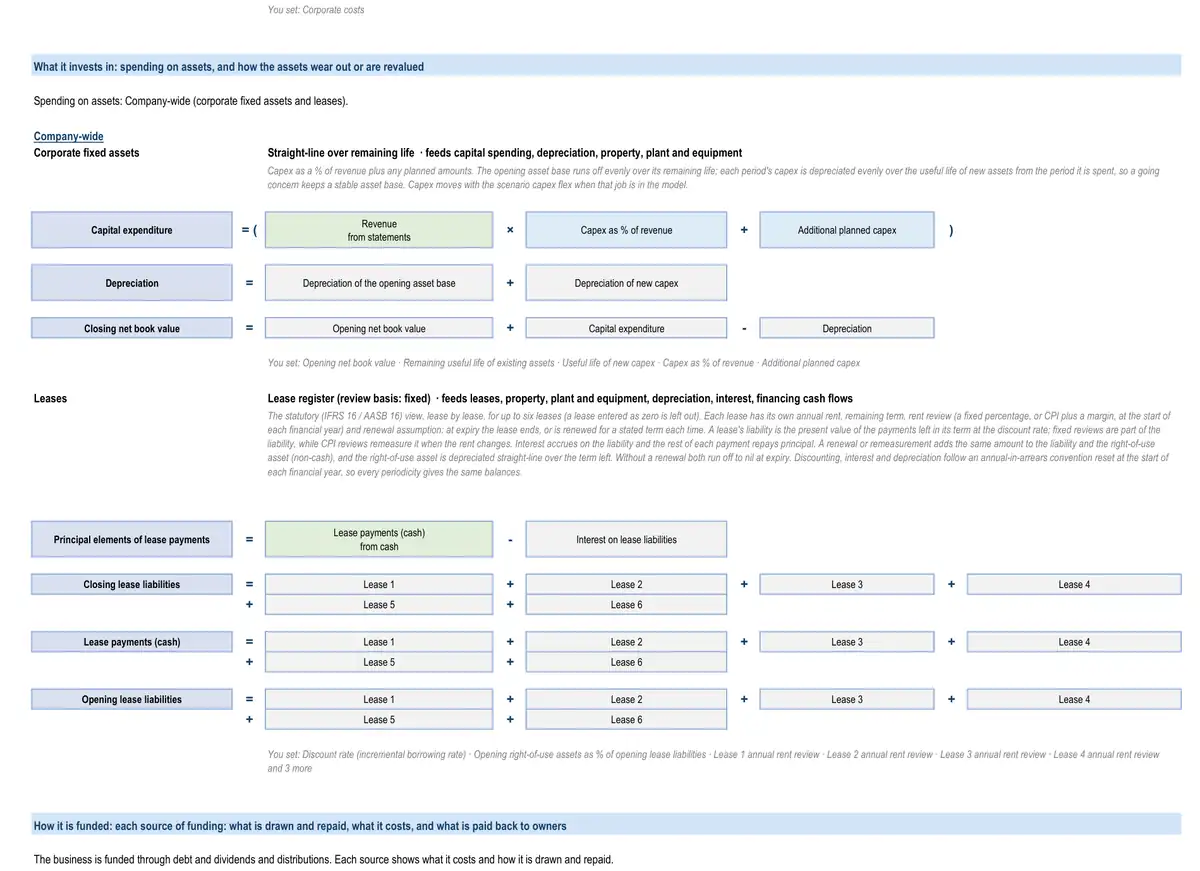
- What it invests in3 formulasCorporate fixed assetsCapital expenditureRevenuefrom statementsCapex as % of revenueAdditional planned capexCorporate fixed assetsDepreciationDepreciation of the opening asset baseDepreciation of new capexCorporate fixed assetsClosing net book valueOpening net book valueCapital expenditureDepreciation
- How it is funded3 formulasDebtRepaymentsScheduled repaymentsPrepayments from an equity raise and the cash sweepDebtClosing balanceOpening balanceDrawdownsRepaymentsDebtInterest expenseOpening balanceAll-in interest rateshare of the year
- How profit becomes cash3 formulasProgress claims, retentions and contract balances · All contractsRetention security held at period endRetention security held at period startRetention security on the period's claimsRetention security releasedProgress claims, retentions and contract balances · All contractsCash retentions receivableCash retentions at period startRetentions withheld from claimsRetentions released (cash received)Working capitalTrade receivablesRevenuefrom statementsDebtor daysDays in period
19 parts, each one tested.
Every part is a tested building block with its own checks: yours is put together from the ones your business needs.
- CPI forecastConsensus curve with long-run anchor
- Exchange rate (US dollar)Exchange rate by financial year
- Operating expensesHeadcount build by function
- Corporate costsFixed cost base indexed to CPI
- Working capitalFull working capital
- Income taxCorporate rate with tax losses
- Corporate fixed assetsStraight-line over remaining life
- DebtAmortising term loan
- Dividends and distributionsPayout of net profit
- Discounted cash flow valuationDCF on free cash flow to the firm
- Multiples valuationEV / EBITDA multiple
- LeasesLease register
- Key-metric summaryLast-twelve-month and run-rate metrics
- Discount rate (WACC)CAPM at target gearing
- Terminal valuePerpetuity growth on normalised cash flow
- Contract revenue (percentage of completion)S-curveHow each contract's value is recognised as revenue over time, and the work still to do (backlog).
- Contract costs and marginFixed margin on revenueThe cost of delivering each contract and the margin recognised, including losses on onerous contracts.
- Progress claims, retentions and contract balancesClaim and payment lag with retentionsWhen contract revenue turns into cash: progress claims, retentions, advance payments and contract assets and liabilities.
- Variations, claims and liquidated damagesVariations as a share of contract valueChanges to each contract's value from approved and unapproved variations and claims (recognised only when highly probable), and damages payable for late completion.
The numbers it tracks.
- 01backlog
- 02revenue by contract type
- 03contract margin
- 04advance payments
- 05bonding utilisation
- 06net cash
What it is used for.
- Operating forecastGuide · Financial projections
- Budget and rolling forecastGuide · Cash flow forecast
- ValuationGuide · DCF valuation model
- Lending and credit analysisGuide · Three-statement model
- Restructuring and liquidityGuide · Financial modelling services
- Scenarios and sensitivities
More in construction and engineering.
- Building contractor financial model
- Civil construction contractor financial model
- Electrical and plumbing contractor financial model
- Engineering services company financial model
Looking for an EPC contractor financial model template? Ours arrives built for your business, with your figures in it.
See a finished model, sheet by sheetThe sample is built on illustrative figures and describes no real business. Models are calculations prepared from the information you provide. They are not financial advice and must be independently verified. See our terms.