Distillery financial model, built free.
A three-statement Excel model for a spirits distiller, built from your own figures and checked to balance.
- Free account
- No card
- Usually ready within the hour
We use generative AI in parts of our process, so mistakes can occur. Every model should be checked by a person before it is relied on. Read more
Distils and matures whisky, rum, gin, vodka and liqueurs (or buys bulk spirit), bottles them and sells through distributors, retailers, on-premise and export, paying excise per litre of alcohol and tying up years of maturing stock in casks.
In short
- 01
Three linked statements
Income statement, balance sheet and cash flow, linked in every period.
- 02
Valued two ways
Discounted cash flow and trading multiples, side by side.
- 03
Monthly to annual
Monthly, quarterly, half-yearly or annual periods, for up to 30 years.
- 04
Checked every period
A Checks sheet shows the balance sheet balances and the cash reconciles.
The sample, as Excel draws it.
Built by the same system and checks as yours: its structure and its inputs, ready for your own figures.
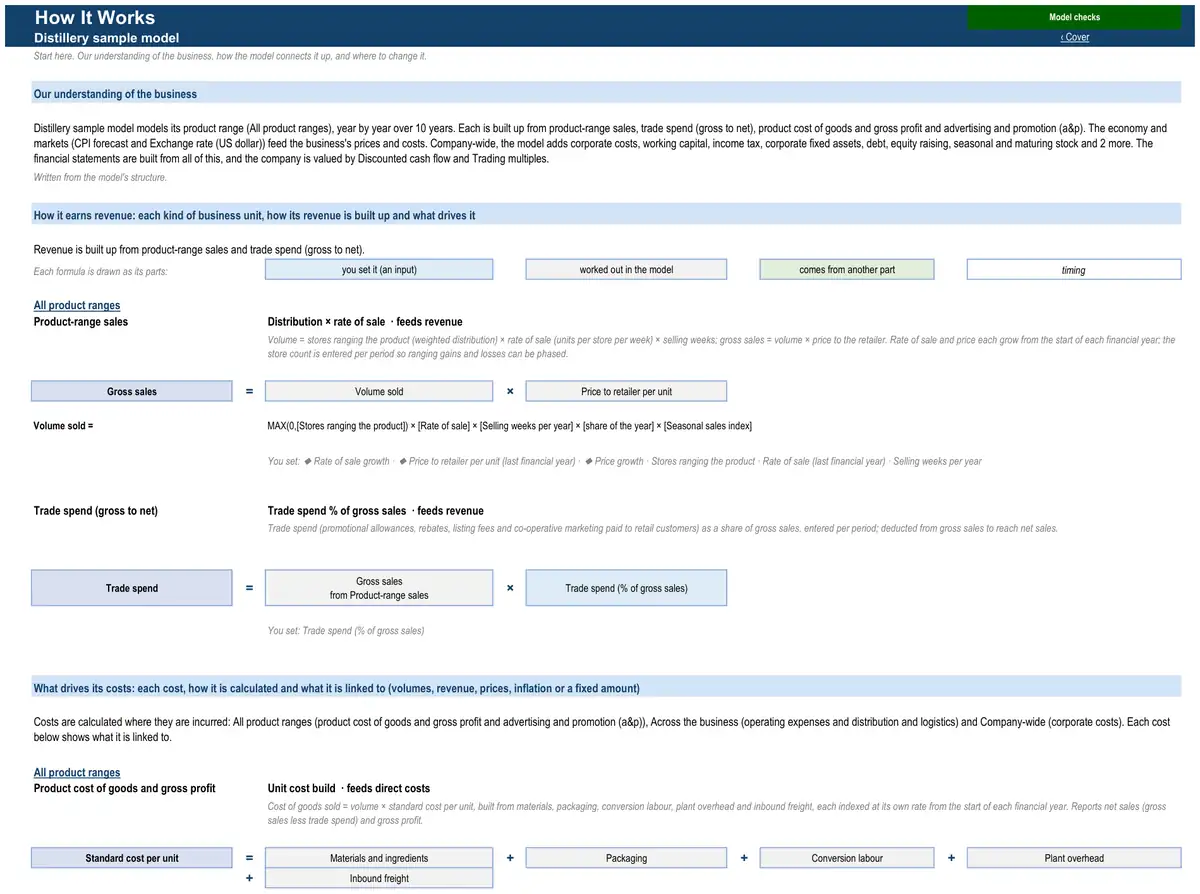
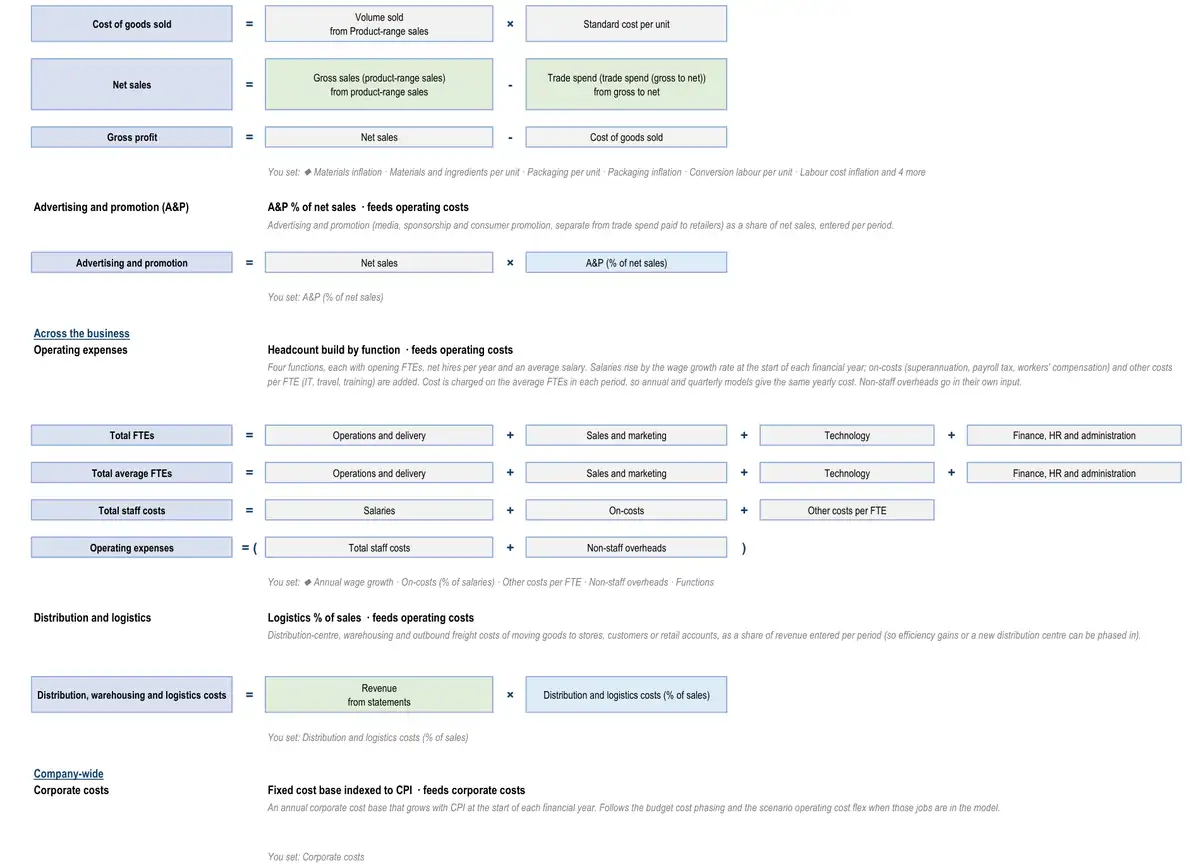
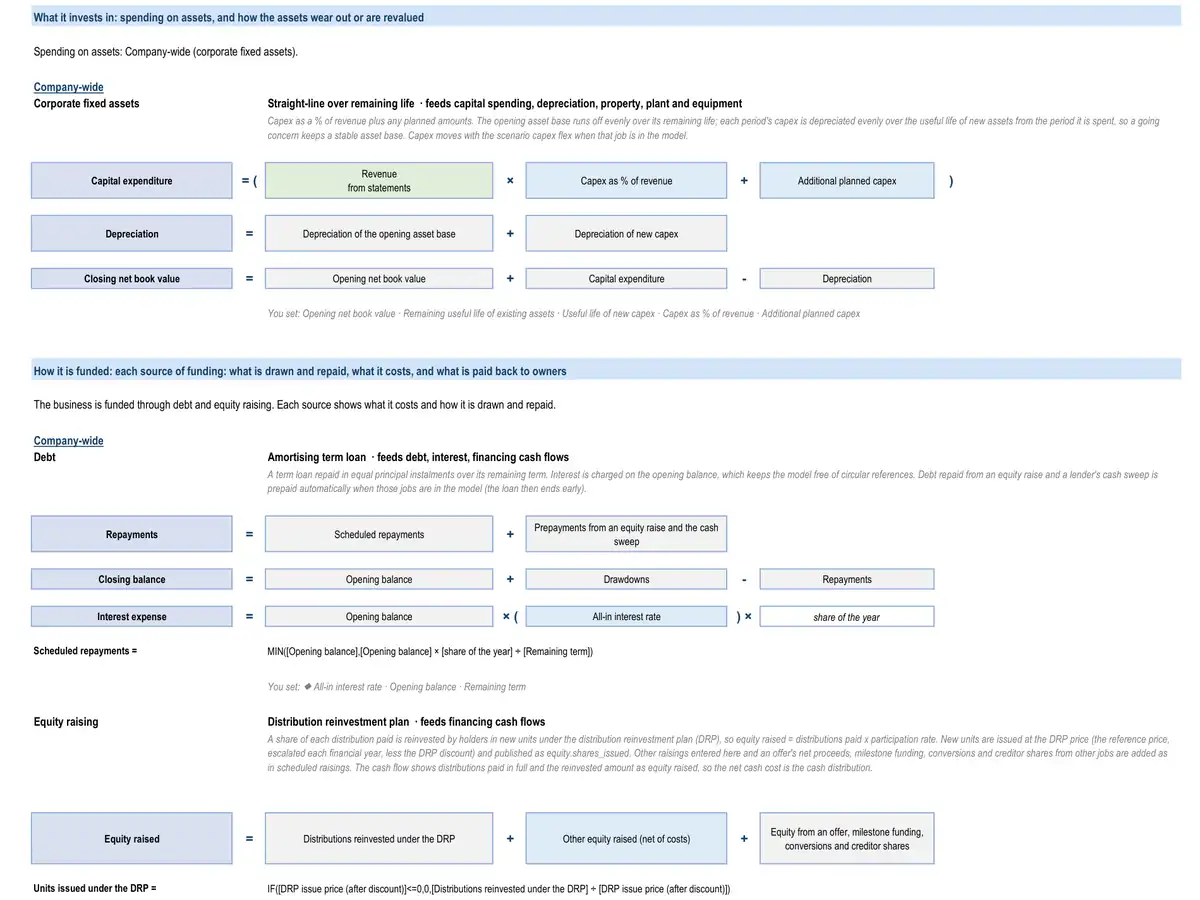
The sample describes no real business. Yours is calibrated to your own figures, so its results are your business’s.
How the model works for a distillery.
- How it earns revenue2 formulasProduct-range sales · All product rangesGross salesVolume soldPrice to retailer per unitTrade spend (gross to net) · All product rangesTrade spendGross salesfrom product-range salesTrade spend (% of gross sales)
- What drives its costs3 formulasProduct cost of goods and gross profit · All product rangesStandard cost per unitMaterials and ingredientsPackagingConversion labourPlant overheadInbound freightProduct cost of goods and gross profit · All product rangesCost of goods soldVolume soldfrom product-range salesStandard cost per unitProduct cost of goods and gross profit · All product rangesNet salesGross sales (product-range sales)from product-range salesTrade spend (trade spend (gross to net))from gross to net
- What it invests in3 formulasCorporate fixed assetsCapital expenditureRevenuefrom statementsCapex as % of revenueAdditional planned capexCorporate fixed assetsDepreciationDepreciation of the opening asset baseDepreciation of new capexCorporate fixed assetsClosing net book valueOpening net book valueCapital expenditureDepreciation
- How it is funded3 formulasDebtRepaymentsScheduled repaymentsPrepayments from an equity raise and the cash sweepDebtClosing balanceOpening balanceDrawdownsRepaymentsDebtInterest expenseOpening balanceAll-in interest rateshare of the year
- How profit becomes cash3 formulasWorking capitalTrade receivablesRevenuefrom statementsDebtor daysDays in periodWorking capitalInventoryDirect costs (positive)from statementsInventory daysDays in periodWorking capitalTrade payablesCash operating costs (positive)from statementsCreditor daysDays in period
23 parts, each one tested.
Every part is a tested building block with its own checks: yours is put together from the ones your business needs.
- CPI forecastConsensus curve with long-run anchor
- Exchange rate (US dollar)Exchange rate by financial year
- Operating expensesHeadcount build by function
- Corporate costsFixed cost base indexed to CPI
- Working capitalFull working capital
- Income taxCorporate rate with tax losses
- Corporate fixed assetsStraight-line over remaining life
- DebtAmortising term loan
- Equity raisingDistribution reinvestment plan
- Discounted cash flow valuationDCF on free cash flow to the firm
- Multiples valuationEV / EBITDA multiple
- Seasonal and maturing stockInventory days
- Key-metric summaryLast-twelve-month and run-rate metrics
- Covenant tests and headroomLVR, gearing and ICR for property
- Borrowing base and security coverReceivables and inventory borrowing base
- Sources and uses of fundsBalanced sources and uses
- Discount rate (WACC)CAPM at target gearing
- Burn and runwayRunway to the forecast cash-out date
- Distribution and logisticsLogistics % of salesDistribution-centre, warehousing and outbound freight costs of moving goods to stores, customers or retail accounts.
- Product-range salesDistribution × rate of saleGross sales of a brand, category or SKU family to retailers, wholesale accounts and export markets.
- Trade spend (gross to net)Trade spend % of gross salesPayments and discounts to retail customers — promotional allowances, rebates, listing fees and co-operative marketing — deducted from gross sales to reach net revenue.
- Product cost of goods and gross profitUnit cost buildCost of making or buying each product range — materials, packaging, conversion and inbound freight.
- Advertising and promotion (A&P)A&P % of net salesBrand investment in media, sponsorship and consumer promotion (separate from trade spend paid to retailers).
The numbers it tracks.
- 019-litre cases
- 02net sales per case
- 03gross margin %
- 04maturing stock (litres of alcohol)
- 05cask stock value
- 06EBIT margin
More in drinks and tobacco.
Looking for a distillery financial model template? Ours arrives built for your business, with your figures in it.
Running a small business? Read what goes into a small business financial model.
See a finished model, sheet by sheetThe sample is built on illustrative figures and describes no real business. Models are calculations prepared from the information you provide. They are not financial advice and must be independently verified. See our terms.