Wealth platform financial model, built free.
A three-statement Excel model for a wealth platform, built from your own figures and checked to balance.
- Free account
- No card
- Usually ready within the hour
We use generative AI in parts of our process, so mistakes can occur. Every model should be checked by a person before it is relied on. Read more
Administers investment and superannuation accounts for advised clients, earning administration fees on funds under administration plus cash and transaction revenue.
In short
- 01
Three linked statements
Income statement, balance sheet and cash flow, linked in every period.
- 02
Valued two ways
Discounted cash flow and trading multiples, side by side.
- 03
Monthly to annual
Monthly, quarterly, half-yearly or annual periods, for up to 30 years.
- 04
Checked every period
A Checks sheet shows the balance sheet balances and the cash reconciles.
The sample, as Excel draws it.
Built by the same system and checks as yours: its structure and its inputs, ready for your own figures.
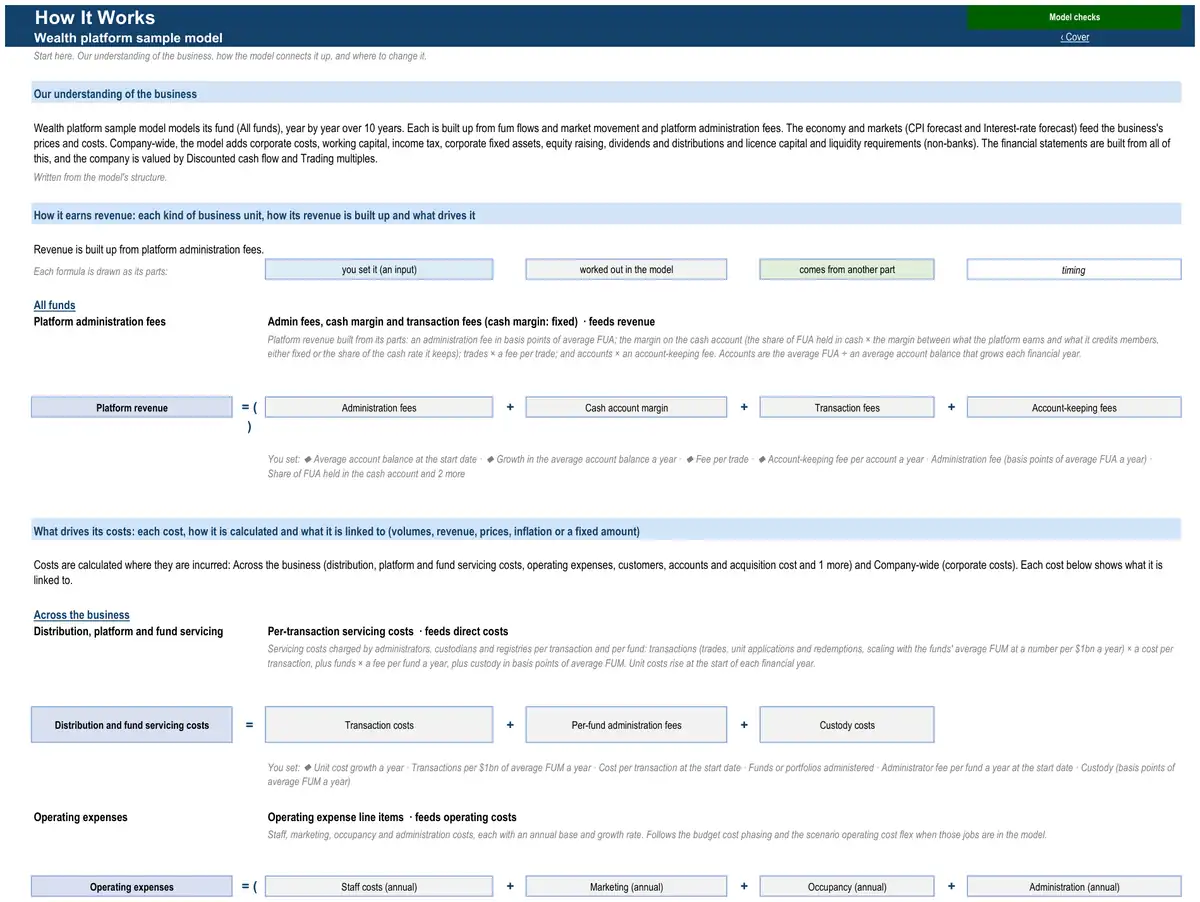
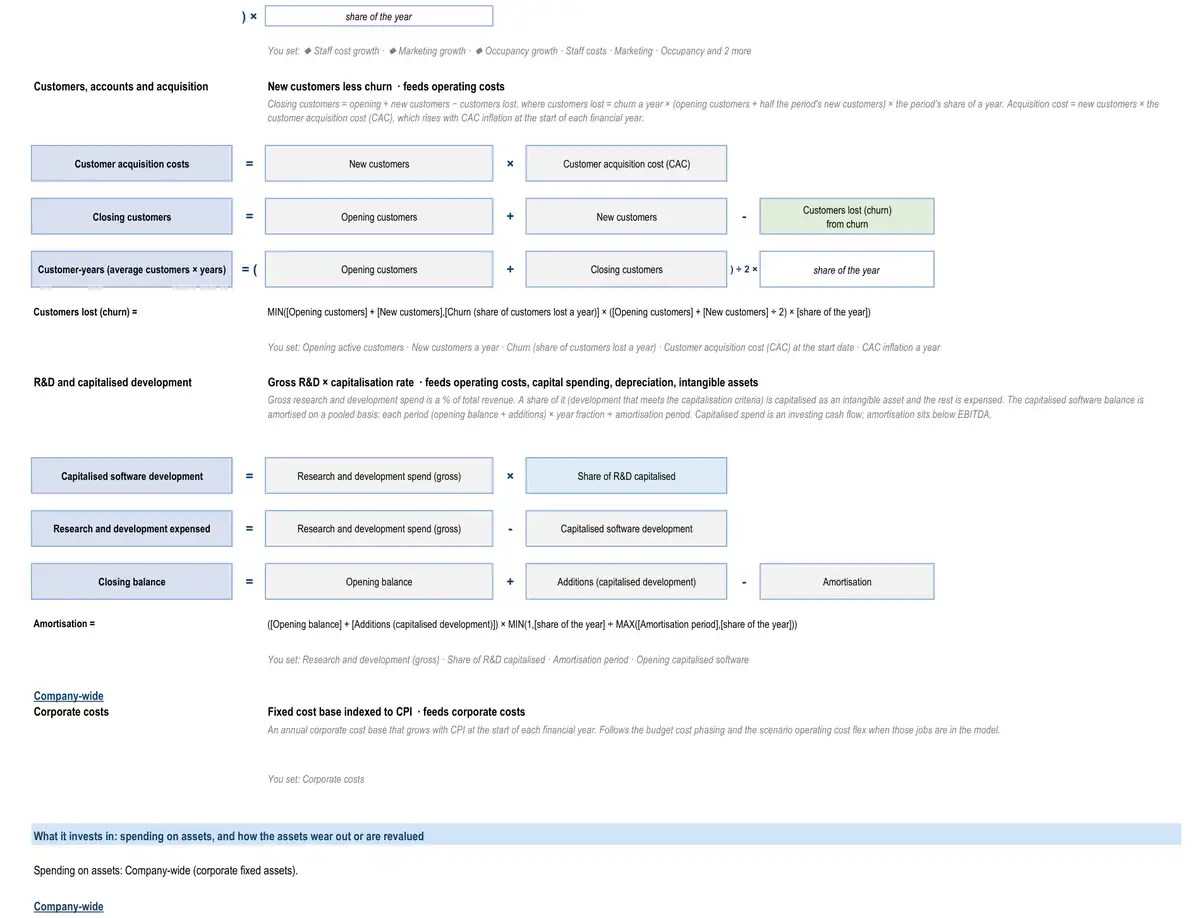
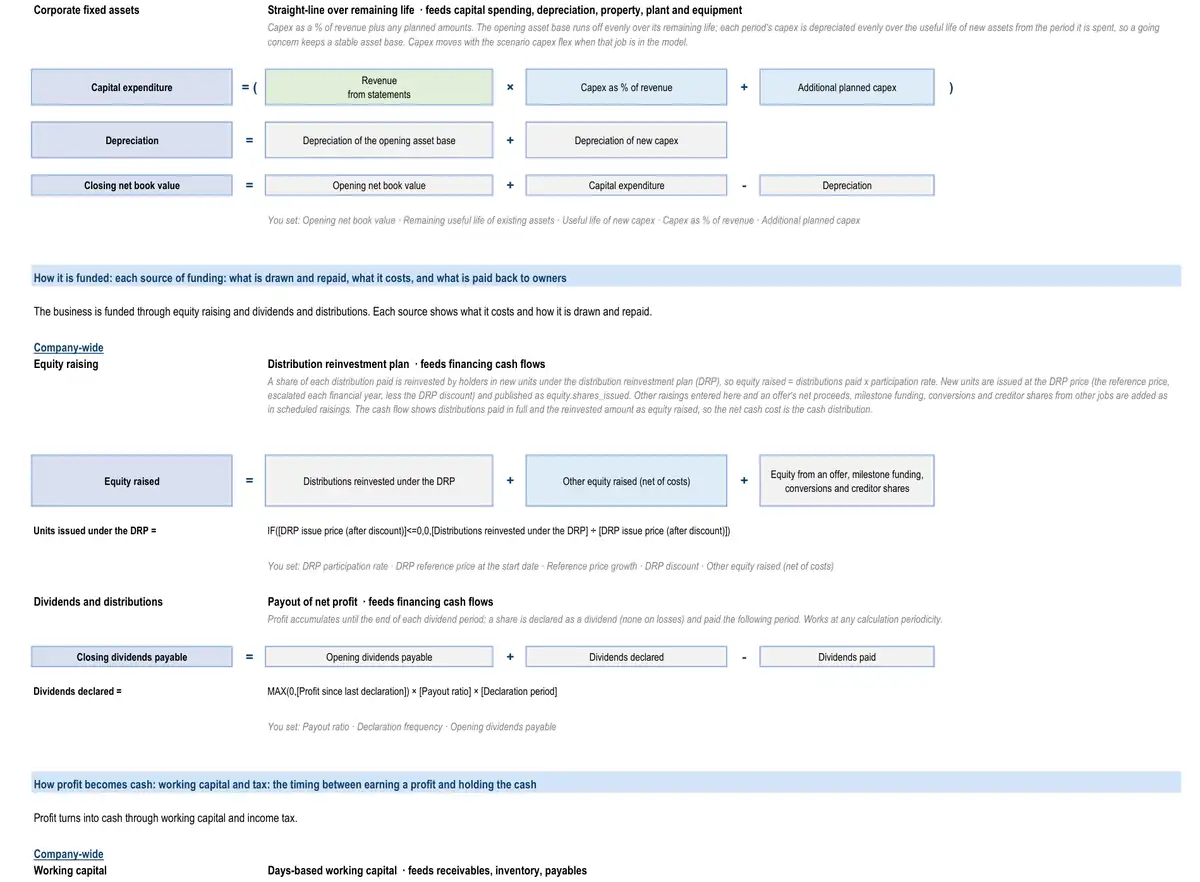
The sample describes no real business. Yours is calibrated to your own figures, so its results are your business’s.
How the model works for a wealth platform.
- How it earns revenue1 formulaPlatform administration fees · All fundsPlatform revenueAdministration feesCash account marginTransaction feesAccount-keeping fees
- What drives its costs3 formulasDistribution, platform and fund servicing costs · Across the businessDistribution and fund servicing costsTransaction costsPer-fund administration feesCustody costsOperating expenses · Across the businessOperating expensesStaff costs (annual)Marketing (annual)Occupancy (annual)Administration (annual)share of the yearCustomers, accounts and acquisition cost · Across the businessCustomer acquisition costsNew customersCustomer acquisition cost (CAC)
- What it invests in3 formulasCorporate fixed assetsCapital expenditureRevenuefrom statementsCapex as % of revenueAdditional planned capexCorporate fixed assetsDepreciationDepreciation of the opening asset baseDepreciation of new capexCorporate fixed assetsClosing net book valueOpening net book valueCapital expenditureDepreciation
- How it is funded2 formulasEquity raisingEquity raisedDistributions reinvested under the DRPOther equity raised (net of costs)Equity from an offer, milestone funding, conversions and creditor sharesDividends and distributionsClosing dividends payableOpening dividends payableDividends declaredDividends paid
- How profit becomes cash3 formulasWorking capitalTrade receivablesRevenuefrom statementsDebtor daysDays in periodWorking capitalInventoryDirect costs (positive)from statementsInventory daysDays in periodWorking capitalTrade payablesCash operating costs (positive)from statementsCreditor daysDays in period
19 parts, each one tested.
Every part is a tested building block with its own checks: yours is put together from the ones your business needs.
- CPI forecastCPI glide path
- Operating expensesOperating expense line items
- Corporate costsFixed cost base indexed to CPI
- Working capitalDays-based working capital
- Income taxCorporate rate with tax losses
- Corporate fixed assetsStraight-line over remaining life
- Equity raisingDistribution reinvestment plan
- Dividends and distributionsPayout of net profit
- Discounted cash flow valuationDCF on free cash flow to the firm
- Multiples valuationEV / EBITDA multiple
- Distribution, platform and fund servicing costsPer-transaction servicing costsCosts that scale with funds under management or capital raised — trail and platform fees, placement agent fees, custody, fund administration and transaction costs borne by the manager.
- Customers, accounts and acquisition costNew customers less churnActive customers or funded accounts of a digital financial service (neobank, BNPL, broker, crypto or wealth app) and the marketing and onboarding cost of winning them.
- Licence capital and liquidity requirements (non-banks)NTA and liquidity requirementMinimum capital, net tangible assets and liquid funds required of licensed non-bank firms, and the surplus available for dividends.
- Key-metric summaryStandard growth, margin and leverage metrics
- Case selectionStackable stress toggles
- R&D and capitalised developmentGross R&D × capitalisation rate
- Interest-rate forecastMarket forward curve
- FUM flows and market movementNet flows plus market movementFunds under management or administration rolled forward from inflows, outflows, market returns and currency.
- Platform administration feesAdmin fees, cash margin and transaction feesAdministration, account, cash and transaction revenue earned by a wealth platform on funds under administration.
The numbers it tracks.
- 01FUA
- 02net inflows
- 03revenue margin (bps)
- 04accounts
- 05cash margin
- 06cost-to-income ratio
- 07EBITDA margin
What it is used for.
- Operating forecastGuide · Financial projections
- Budget and rolling forecastGuide · Cash flow forecast
- ValuationGuide · DCF valuation model
- Equity capital raisingGuide · Startup financial model
- Merger or acquisition (strategic)Guide · Financial modelling services
- Startup and venture fundingGuide · Startup financial model
- Scenarios and sensitivities
More in investment and wealth.
- Asset manager financial model
- Financial advice firm financial model
- Investment holding company financial model
- Private equity and venture capital firm financial model
- Hedge fund manager financial model
- Superannuation fund financial model
- Trustee company financial model
Looking for a wealth platform financial model template? Ours arrives built for your business, with your figures in it.
See a finished model, sheet by sheetThe sample is built on illustrative figures and describes no real business. Models are calculations prepared from the information you provide. They are not financial advice and must be independently verified. See our terms.