HVAC manufacturer financial model, built free.
A three-statement Excel model for an HVAC and building systems manufacturer, built from your own figures and checked to balance.
- Free account
- No card
- Usually ready within the hour
We use generative AI in parts of our process, so mistakes can occur. Every model should be checked by a person before it is relied on. Read more
Makes heating, ventilation, air-conditioning, refrigeration, fire and security and building-controls equipment sold for new buildings and replacement, plus installation, service contracts and parts on the installed base; demand is seasonal and weather-driven.
In short
- 01
Three linked statements
Income statement, balance sheet and cash flow, linked in every period.
- 02
Valued two ways
Discounted cash flow and trading multiples, side by side.
- 03
Monthly to annual
Monthly, quarterly, half-yearly or annual periods, for up to 30 years.
- 04
Checked every period
A Checks sheet shows the balance sheet balances and the cash reconciles.
The sample, as Excel draws it.
Built by the same system and checks as yours, on illustrative figures: every sheet as Excel draws it, or live.
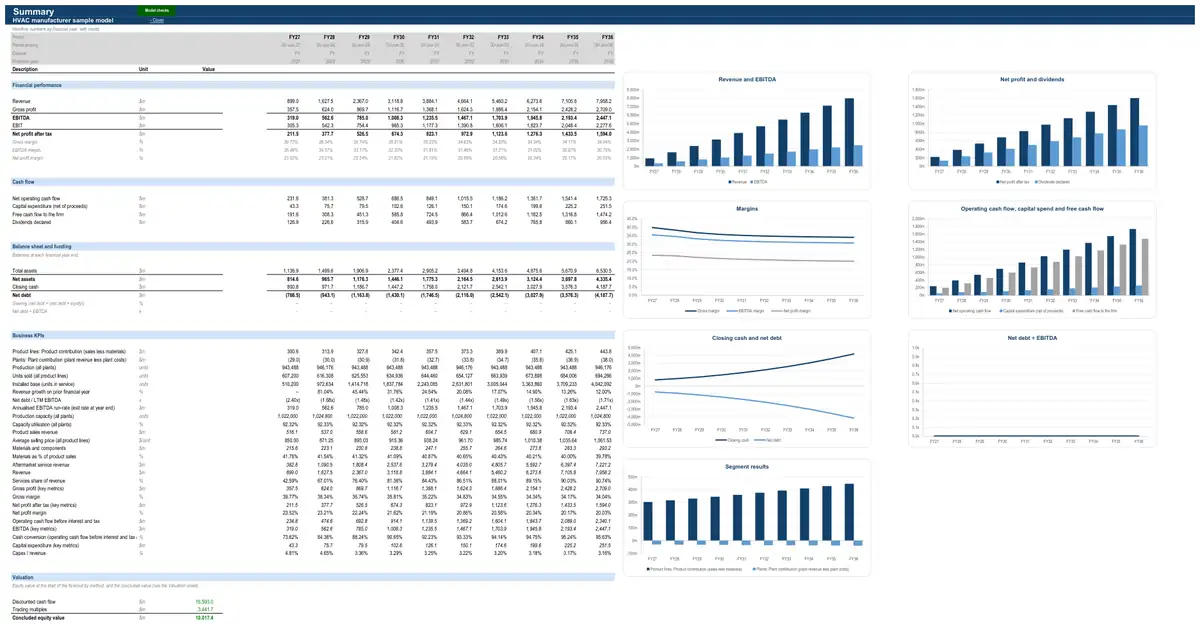
Illustrative figures: the sample describes no real business. The live preview shows values; your model’s Excel file has every formula.
How the model works for an HVAC manufacturer.
- How it earns revenue3 formulasPricing and pass-through · All product linesProduct sales revenueUnits soldfrom sales volumes by productAverage selling pricePricing and pass-through · All product linesAverage selling priceAverage selling price at the start datePrice indexAftermarket services and service contracts · Across the businessService contract revenueUnits under service contract (average)Annual service contract valueContract price indexshare of the year
- What drives its costs3 formulasDirect labour · All plantsDirect labourFixed labourVariable labour (production × cost per unit)Plant fixed overheads · All plantsPlant fixed overheadsBase overheadsStep costs (extra shifts and lines)Warranty provisions · Across the businessWarranty expenseProduct sales revenuefrom all unitsWarranty expense as % of revenue
- What it invests in3 formulasPlant capex and depreciation · All plantsPlant capital expenditureSustaining capexGrowth capexPlant capex and depreciation · All plantsPlant depreciationDepreciation of existing assetsDepreciation of sustaining additionsProject 1 depreciation (from commissioning)from from commissioningProject 2 depreciation (from commissioning)from from commissioningProject 3 depreciation (from commissioning)from from commissioningPlant capex and depreciation · All plantsClosing net book valueOpening net book valuePlant capital expenditurePlant depreciation
- How it is funded3 formulasDebtRepaymentsScheduled repaymentsPrepayments from an equity raise and the cash sweepDebtClosing balanceOpening balanceDrawdownsRepaymentsDebtInterest expenseOpening balanceAll-in interest rateshare of the year
- How profit becomes cash3 formulasWorking capitalTrade receivablesRevenuefrom statementsDebtor daysDays in periodWorking capitalInventoryDirect costs (positive)from statementsInventory daysDays in periodWorking capitalTrade payablesCash operating costs (positive)from statementsCreditor daysDays in period
26 parts, each one tested.
Every part is a tested building block with its own checks: yours is put together from the ones your business needs.
- CPI forecastConsensus curve with long-run anchor
- Exchange rate (US dollar)Exchange rate by financial year
- Operating expensesHeadcount build by function
- Corporate costsFixed cost base indexed to CPI
- Working capitalFull working capital
- Income taxCorporate rate with tax losses
- Corporate fixed assetsStraight-line over remaining life
- DebtAmortising term loan
- Dividends and distributionsPayout of net profit
- Discounted cash flow valuationDCF on free cash flow to the firm
- Multiples valuationEV / EBITDA multiple
- LeasesLease register
- InventoryWeighted average costRaw materials, work-in-progress and finished goods held to support production and sales (used in place of the inventory part of working capital), and the cost-of-sales effect of the costing method and stock provisions.
- Warranty provisionsWarranty as % of revenueThe cost of repairing or replacing faulty products sold, and the provision held for future claims.
- Research, development and engineeringR&D intensityResearch, product development and sustaining engineering spend, the share capitalised as development costs and its amortisation, customer-funded engineering, and R&D tax incentives.
- Aftermarket services and service contractsInstalled base × attach rate × contract valueService, maintenance, repair and consumables revenue earned from the installed base of equipment the business has sold, and the cost of delivering it.
- Key-metric summaryLast-twelve-month and run-rate metrics
- Discount rate (WACC)CAPM at target gearing
- Terminal valuePerpetuity growth on normalised cash flow
- Capacity and productionOperating days × daily rateHow much a plant can make and how much it does make, from capacity, operating time, utilisation and yield.
- Direct labourFixed plus variable labourWages and on-costs of the production workforce at each plant.
- Plant fixed overheadsStep-fixed with shifts and linesSite costs that do not vary with output: site management and supervision, quality, site services, insurance, rates and other production overheads of each plant.
- Plant capex and depreciationSustaining capex plus growth projectsSustaining and expansion capital expenditure on plant, and the depreciation and book value that follow.
- Sales volumes by productEnd-market production × content per unitUnits sold of each product line.
- Pricing and pass-throughPrice with annual increasesSelling price of each product line and the revenue it earns (units × price).
- Bill of materials and input costsStandard cost per unitRaw materials, components and bought-in parts consumed by each product line.
The numbers it tracks.
- 01units shipped
- 02replacement share
- 03service revenue
- 04price/mix
- 05gross margin
- 06EBITA margin
What it is used for.
- Operating forecastGuide · Financial projections
- Budget and rolling forecastGuide · Cash flow forecast
- ValuationGuide · DCF valuation model
- Lending and credit analysisGuide · Three-statement model
- Leveraged buyout (private equity)Guide · Financial modelling services
- Merger or acquisition (strategic)Guide · Financial modelling services
More in manufacturing and machinery.
- Discrete manufacturer financial model
- Contract manufacturer financial model
- Metal fabricator financial model
- Capital equipment manufacturer financial model
- Industrial components manufacturer financial model
- Robotics and automation manufacturer financial model
- Electrical equipment manufacturer financial model
- Heavy equipment manufacturer financial model
- 3D printing company financial model
- Industrial conglomerate financial model
Looking for an HVAC manufacturer financial model template? Ours arrives built for your business, with your figures in it.
See a finished model, sheet by sheetThe sample is built on illustrative figures and describes no real business. Models are calculations prepared from the information you provide. They are not financial advice and must be independently verified. See our terms.