Government business enterprise financial model, built free.
A three-statement Excel model for a state-owned corporation / government business enterprise, built from your own figures and checked to balance.
- Free account
- No card
- Usually ready within the hour
We use generative AI in parts of our process, so mistakes can occur. Every model should be checked by a person before it is relied on. Read more
A commercially run government-owned business (water, ports, rail, forestry, energy, lotteries) that charges customers, receives community service obligation payments for services it must provide below cost, and pays tax equivalents, guarantee fees and dividends to its shareholding ministers; sector revenue and asset jobs come from the matching industry file (network.* for water, port.* for ports, rail.* for rail) in place of rev.general.
In short
- 01
Three linked statements
Income statement, balance sheet and cash flow, linked in every period.
- 02
Valued two ways
Discounted cash flow and trading multiples, side by side.
- 03
Monthly to annual
Monthly, quarterly, half-yearly or annual periods, for up to 30 years.
- 04
Checked every period
A Checks sheet shows the balance sheet balances and the cash reconciles.
The sample, as Excel draws it.
Built by the same system and checks as yours: its structure and its inputs, ready for your own figures.
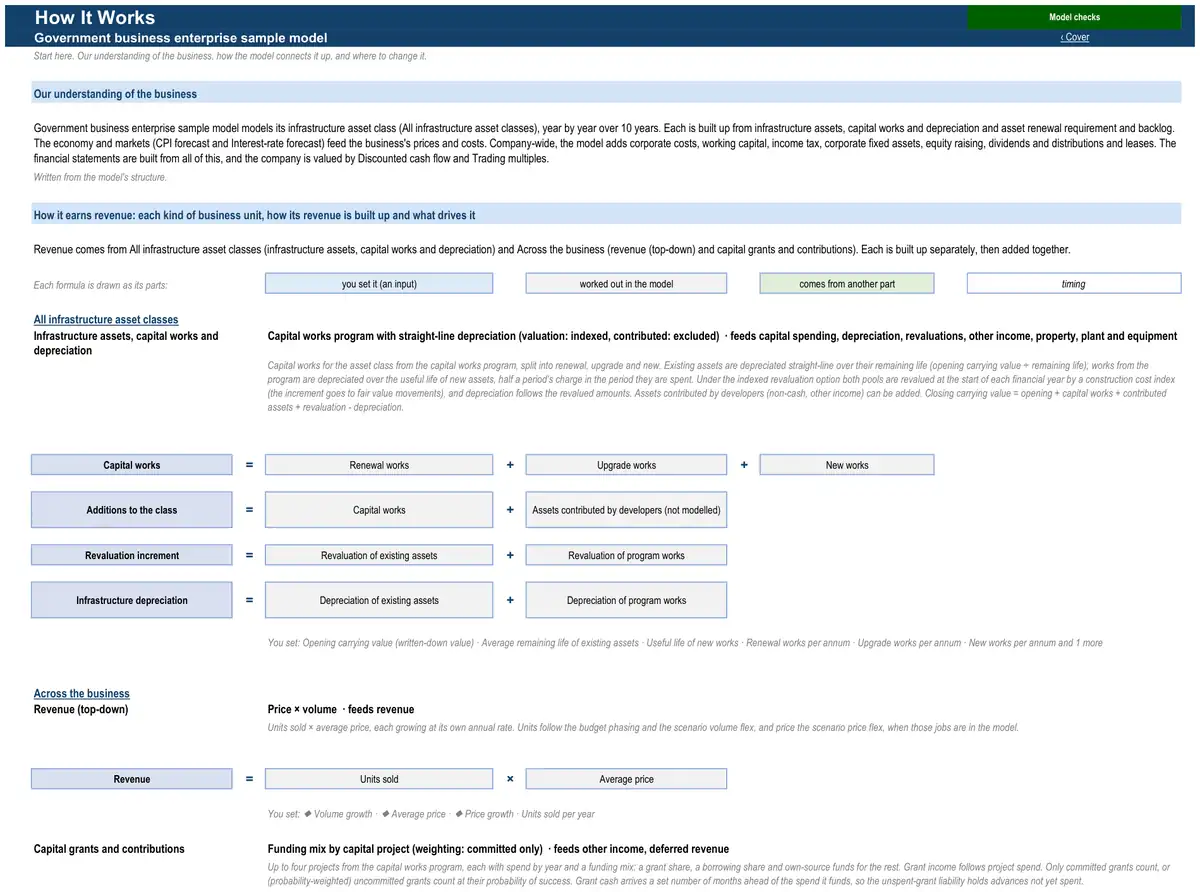
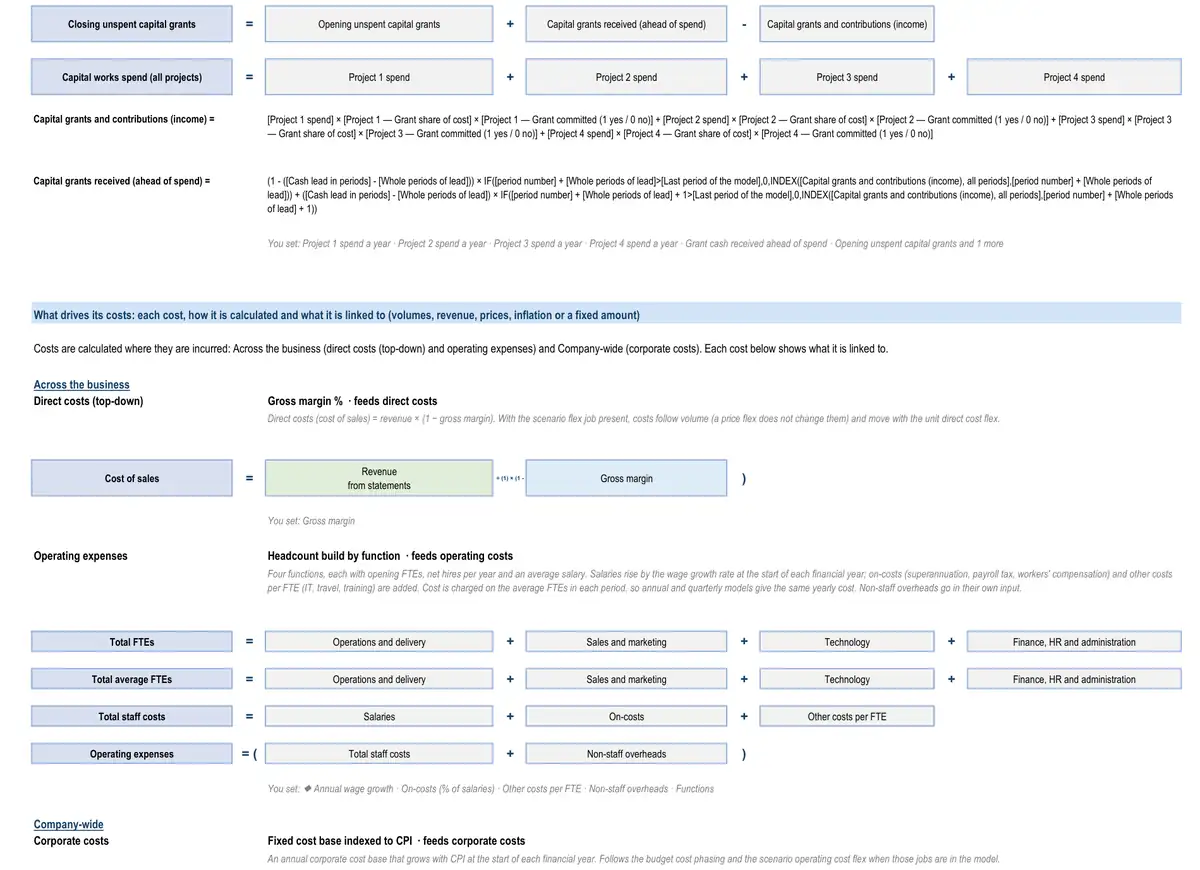
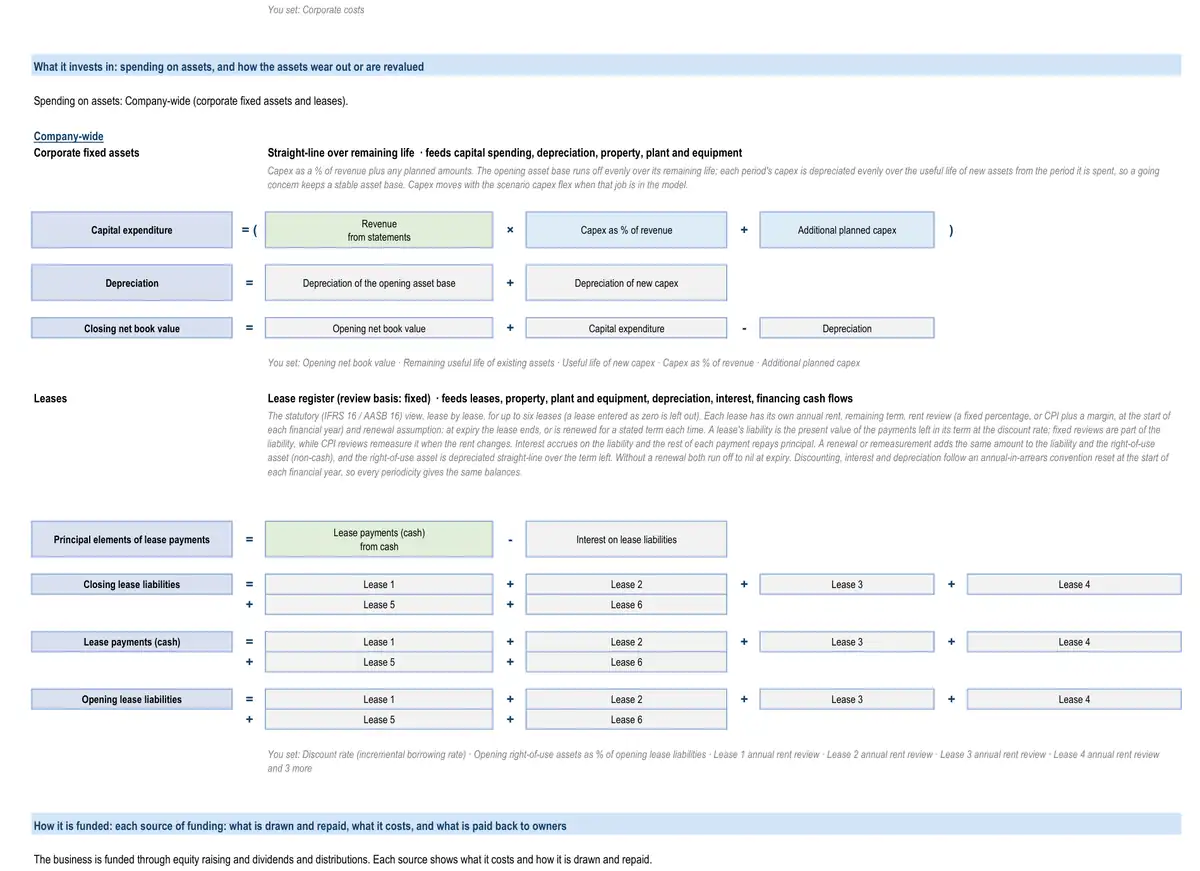
The sample describes no real business. Yours is calibrated to your own figures, so its results are your business’s.
How the model works for a government business enterprise.
- How it earns revenue3 formulasInfrastructure assets, capital works and depreciation · All infrastructure asset classesCapital worksRenewal worksUpgrade worksNew worksInfrastructure assets, capital works and depreciation · All infrastructure asset classesAdditions to the classCapital worksAssets contributed by developers (not modelled)Infrastructure assets, capital works and depreciation · All infrastructure asset classesRevaluation incrementRevaluation of existing assetsRevaluation of program works
- What drives its costs3 formulasDirect costs (top-down) · Across the businessCost of salesRevenuefrom statementsGross marginOperating expenses · Across the businessTotal FTEsOperations and deliverySales and marketingTechnologyFinance, HR and administrationOperating expenses · Across the businessTotal average FTEsOperations and deliverySales and marketingTechnologyFinance, HR and administration
- What it invests in3 formulasCorporate fixed assetsCapital expenditureRevenuefrom statementsCapex as % of revenueAdditional planned capexCorporate fixed assetsDepreciationDepreciation of the opening asset baseDepreciation of new capexCorporate fixed assetsClosing net book valueOpening net book valueCapital expenditureDepreciation
- How it is funded2 formulasEquity raisingEquity raisedDistributions reinvested under the DRPOther equity raised (net of costs)Equity from an offer, milestone funding, conversions and creditor sharesDividends and distributionsClosing dividends payableOpening dividends payableDividends declaredDividends paid
- How profit becomes cash3 formulasWorking capitalTrade receivablesRevenuefrom statementsDebtor daysDays in periodWorking capitalInventoryDirect costs (positive)from statementsInventory daysDays in periodWorking capitalTrade payablesCash operating costs (positive)from statementsCreditor daysDays in period
17 parts, each one tested.
Every part is a tested building block with its own checks: yours is put together from the ones your business needs.
- CPI forecastConsensus curve with long-run anchor
- Revenue (top-down)Price × volume
- Direct costs (top-down)Gross margin %
- Operating expensesHeadcount build by function
- Corporate costsFixed cost base indexed to CPI
- Working capitalFull working capital
- Income taxCorporate rate with tax losses
- Corporate fixed assetsStraight-line over remaining life
- Equity raisingDistribution reinvestment plan
- Dividends and distributionsPayout of net profit
- Discounted cash flow valuationDCF on free cash flow to the firm
- Multiples valuationEV / EBITDA multiple
- Capital grants and contributionsFunding mix by capital projectGrants to build or acquire assets the entity will control, recognised as income as the asset is built (AASB 1058 paragraphs 15–16; a conditional-grant liability under IPSAS 23 and similar standards), with unspent amounts held as a liability and the income kept below the operating result. Used by councils, agencies, health services, charities, clubs and housing providers.
- LeasesLease register
- Interest-rate forecastMarket forward curve
- Asset renewal requirement and backlogAnnual consumption as the requirementThe renewal spend each asset class needs to hold its target service level (from the asset management plan) and the backlog of assets below a satisfactory standard — the basis of the renewal gap.
- Infrastructure assets, capital works and depreciationCapital works program with straight-line depreciationRoll-forward of each asset class — capital works split into renewal, upgrade and new, assets contributed by developers, depreciation and revaluations — carried at fair value (current replacement cost) under AASB 116 and AASB 13 or IPSAS 17. Revaluation increments go to the asset revaluation reserve (other comprehensive income).
The numbers it tracks.
- 01EBITDA
- 02return on assets
- 03CSO funding
- 04tax-equivalent payments
- 05dividend to government
- 06gearing
- 07interest cover
- 08commercial value
What it is used for.
- Budget and rolling forecastGuide · Cash flow forecast
- Operating forecastGuide · Financial projections
- ValuationGuide · DCF valuation model
- Lending and credit analysisGuide · Three-statement model
- Merger or acquisition (strategic)Guide · Financial modelling services
- Restructuring and liquidityGuide · Financial modelling services
- Scenarios and sensitivities
More in government.
Looking for a government business enterprise financial model template? Ours arrives built for your business, with your figures in it.
See a finished model, sheet by sheetThe sample is built on illustrative figures and describes no real business. Models are calculations prepared from the information you provide. They are not financial advice and must be independently verified. See our terms.