Apartment development financial model, built free.
A three-statement Excel model for a residential apartment developer, built from your own figures and checked to balance.
- Free account
- No card
- Usually ready within the hour
We use generative AI in parts of our process, so mistakes can occur. Every model should be checked by a person before it is relied on. Read more
Buys sites, builds apartments or townhouses and sells them off the plan; revenue and margin are recognised when units settle after completion.
In short
- 01
Three linked statements
Income statement, balance sheet and cash flow, linked in every period.
- 02
Valued three ways
Discounted cash flow, trading multiples and net asset value, side by side.
- 03
Monthly to annual
Monthly, quarterly, half-yearly or annual periods, for up to 30 years.
- 04
Checked every period
A Checks sheet shows the balance sheet balances and the cash reconciles.
The sample, as Excel draws it.
Built by the same system and checks as yours: its structure and its inputs, ready for your own figures.
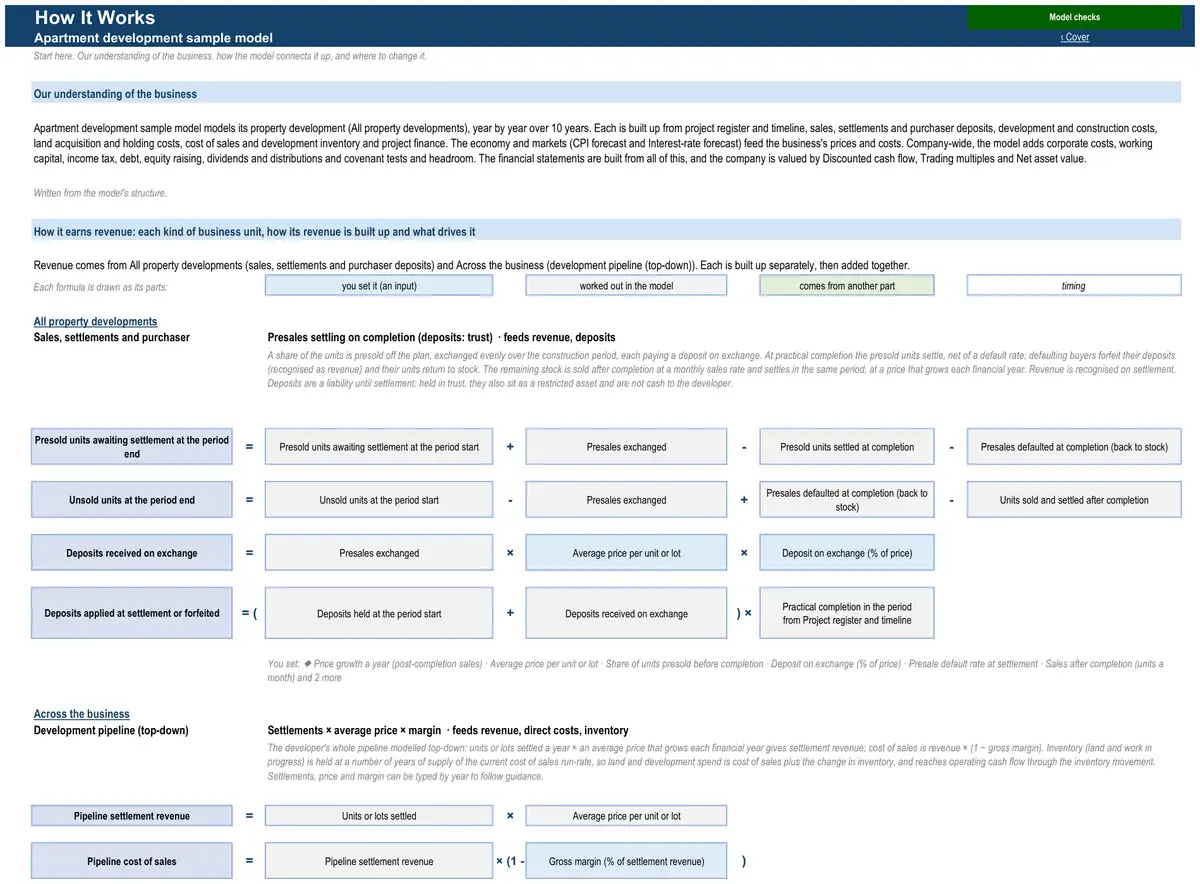
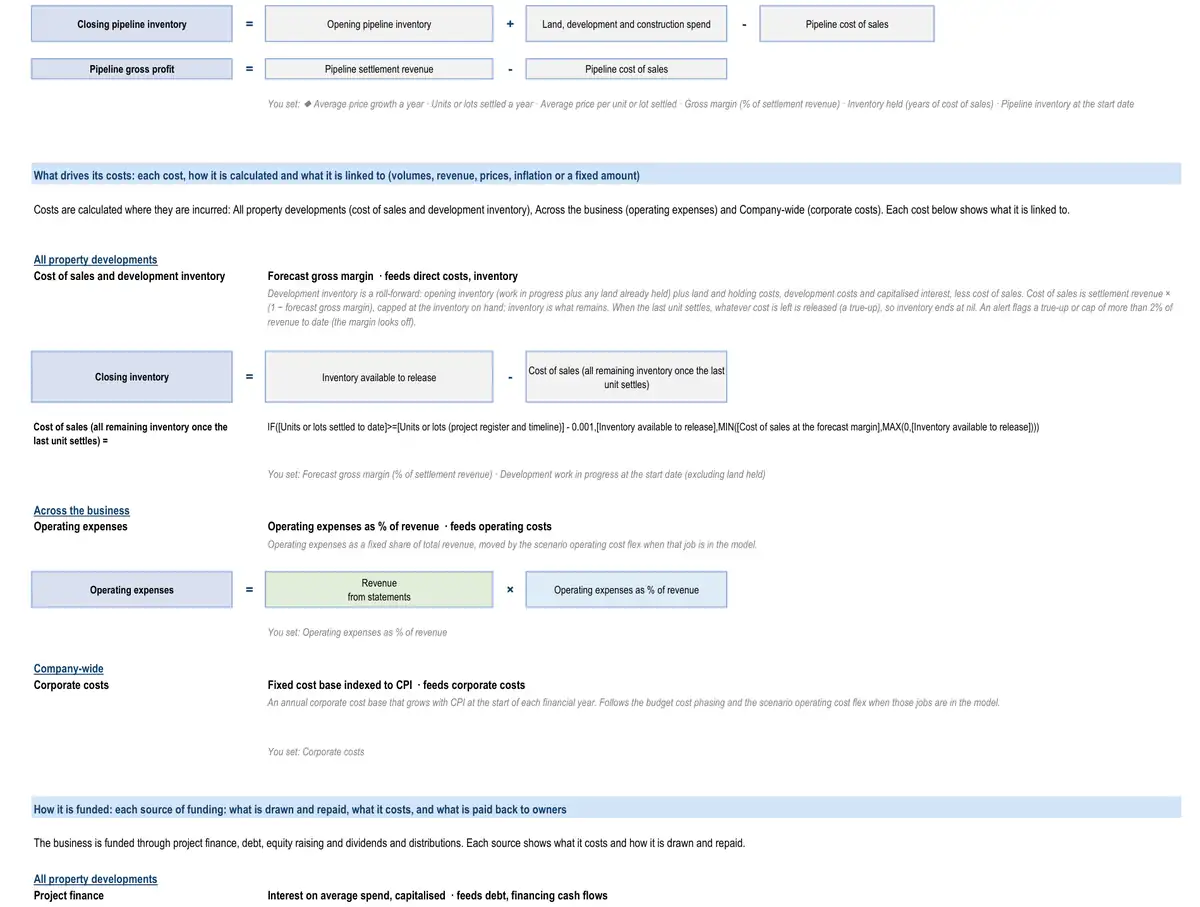
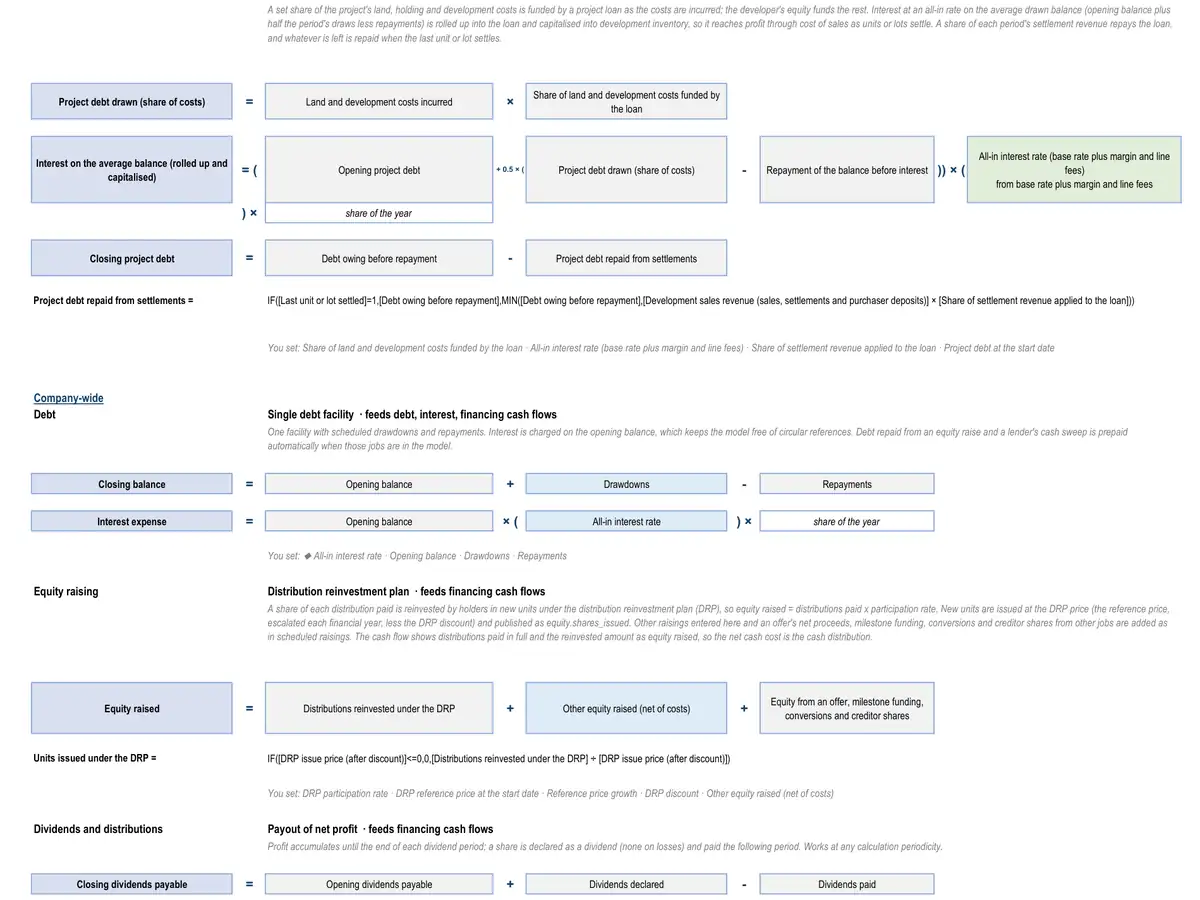
The sample describes no real business. Yours is calibrated to your own figures, so its results are your business’s.
How the model works for an apartment development.
- How it earns revenue3 formulasSales, settlements and purchaser deposits · All property developmentsPresold units awaiting settlement at the period endPresold units awaiting settlement at the period startPresales exchangedPresold units settled at completionPresales defaulted at completion (back to stock)Sales, settlements and purchaser deposits · All property developmentsUnsold units at the period endUnsold units at the period startPresales exchangedPresales defaulted at completion (back to stock)Units sold and settled after completionSales, settlements and purchaser deposits · All property developmentsDeposits received on exchangePresales exchangedAverage price per unit or lotDeposit on exchange (% of price)
- What drives its costs2 formulasCost of sales and development inventory · All property developmentsClosing inventoryInventory available to releaseCost of sales (all remaining inventory once the last unit settles)Operating expenses · Across the businessOperating expensesRevenuefrom statementsOperating expenses as % of revenue
- How it is funded3 formulasProject finance · All property developmentsProject debt drawn (share of costs)Land and development costs incurredShare of land and development costs funded by the loanProject finance · All property developmentsInterest on the average balance (rolled up and capitalised)Opening project debtProject debt drawn (share of costs)Repayment of the balance before interestAll-in interest rate (base rate plus margin and line fees)from base rate plus margin and line feesshare of the yearProject finance · All property developmentsClosing project debtDebt owing before repaymentProject debt repaid from settlements
- How profit becomes cash3 formulasWorking capitalTrade receivablesRevenuefrom statementsDebtor daysDays in periodWorking capitalInventoryDirect costs (positive)from statementsInventory daysDays in periodWorking capitalTrade payablesCash operating costs (positive)from statementsCreditor daysDays in period
26 parts, each one tested.
Every part is a tested building block with its own checks: yours is put together from the ones your business needs.
- CPI forecastCPI glide path
- Operating expensesOperating expenses as % of revenue
- Corporate costsFixed cost base indexed to CPI
- Working capitalDays-based working capital
- Income taxCorporate rate with tax losses
- DebtSingle debt facility
- Equity raisingDistribution reinvestment plan
- Dividends and distributionsPayout of net profit
- Discounted cash flow valuationDCF on free cash flow to the firm
- Multiples valuationEV / EBITDA multiple
- Net asset valueBook net asset value
- Key-metric summaryStandard growth, margin and leverage metrics
- Covenant tests and headroomLVR, gearing and ICR for property
- Cost to completeBudget less cost incurred
- Feasibility metricsCash-flow returns
- Discount rate (WACC)CAPM at target gearing
- Development pipeline (top-down)Settlements × average price × marginRevenue, margin and inventory for the developer's whole pipeline when projects are not modelled one by one — settlements by year, landbank run-off and capital employed.
- Interest-rate forecastMarket forward curve
- Completed valueCapitalised income
- Project register and timelineSingle-stage projectUnits or lots, saleable area and the construction and completion timing every other part of the model uses.
- Land acquisition and holding costsUpfront purchase with holding costsThe land purchase, its payment terms, stamp duty and the holding costs (land tax, rates) until development.
- Development and construction costsTotal cost on an S-curveConstruction, professional fees, statutory contributions, marketing and contingency, and when they are spent.
- Sales, settlements and purchaser depositsPresales settling on completionUnits or lots sold (exchanged) and settled, the revenue recognised on settlement, and deposits received from buyers.
- Cost of sales and development inventoryForecast gross marginCapitalised land, construction and interest costs held as inventory and released to cost of sales as units settle.
- Project financeInterest on average spend, capitalisedConstruction and land loans at project level, with interest usually capitalised into inventory.
- Feasibility and project returnsResidual land valueThe project's profit, margin and return metrics used to approve and track the development.
The numbers it tracks.
- 01settlements
- 02development margin
- 03presales
- 04peak debt
- 05project IRR
- 06NTA per share
What it is used for.
- Development feasibilityGuide · Financial modelling services
- Lending and credit analysisGuide · Three-statement model
- Operating forecastGuide · Financial projections
- Budget and rolling forecastGuide · Cash flow forecast
- ValuationGuide · DCF valuation model
- Equity capital raisingGuide · Startup financial model
- Restructuring and liquidityGuide · Financial modelling services
- Scenarios and sensitivities
- Closed-end fund, syndicate or trust
More in property development.
- Land subdivision financial model
- Commercial property development financial model
- Volume homebuilder financial model
Looking for an apartment development financial model template? Ours arrives built for your business, with your figures in it.
See a finished model, sheet by sheetThe sample is built on illustrative figures and describes no real business. Models are calculations prepared from the information you provide. They are not financial advice and must be independently verified. See our terms.