Property syndicator financial model, built free.
A three-statement Excel model for a property syndicator, built from your own figures and checked to balance.
- Free account
- No card
- Usually ready within the hour
We use generative AI in parts of our process, so mistakes can occur. Every model should be checked by a person before it is relied on. Read more
Raises equity from wholesale and retail investors into single-asset or small-portfolio syndicates, earning acquisition and equity-raising fees on launch, ongoing management fees, and a performance fee when each syndicate is sold at the end of its term.
In short
- 01
Three linked statements
Income statement, balance sheet and cash flow, linked in every period.
- 02
Valued two ways
Discounted cash flow and trading multiples, side by side.
- 03
Monthly to annual
Monthly, quarterly, half-yearly or annual periods, for up to 30 years.
- 04
Checked every period
A Checks sheet shows the balance sheet balances and the cash reconciles.
The sample, as Excel draws it.
Built by the same system and checks as yours, on illustrative figures: every sheet as Excel draws it, or live.
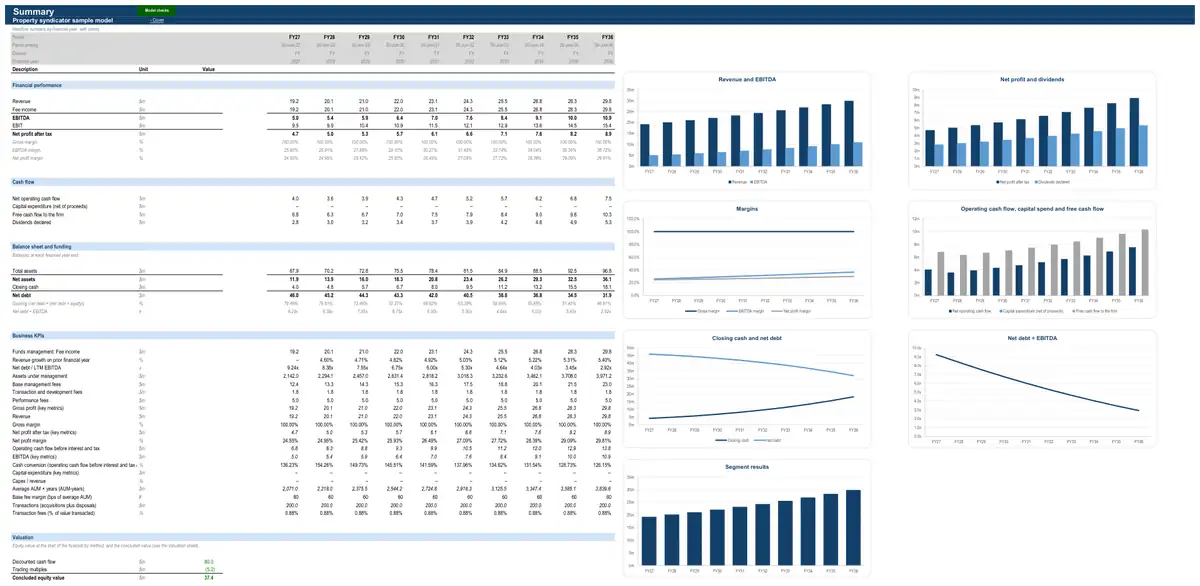
Illustrative figures: the sample describes no real business. The live preview shows values; your model’s Excel file has every formula.
How the model works for a property syndicator.
- How it earns revenue3 formulasBase management fees · All managed property fundsBase management feesAverage fee base × yearsManagement fee rate (% a year)Transaction, development, property management and licence fees · All managed property fundsTransaction feesAcquisition feesDisposal feesTransaction, development, property management and licence fees · All managed property fundsTotal value transactedAcquisitionsDisposals
- What drives its costs1 formulaOperating expenses · Across the businessOperating expensesStaff costs (annual)Marketing (annual)Occupancy (annual)Administration (annual)share of the year
- How it is funded3 formulasDebtClosing balanceOpening balanceDrawdownsRepaymentsDebtInterest expenseOpening balanceAll-in interest rateshare of the yearDividends and distributionsClosing dividends payableOpening dividends payableDividends declaredDividends paid
- How profit becomes cash3 formulasWorking capitalTrade receivablesRevenuefrom statementsDebtor daysDays in periodWorking capitalInventoryDirect costs (positive)from statementsInventory daysDays in periodWorking capitalTrade payablesCash operating costs (positive)from statementsCreditor daysDays in period
16 parts, each one tested.
Every part is a tested building block with its own checks: yours is put together from the ones your business needs.
- CPI forecastCPI glide path
- Operating expensesOperating expense line items
- Corporate costsFixed cost base indexed to CPI
- Working capitalDays-based working capital
- Income taxCorporate rate with tax losses
- DebtSingle debt facility
- Dividends and distributionsPayout of net profit
- Discounted cash flow valuationDCF on free cash flow to the firm
- Multiples valuationEV / EBITDA multiple
- Key-metric summaryStandard growth, margin and leverage metrics
- Discount rate (WACC)CAPM at target gearing
- Assets under managementAUM with net flows and revaluation %The fund's assets under management over time — the base on which most fees are charged.
- Base management feesFee rate × average AUMRecurring fees charged on the fund's assets, equity or commitments.
- Transaction, development, property management and licence feesFee % × transaction volumeFees for acquisitions and disposals, equity raising, development management, property management and leasing, and brand licensing.
- Performance feesGuided performance feesFees earned when fund returns beat a benchmark or hurdle.
- Co-investment in managed fundsEquity-accounted share of fund earningsThe manager's own stake in the funds it manages and the income it earns from that stake.
The numbers it tracks.
- 01syndicates launched
- 02equity raised
- 03AUM
- 04fee revenue by type
- 05recurring versus transactional earnings
- 06performance fees crystallised
What it is used for.
- Operating forecastGuide · Financial projections
- Budget and rolling forecastGuide · Cash flow forecast
- ValuationGuide · DCF valuation model
- Merger or acquisition (strategic)Guide · Financial modelling services
- Scenarios and sensitivities
- Closed-end fund, syndicate or trust
More in property funds and services.
- Unlisted property fund or syndicate financial model
- Property funds manager financial model
- Real estate agency financial model
- Commercial real estate agency financial model
- Strata management company financial model
Looking for a property syndicator financial model template? Ours arrives built for your business, with your figures in it.
See a finished model, sheet by sheetThe sample is built on illustrative figures and describes no real business. Models are calculations prepared from the information you provide. They are not financial advice and must be independently verified. See our terms.