Vending machine business financial model, built free.
A three-statement Excel model for a vending and micro-market operator, built from your own figures and checked to balance.
- Free account
- No card
- Usually ready within the hour
We use generative AI in parts of our process, so mistakes can occur. Every model should be checked by a person before it is relied on. Read more
Places vending machines, unattended micro-markets and office-coffee units at host sites (offices, factories, hospitals, campuses, transport hubs), earning sales per machine after product cost, route servicing and the commission paid to the site host.
In short
- 01
Three linked statements
Income statement, balance sheet and cash flow, linked in every period.
- 02
Valued two ways
Discounted cash flow and trading multiples, side by side.
- 03
Monthly to annual
Monthly, quarterly, half-yearly or annual periods, for up to 30 years.
- 04
Checked every period
A Checks sheet shows the balance sheet balances and the cash reconciles.
The sample, as Excel draws it.
Built by the same system and checks as yours, on illustrative figures: every sheet as Excel draws it, or live.
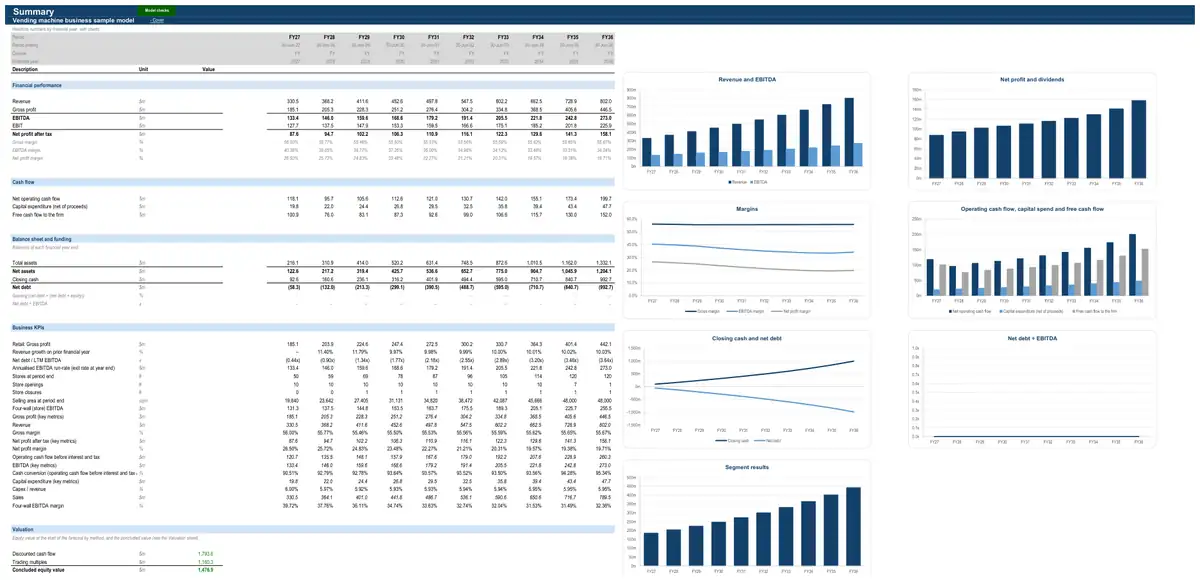
Illustrative figures: the sample describes no real business. The live preview shows values; your model’s Excel file has every formula.
How the model works for a vending machine business.
- How it earns revenue3 formulasSales · All store formatsOnline salesOrdersAverage order valueSynergies · Valuation and analysisCost synergiesRun-rate cost synergiesCost synergies achieved (share of run-rate)CPI index (1.00 in the first year)share of the yearSynergies · Valuation and analysisRevenue synergiesRun-rate revenue synergiesRevenue synergies achieved (share of run-rate)CPI index (1.00 in the first year)share of the year
- What drives its costs2 formulasCost of goods sold · All store formatsCost of goods soldLanded cost of product soldShrinkageFreight and logisticsLess supplier rebatesStore and channel operating costs · All store formatsStore operating costsStore wagesRentOther store costsVariable store costsPre-opening costs
- What it invests in3 formulasStore capex and depreciation · All store formatsCapital expenditureOnline salesfrom salesCapex as % of salesStore capex and depreciation · All store formatsLess depreciationDepreciation (run-off of a mix of vintages)DepreciationStore capex and depreciation · All store formatsClosing net book valueOpening net book valueAdd capital expenditureLess depreciation
- How it is funded3 formulasDebtRepaymentsScheduled repaymentsPrepayments from an equity raise and the cash sweepDebtClosing balanceOpening balanceDrawdownsRepaymentsDebtInterest expenseOpening balanceAll-in interest rateshare of the year
- How profit becomes cash3 formulasWorking capitalTrade receivablesRevenuefrom statementsDebtor daysDays in periodWorking capitalInventoryDirect costs (positive)from statementsInventory daysDays in periodWorking capitalTrade payablesCash operating costs (positive)from statementsCreditor daysDays in period
22 parts, each one tested.
Every part is a tested building block with its own checks: yours is put together from the ones your business needs.
- CPI forecastConsensus curve with long-run anchor
- Corporate costsFixed cost base indexed to CPI
- Working capitalFull working capital
- Income taxCorporate rate with tax losses
- Corporate fixed assetsStraight-line over remaining life
- DebtAmortising term loan
- Discounted cash flow valuationDCF on free cash flow to the firm
- Multiples valuationEV / EBITDA multiple
- Key-metric summaryLast-twelve-month and run-rate metrics
- Covenant tests and headroomLVR, gearing and ICR for property
- Sources and uses at completionEntry multiple with debt sized in turns of EBITDA
- Management equity and ratchetsFixed management share or option pool
- Exit valuation and timingExit multiple of LTM EBITDA
- Sponsor returns and value creationValue creation bridge
- SynergiesRun-rate synergies with phasing
- InventoryStock per store plus DC stockStock held in stores, distribution centres and in transit, and the cash it ties up.
- Store networkRoll-out to a target networkStores trading in each period — openings, closures and selling area — which every per-store driver multiplies.
- SalesOnline sales from active customers × orders × order valueSales of the format — stores, restaurants, cafés or an online channel — the revenue base of every retailer.
- Cost of goods soldProduct margin less shrinkage and freightCost of the goods (or food) sold by the format, after supplier terms, freight, markdowns and shrinkage.
- Store and channel operating costsPer-store wages, rent and other costsCosts of running the format — store wages, rent and occupancy, running costs, or an online channel's fulfilment and platform costs (rent here is the pre-AASB 16 cash view).
- Store capex and depreciationCapex as % of salesFit-out spend on new stores, refurbishments and maintenance, and the depreciation and book value of store assets.
- Store and unit economicsNew-store investment and paybackFour-wall (store) profit and the return on each new store or restaurant — the unit economics that support a roll-out, a franchise system or an online channel; reporting only.
The numbers it tracks.
- 01machines placed
- 02sales per machine per week
- 03gross margin %
- 04route cost per fill
- 05host commission %
- 06EBITDA per machine
More in online and direct to consumer.
- E-commerce store financial model
- Direct-to-consumer brand financial model
- Subscription box and meal kit financial model
Looking for a vending machine business financial model template? Ours arrives built for your business, with your figures in it.
Running a small business? Read what goes into a small business financial model.
See a finished model, sheet by sheetThe sample is built on illustrative figures and describes no real business. Models are calculations prepared from the information you provide. They are not financial advice and must be independently verified. See our terms.