Consumer rental business financial model, built free.
A three-statement Excel model for a consumer rental and subscription services, built from your own figures and checked to balance.
- Free account
- No card
- Usually ready within the hour
We use generative AI in parts of our process, so mistakes can occur. Every model should be checked by a person before it is relied on. Read more
Rents furniture, appliances, electronics or cars to households on subscriptions or consumer leases, owning a pool of assets that is refurbished and redeployed between customers and funded with asset-backed debt.
In short
- 01
Three linked statements
Income statement, balance sheet and cash flow, linked in every period.
- 02
Valued two ways
Discounted cash flow and trading multiples, side by side.
- 03
Monthly to annual
Monthly, quarterly, half-yearly or annual periods, for up to 30 years.
- 04
Checked every period
A Checks sheet shows the balance sheet balances and the cash reconciles.
The sample, as Excel draws it.
Built by the same system and checks as yours, on illustrative figures: every sheet as Excel draws it, or live.
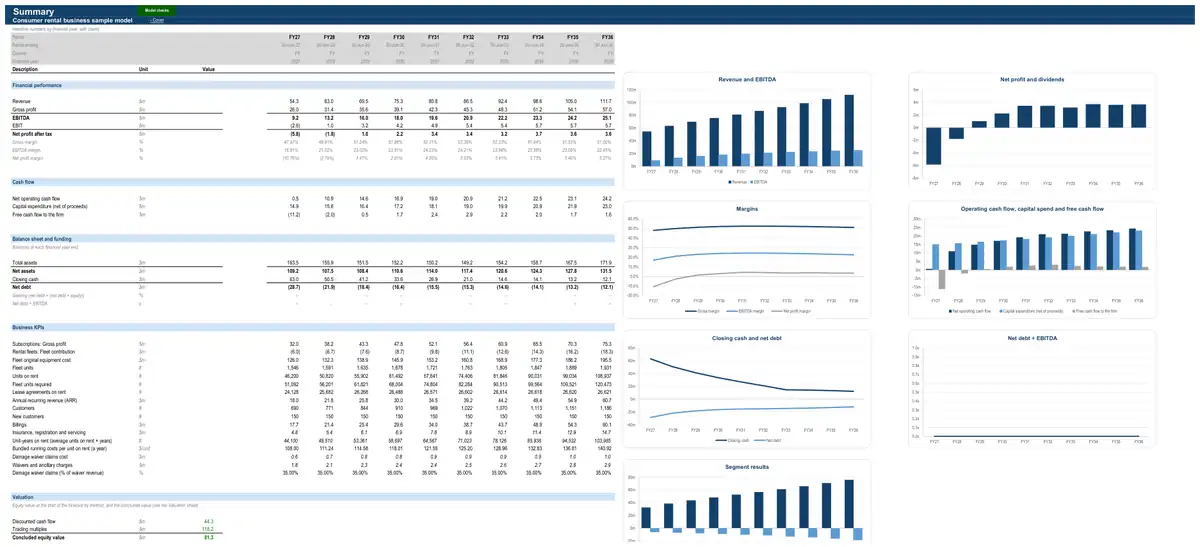
Illustrative figures: the sample describes no real business. The live preview shows values; your model’s Excel file has every formula.
How the model works for a consumer rental business.
- How it earns revenue3 formulasRental fleet: cost, capex and disposals · All rental fleet classesProceeds from used equipment salesUnits sold at original costSale price of used equipment (% of original cost)Rental fleet: cost, capex and disposals · All rental fleet classesClosing fleet unitsOpening fleet unitsUnits soldUnits boughtRental fleet: cost, capex and disposals · All rental fleet classesFleet unit-years (average fleet units × years)Opening fleet unitsClosing fleet unitsshare of the year
- What drives its costs3 formulasAssets on rent and refurbishment · All rental fleet classesRefurbishment and redeployment costUnits returned and refurbishedRefurbishment cost per returned unitAssets on rent and refurbishment · All rental fleet classesClosing units on rentClosing subscribersItems on rent per subscriberAssets on rent and refurbishment · All rental fleet classesUnit-years on rent (average units on rent × years)Opening units on rentClosing units on rentshare of the year
- What it invests in3 formulasLeasesPrincipal elements of lease paymentsLease payments (cash)from cashInterest on lease liabilitiesLeasesClosing lease liabilitiesLease 1Lease 2Lease 3Lease 4Lease 5Lease 6LeasesLease payments (cash)Lease 1Lease 2Lease 3Lease 4Lease 5Lease 6
- How it is funded3 formulasDebtRepaymentsScheduled repaymentsPrepayments from an equity raise and the cash sweepDebtClosing balanceOpening balanceDrawdownsRepaymentsDebtInterest expenseOpening balanceAll-in interest rateshare of the year
- How profit becomes cash3 formulasBillings and deferred revenue · All product plansClosing deferred revenueClosing ARR (recurring revenue and arr)from recurring revenue and arrShare of ARR billed in advanceBilling term invoiced in advanceBillings and deferred revenue · All product plansBillingsSubscription revenue (recurring revenue and arr)from recurring revenue and arrClosing deferred revenueOpening deferred revenueWorking capitalTrade receivablesRevenuefrom statementsDebtor daysDays in period
21 parts, each one tested.
Every part is a tested building block with its own checks: yours is put together from the ones your business needs.
- CPI forecastConsensus curve with long-run anchor
- Operating expensesHeadcount build by function
- Corporate costsFixed cost base indexed to CPI
- Working capitalFull working capital
- Income taxCorporate rate with tax losses
- DebtAmortising term loan
- Equity raisingDistribution reinvestment plan
- Discounted cash flow valuationDCF on free cash flow to the firm
- Multiples valuationEV / EBITDA multiple
- LeasesLease register
- Interest-rate forecastMarket forward curve
- Rental fleet: cost, capex and disposalsFleet cost (OEC) roll-forward
- Assets on rent and refurbishmentSubscribers × items plus pipelineAssets needed to serve subscribers — on rent, in refurbishment and idle — and the cost of refurbishing and redeploying returns.
- Bundled running costsCost per unit per monthInsurance, registration, servicing, damage and delivery costs included in the subscription price.
- Ancillary chargesDamage waiver take-upDamage waivers, excess-usage and damage charges, buy-outs and early termination fees on top of the subscription.
- Consumer leases and rent-to-ownOperating lease rent-to-ownConsumer lease and rent-to-own agreements — lease revenue, the merchandise or receivable on the balance sheet, and losses on non-payment or non-return.
- New customers and sales and marketingNew customers per period × CAC
- Customer base and churnConstant churn rate
- Recurring revenue and ARRARR bridge on ARPA with price increases and net expansion
- Billings and deferred revenueBilled in advance (billing mix) with deferred revenue
- Cost of revenueHosting and support as % of revenue
The numbers it tracks.
- 01active subscribers
- 02churn
- 03revenue per subscriber
- 04assets on rent
- 05utilisation
- 06asset cost per subscriber
- 07residual values
- 08loss rate
- 09EBITDA and cash burn
What it is used for.
- Operating forecastGuide · Financial projections
- Equity capital raisingGuide · Startup financial model
- Lending and credit analysisGuide · Three-statement model
- ValuationGuide · DCF valuation model
- Scenarios and sensitivities
More in personal and home services.
- Hair and beauty salon financial model
- Boutique fitness studio financial model
- Pet grooming and boarding financial model
- Tutoring centre financial model
- Home services franchise financial model
- Laundromat and dry cleaner financial model
- Funeral home financial model
Looking for a consumer rental business financial model template? Ours arrives built for your business, with your figures in it.
Running a small business? Read what goes into a small business financial model.
See a finished model, sheet by sheetThe sample is built on illustrative figures and describes no real business. Models are calculations prepared from the information you provide. They are not financial advice and must be independently verified. See our terms.