Hair and beauty salon financial model, built free.
A three-statement Excel model for a hair, beauty and wellness salon network, built from your own figures and checked to balance.
- Free account
- No card
- Usually ready within the hour
We use generative AI in parts of our process, so mistakes can occur. Every model should be checked by a person before it is relied on. Read more
Operates or franchises hair, barber, beauty, nail, brow and massage salons, earning service revenue from appointments delivered by commissioned or employed practitioners plus retail product sales.
In short
- 01
Three linked statements
Income statement, balance sheet and cash flow, linked in every period.
- 02
Valued two ways
Discounted cash flow and trading multiples, side by side.
- 03
Monthly to annual
Monthly, quarterly, half-yearly or annual periods, for up to 30 years.
- 04
Checked every period
A Checks sheet shows the balance sheet balances and the cash reconciles.
The sample, as Excel draws it.
Built by the same system and checks as yours, on illustrative figures: every sheet as Excel draws it, or live.
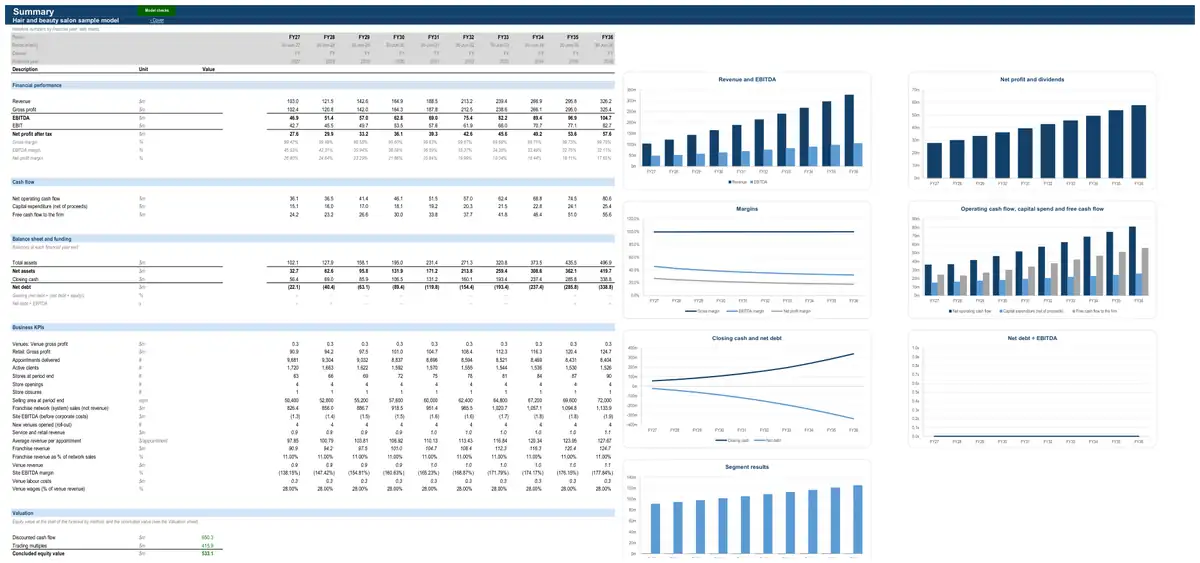
Illustrative figures: the sample describes no real business. The live preview shows values; your model’s Excel file has every formula.
How the model works for a hair and beauty salon.
- How it earns revenue3 formulasFranchisor revenue · All store formatsUnspent marketing fund levies at period endUnspent marketing fund levies at start of periodMarketing levies charged to franchiseesMarketing fund spendingFranchisor revenue · All store formatsFranchise revenue (royalty and levies)Royalty incomeMarketing levy income (recognised as the fund spends)Technology levy incomeFranchisor revenue · All store formatsMarketing fund and technology costsMarketing fund spendingNetwork technology costs funded by the levy
- What drives its costs3 formulasPractitioner and instructor pay · All venuesPractitioner payBase wagesProductivity bonusOn-costsCost of goods sold and content costs · All venuesCost of goods sold and content costsBeverage cost of salesFood cost of salesMerchandise cost of salesContent costs on admissionsVenue labour costs · All venuesVenue labour costsVenue revenuefrom venue revenue and site EBITDAVenue labour (% of venue revenue)
- What it invests in3 formulasCorporate fixed assetsCapital expenditureRevenuefrom statementsCapex as % of revenueAdditional planned capexCorporate fixed assetsDepreciationDepreciation of the opening asset baseDepreciation of new capexCorporate fixed assetsClosing net book valueOpening net book valueCapital expenditureDepreciation
- How it is funded3 formulasDebtRepaymentsScheduled repaymentsPrepayments from an equity raise and the cash sweepDebtClosing balanceOpening balanceDrawdownsRepaymentsDebtInterest expenseOpening balanceAll-in interest rateshare of the year
- How profit becomes cash3 formulasWorking capitalTrade receivablesRevenuefrom statementsDebtor daysDays in periodWorking capitalInventoryDirect costs (positive)from statementsInventory daysDays in periodWorking capitalTrade payablesCash operating costs (positive)from statementsCreditor daysDays in period
22 parts, each one tested.
Every part is a tested building block with its own checks: yours is put together from the ones your business needs.
- CPI forecastConsensus curve with long-run anchor
- Corporate costsFixed cost base indexed to CPI
- Working capitalFull working capital
- Income taxCorporate rate with tax losses
- Corporate fixed assetsStraight-line over remaining life
- DebtAmortising term loan
- Discounted cash flow valuationDCF on free cash flow to the firm
- Multiples valuationEV / EBITDA multiple
- LeasesLease register
- New venues, acquisitions and refurbishments (top-down)Openings schedule with ramp to maturity
- Customer deposits, deferred revenue and loyaltyDeferred revenue as days of revenue
- Store networkScheduled openings and closures
- Franchise network salesLFL plus new-outlet contribution
- Franchisor revenueRoyalty plus marketing and technology levies
- Appointment services and retail attachActive clients × visit frequency × ticketRevenue from booked services delivered by practitioners — hair, beauty, massage, grooming or personal training — plus retail products sold alongside.
- Practitioner and instructor payWage plus productivity bonusPay of stylists, therapists, groomers and instructors — commission, wages with bonus, contractor splits or per-class fees.
- Venue registerOpening date, closing date and capacity
- Cost of goods sold and content costsMargin by revenue stream
- Venue labour costsWages as % of revenue
- Venue rent and occupancy costsBase rent plus turnover rent
- Other venue operating costsCost lines with growth
- Venue revenue and site EBITDA
The numbers it tracks.
- 01appointments
- 02average service ticket
- 03practitioner utilisation
- 04retail attach rate
- 05practitioner pay to service revenue
- 06salon EBITDA
What it is used for.
- Operating forecastGuide · Financial projections
- Budget and rolling forecastGuide · Cash flow forecast
- Startup and venture fundingGuide · Startup financial model
- Lending and credit analysisGuide · Three-statement model
- ValuationGuide · DCF valuation model
- Merger or acquisition (strategic)Guide · Financial modelling services
More in personal and home services.
- Boutique fitness studio financial model
- Pet grooming and boarding financial model
- Tutoring centre financial model
- Home services franchise financial model
- Laundromat and dry cleaner financial model
- Funeral home financial model
- Consumer rental business financial model
Looking for a hair and beauty salon financial model template? Ours arrives built for your business, with your figures in it.
Running a small business? Read what goes into a small business financial model.
See a finished model, sheet by sheetThe sample is built on illustrative figures and describes no real business. Models are calculations prepared from the information you provide. They are not financial advice and must be independently verified. See our terms.