Insurance broker financial model, built free.
A three-statement Excel model for an insurance broker, built from your own figures and checked to balance.
- Free account
- No card
- Usually ready within the hour
We use generative AI in parts of our process, so mistakes can occur. Every model should be checked by a person before it is relied on. Read more
Places insurance for clients, earning commission and fees from insurers and clients plus interest on premium trust funds; often grows by acquiring brokerages.
In short
- 01
Three linked statements
Income statement, balance sheet and cash flow, linked in every period.
- 02
Valued two ways
Discounted cash flow and trading multiples, side by side.
- 03
Monthly to annual
Monthly, quarterly, half-yearly or annual periods, for up to 30 years.
- 04
Checked every period
A Checks sheet shows the balance sheet balances and the cash reconciles.
The sample, as Excel draws it.
Built by the same system and checks as yours, on illustrative figures: every sheet as Excel draws it, or live.
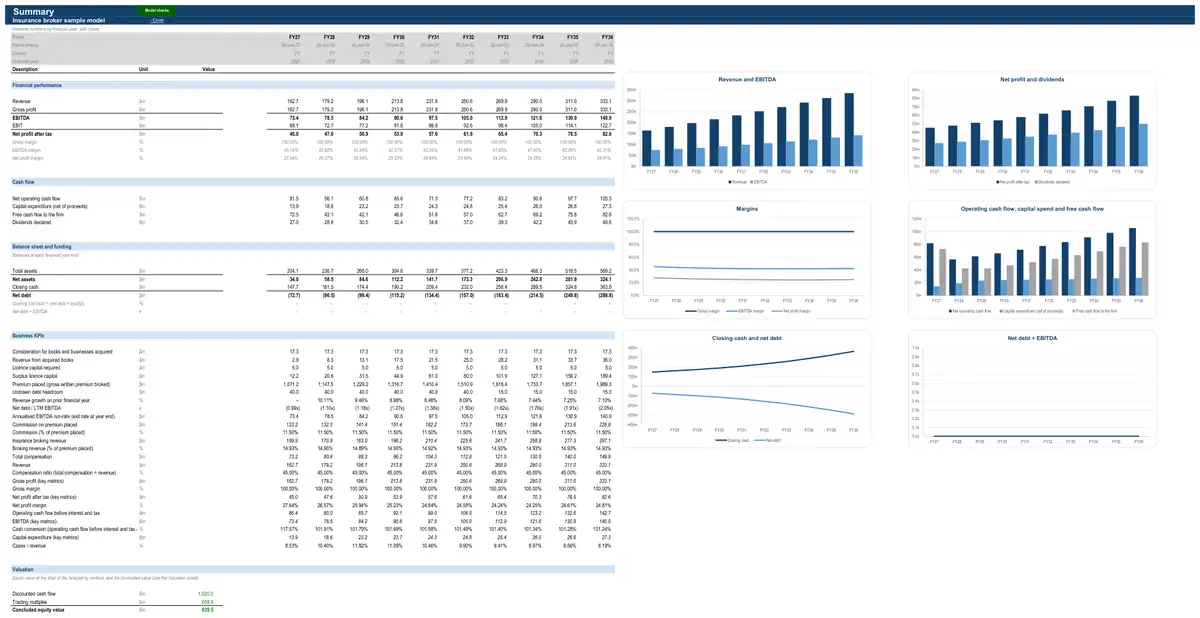
Illustrative figures: the sample describes no real business. The live preview shows values; your model’s Excel file has every formula.
How the model works for an insurance broker.
- How it earns revenue3 formulasAcquired client books, practices and brokerages · The businessClosing deferred considerationClosing instalments due at the later testClosing instalments due at the next testAcquired client books, practices and brokerages · The businessPayments for books boughtPaid at completionInstalments paid (first period of the financial year)Acquired client books, practices and brokerages · The businessRevenue from acquired booksOpening recurring revenue of books bought (a year)Closing recurring revenue of books bought (a year)share of the year
- What drives its costs3 formulasOperating expenses · The businessOperating expensesStaff costs (annual)Marketing (annual)Occupancy (annual)Administration (annual)share of the yearCompensation ratio, bonus pools and deferred awards · The businessFixed compensation (salaries and on-costs)Total compensationFixed pay share of total compensationCompensation ratio, bonus pools and deferred awards · The businessVariable compensation (bonuses)Total compensationFixed compensation (salaries and on-costs)
- What it invests in3 formulasCorporate fixed assetsCapital expenditureRevenuefrom statementsCapex as % of revenueAdditional planned capexCorporate fixed assetsDepreciationDepreciation of the opening asset baseDepreciation of new capexCorporate fixed assetsClosing net book valueOpening net book valueCapital expenditureDepreciation
- How it is funded3 formulasDebtClosing balanceOpening balanceDrawdowns allocatedRepaid at maturityPlanned repayments and prepayments allocatedDebtOpening drawn balance (all facilities)Facility 1 (revolver) — Opening drawn balancefrom revolver) — Opening drawn balanceFacility 2 (term loan) — Opening drawn balancefrom term loan) — Opening drawn balanceFacility 3 (notes) — Opening drawn balancefrom notes) — Opening drawn balanceEquity raisingEquity raisedDistributions reinvested under the DRPOther equity raised (net of costs)from net of costsEquity from an offer, milestone funding, conversions and creditor shares
- How profit becomes cash3 formulasWorking capitalTrade receivablesRevenuefrom statementsDebtor daysDays in periodWorking capitalInventoryDirect costs (positive)from statementsInventory daysDays in periodWorking capitalTrade payablesCash operating costs (positive)from statementsCreditor daysDays in period
20 parts, each one tested.
Every part is a tested building block with its own checks: yours is put together from the ones your business needs.
- CPI forecastConsensus curve with long-run anchor
- Operating expensesOperating expense line items
- Corporate costsFixed cost base indexed to CPI
- Working capitalDays-based working capital
- Income taxCorporate rate with tax losses
- Corporate fixed assetsStraight-line over remaining life
- DebtFacility register with limits and refinancing
- Equity raisingDistribution reinvestment plan
- Dividends and distributionsPayout of net profit
- Discounted cash flow valuationDCF on free cash flow to the firm
- Multiples valuationEV / EBITDA multiple
- Acquired client books, practices and brokeragesInstalments with retention clawbackRoll-up acquisitions of advice client books, insurance brokerages, mortgage broking businesses and investment mandates — consideration, retained revenue, customer intangibles and their amortisation, and deferred payments.
- Licence capital and liquidity requirements (non-banks)NTA and liquidity requirementMinimum capital, net tangible assets and liquid funds required of licensed non-bank firms, and the surplus available for dividends.
- Insurance broking commissionPremium placed × commission rateCommission and fees earned for placing insurance, plus interest on premium trust funds.
- LeasesLease register
- Compensation ratio, bonus pools and deferred awardsCompensation ratioFixed pay, variable bonus pools, adviser or producer payouts and deferred awards for revenue-generating financial businesses, where compensation is the largest cost and flexes with revenue.
- Key-metric summaryLast-twelve-month and run-rate metrics
- Covenant tests and headroomFacility-agreement definitions and step-downs
- Case selectionLive case drop-down
- Interest-rate forecastMarket forward curve
The numbers it tracks.
- 01GWP placed
- 02commission rate
- 03organic growth
- 04acquired revenue
- 05EBITA margin
- 06EPS
What it is used for.
- Operating forecastGuide · Financial projections
- Budget and rolling forecastGuide · Cash flow forecast
- ValuationGuide · DCF valuation model
- Merger or acquisition (strategic)Guide · Financial modelling services
- Leveraged buyout (private equity)Guide · Financial modelling services
- Lending and credit analysisGuide · Three-statement model
More in insurance.
- General insurer financial model
- Life insurer financial model
- Health insurer financial model
- Reinsurer financial model
- Annuity provider financial model
- Underwriting agency (MGA) financial model
Looking for an insurance broker financial model template? Ours arrives built for your business, with your figures in it.
See a finished model, sheet by sheetThe sample is built on illustrative figures and describes no real business. Models are calculations prepared from the information you provide. They are not financial advice and must be independently verified. See our terms.