Land-lease community financial model, built free.
A three-statement Excel model for a land-lease and manufactured housing community owner, built from your own figures and checked to balance.
- Free account
- No card
- Usually ready within the hour
We use generative AI in parts of our process, so mistakes can occur. Every model should be checked by a person before it is relied on. Read more
Owns land-lease, manufactured-housing or lifestyle communities where residents own their homes and pay a weekly site rent, and earns development profit from building and selling new homes in the community plus, in some contracts, a deferred management fee when homes are resold.
In short
- 01
Three linked statements
Income statement, balance sheet and cash flow, linked in every period.
- 02
Valued two ways
Discounted cash flow and net asset value, side by side.
- 03
Monthly to annual
Monthly, quarterly, half-yearly or annual periods, for up to 30 years.
- 04
Checked every period
A Checks sheet shows the balance sheet balances and the cash reconciles.
The sample, as Excel draws it.
Built by the same system and checks as yours, on illustrative figures: every sheet as Excel draws it, or live.
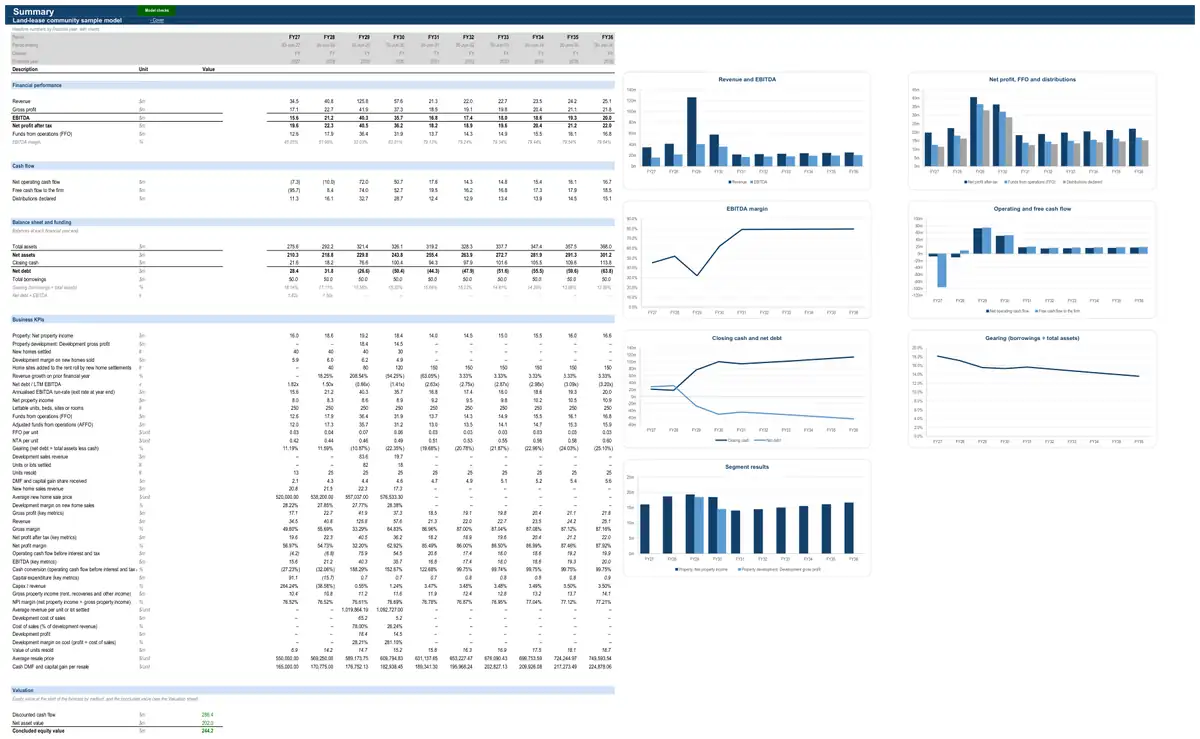
Illustrative figures: the sample describes no real business. The live preview shows values; your model’s Excel file has every formula.
How the model works for a land-lease community.
- How it earns revenue3 formulasNew home sales on land-lease sites · All propertiesNew home sales revenueNew homes settledAverage sale price per homeNew home sales on land-lease sites · All propertiesNew homes under construction and unsold (at cost)Homes inventory at start of periodBuild spendCost of new homes sold (average cost)New home sales on land-lease sites · All propertiesSites added to the rent roll (settled in earlier periods)Sites added to the rent roll (settled in earlier periods), last periodfrom settled in earlier periods), last periodNew homes settled, last period
- What drives its costs3 formulasProperty operating costs · All propertiesProperty operating costsOn-site staff and building managementRepairs and maintenanceUtilities and cleaningMarketing and leasingRates, land tax and insuranceCost of sales and development inventory · All property developmentsClosing inventoryInventory available to releaseCost of sales (all remaining inventory once the last unit settles)Cost of sales and development inventory · All property developmentsOpening development inventoryDevelopment work in progress at the start date (excluding land held)Book value of land at the start date
- What it invests in1 formulaValuation · All propertiesClosing valueOpening valueMaintenance capex (capital expenditure)from capital expenditureFair value movement
- How it is funded3 formulasDebtClosing balanceOpening balanceDrawdownsRepaymentsDebtInterest expenseOpening balanceAll-in interest rateshare of the yearEquity raisingEquity raisedDistributions reinvested under the DRPOther equity raised (net of costs)Equity from an offer, milestone funding, conversions and creditor shares
- How profit becomes cash3 formulasWorking capitalTrade receivablesRevenuefrom statementsDebtor daysDays in periodWorking capitalInventoryDirect costs (positive)from statementsInventory daysDays in periodWorking capitalTrade payablesCash operating costs (positive)from statementsCreditor daysDays in period
34 parts, each one tested.
Every part is a tested building block with its own checks: yours is put together from the ones your business needs.
- CPI forecastCPI glide path
- Corporate costsFixed cost base indexed to CPI
- Working capitalDays-based working capital
- Income taxFlow-through entity (no entity tax)
- DebtSingle debt facility
- Equity raisingDistribution reinvestment plan
- Dividends and distributionsPayout of FFO
- Discounted cash flow valuationDCF on free cash flow to the firm
- Net asset valueBook net asset value
- Interest-rate hedgingHedged share at a fixed rate
- Key-metric summaryLast-twelve-month and run-rate metrics
- Covenant tests and headroomLVR, gearing and ICR for property
- Discount rate (WACC)CAPM at target gearing
- Tenant receivables, bad debts and depositsSecurity deposits and bonds heldRent arrears and bad debts, rent received in advance, and security deposits or bonds held for tenants — the property-specific working-capital balances.
- REIT metrics (FFO, AFFO, NTA, gearing)FFO and AFFO (Property Council of Australia)The earnings, balance-sheet and portfolio metrics investors use for property owners — FFO and AFFO, NTA per unit, gearing and covenant headroom, WALE and occupancy, like-for-like growth and rent cover.
- Acquisitions, disposals and capital recyclingNamed acquisitions and disposalsProperties bought and sold during the forecast — named transactions, generic acquisitions at an assumed yield, and disposals that recycle capital — with transaction costs and gains or losses on sale.
- Trust and REIT tax statusTaxable subsidiary or stapled companyThe tax rules that come with trust or REIT status — distribution requirements, taxable subsidiaries, tax-deferred distributions and withholding on property income paid to investors.
- Interest-rate forecastFlat base rate
- New home sales on land-lease sitesSettlements per year × price and build costNew homes built and sold to residents on a land-lease community's vacant or newly developed sites. The sale is revenue and the build cost a cost of sales (the development margin), and each settled home adds a site paying the community's weekly site rent, so development grows the rent roll.
- Property registerUnit-based register (apartments, beds, rooms, storage units)The facts every other part of the model builds on — size, units, ownership share and opening value.
- Rental incomeUnits × weekly rent × occupancyBase rent earned from tenants and the occupancy that drives it.
- Property operating costsOperating costs per unit or bedOutgoings and other costs of running the property (rates, land tax, insurance, cleaning, security, repairs, management).
- Net property incomeFull income waterfallProperty-level income less property operating costs.
- Capital expenditureMaintenance capex as % of valueMaintenance, refurbishment and development spend added to the property's value.
- ValuationCapitalisation-rate valuation (fair value)Opening and closing property value and the fair value movement between them.
- Other property incomeCar park bays × rate × utilisationCar park, turnover rent, amenity fees, storage ancillaries and other income earned at the property.
- Resident turnover and resalesUnits × turnover rate × current entry priceHow many units turn over each year as residents leave, how long they take to resell, and the price achieved on each resale.
- Deferred management fee and capital gain shareDMF and capital gain share realised on exitThe operator's share of each exit — the deferred management fee accrued over the resident's tenure and any share of the capital gain — and when it is recognised.
- Project register and timelineSingle-stage projectUnits or lots, saleable area and the construction and completion timing every other part of the model uses.
- Land acquisition and holding costsLand already held at book valueThe land purchase, its payment terms, stamp duty and the holding costs (land tax, rates) until development.
- Development and construction costsTotal cost spread evenlyConstruction, professional fees, statutory contributions, marketing and contingency, and when they are spent.
- Sales, settlements and purchaser depositsPresales settling on completionUnits or lots sold (exchanged) and settled, the revenue recognised on settlement, and deposits received from buyers.
- Cost of sales and development inventoryForecast gross marginCapitalised land, construction and interest costs held as inventory and released to cost of sales as units settle.
- Feasibility and project returnsResidual land valueThe project's profit, margin and return metrics used to approve and track the development.
The numbers it tracks.
- 01sites
- 02weekly site rent
- 03home settlements
- 04development margin per home
- 05rental EBIT
- 06operating earnings per security
- 07NTA
What it is used for.
- Operating forecastGuide · Financial projections
- Budget and rolling forecastGuide · Cash flow forecast
- ValuationGuide · DCF valuation model
- Lending and credit analysisGuide · Three-statement model
- Equity capital raisingGuide · Startup financial model
- Development feasibilityGuide · Financial modelling services
- Merger or acquisition (strategic)Guide · Financial modelling services
- Scenarios and sensitivities
- Asset acquisition
More in residential, living and flexible space.
- Build-to-rent financial model
- Rental property portfolio financial model
- Student accommodation financial model
- Retirement village financial model
- Co-working space financial model
Looking for a land-lease community financial model template? Ours arrives built for your business, with your figures in it.
See a finished model, sheet by sheetThe sample is built on illustrative figures and describes no real business. Models are calculations prepared from the information you provide. They are not financial advice and must be independently verified. See our terms.