Bitcoin mining company financial model, built free.
A three-statement Excel model for a digital asset miner and HPC host, built from your own figures and checked to balance.
- Free account
- No card
- Usually ready within the hour
We use generative AI in parts of our process, so mistakes can occur. Every model should be checked by a person before it is relied on. Read more
Runs fleets of bitcoin mining machines (or GPUs) in its own powered sites, earning block rewards that depend on its share of network hashrate and the coin price, and increasingly leases capacity to AI and HPC tenants.
In short
- 01
Three linked statements
Income statement, balance sheet and cash flow, linked in every period.
- 02
Valued three ways
Discounted cash flow, trading multiples and net asset value, side by side.
- 03
Monthly to annual
Monthly, quarterly, half-yearly or annual periods, for up to 30 years.
- 04
Checked every period
A Checks sheet shows the balance sheet balances and the cash reconciles.
The sample, as Excel draws it.
Built by the same system and checks as yours: its structure and its inputs, ready for your own figures.
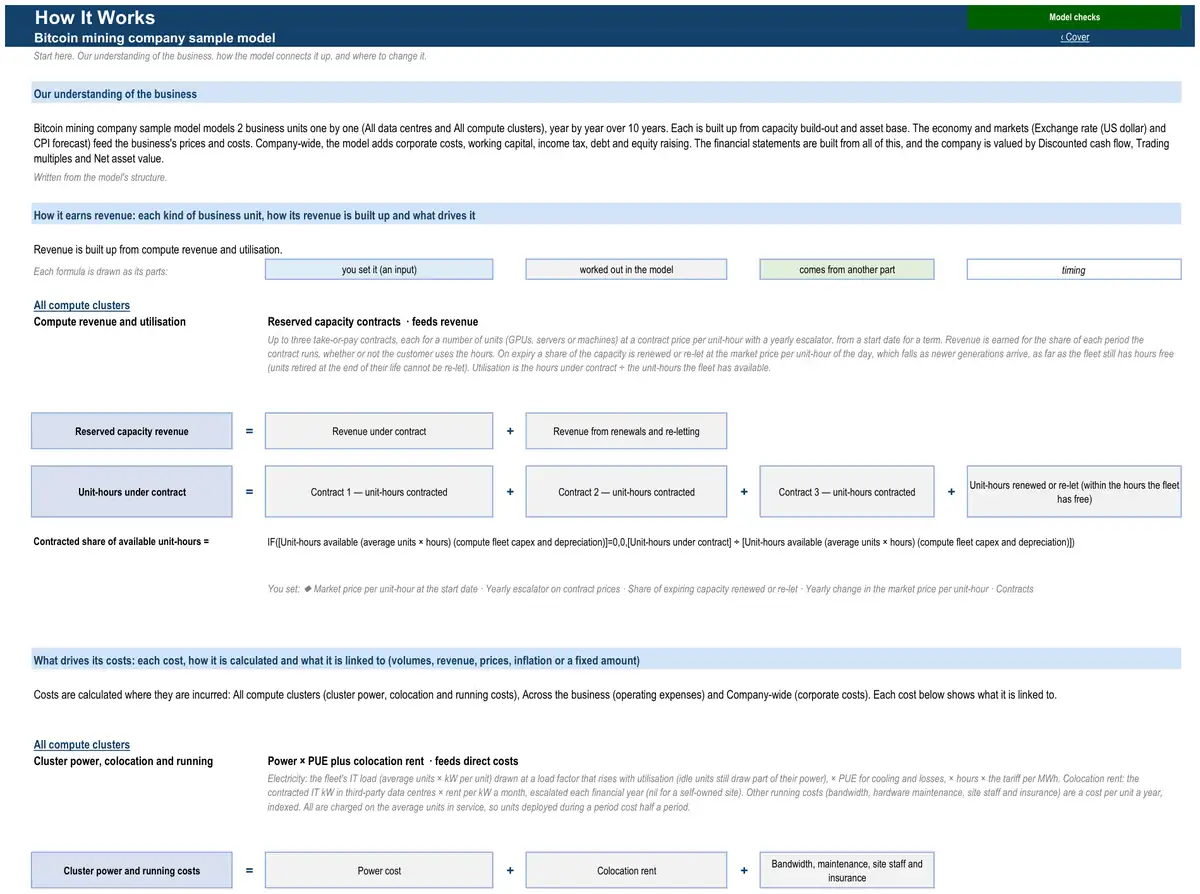
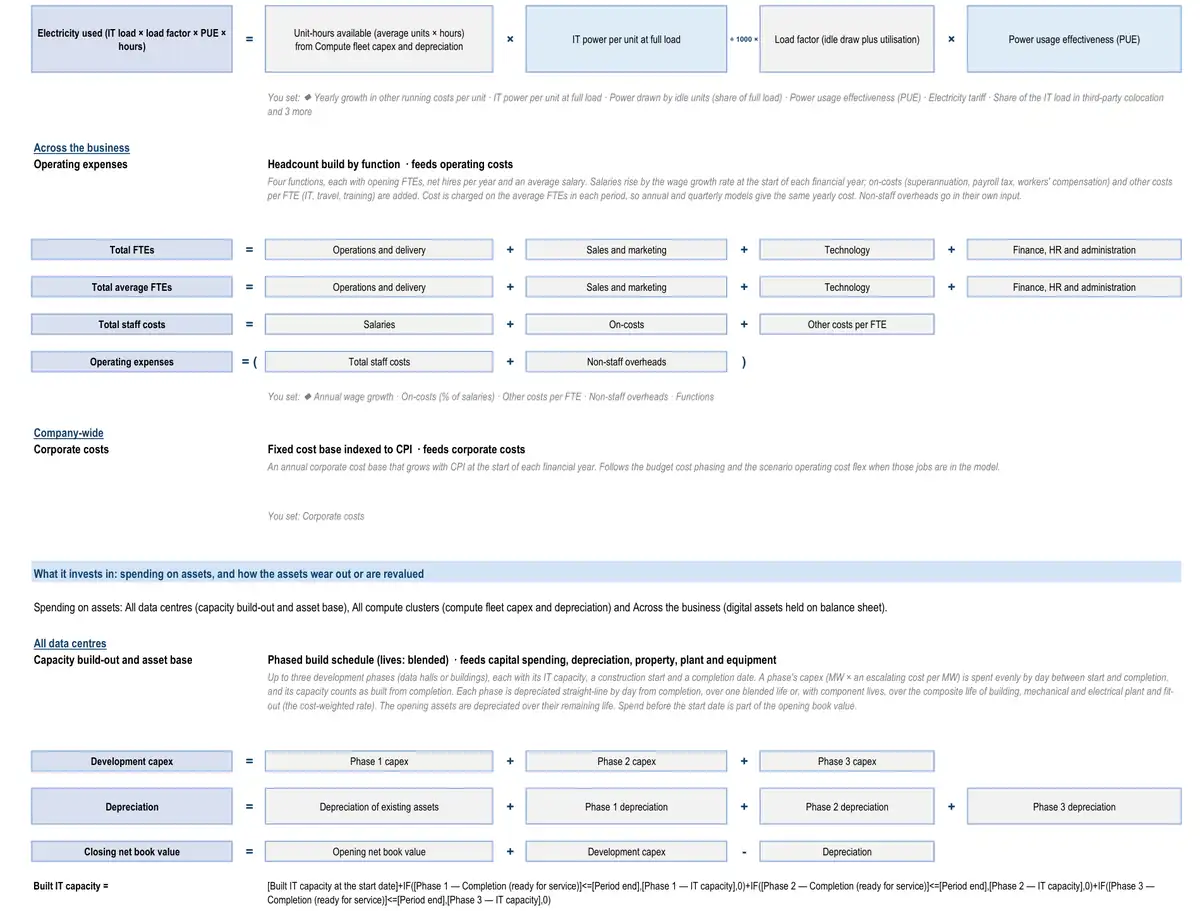
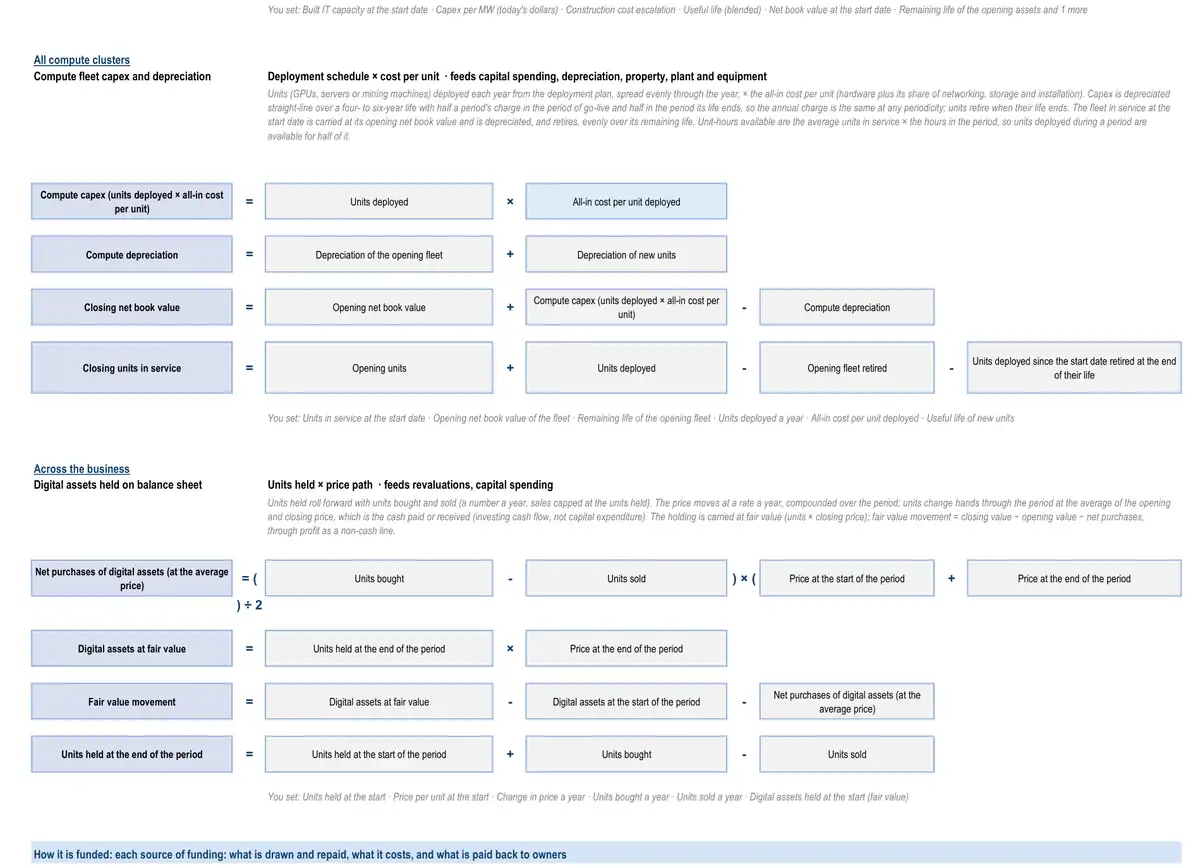
The sample describes no real business. Yours is calibrated to your own figures, so its results are your business’s.
How the model works for a bitcoin mining company.
- How it earns revenue2 formulasCompute revenue and utilisation · All compute clustersReserved capacity revenueRevenue under contractRevenue from renewals and re-lettingCompute revenue and utilisation · All compute clustersUnit-hours under contractContract 1 — unit-hours contractedContract 2 — unit-hours contractedContract 3 — unit-hours contractedUnit-hours renewed or re-let (within the hours the fleet has free)
- What drives its costs3 formulasCluster power, colocation and running costs · All compute clustersCluster power and running costsPower costColocation rentBandwidth, maintenance, site staff and insuranceCluster power, colocation and running costs · All compute clustersElectricity used (IT load × load factor × PUE × hours)Unit-hours available (average units × hours)from compute fleet capex and depreciationIT power per unit at full loadLoad factor (idle draw plus utilisation)Power usage effectiveness (PUE)Operating expenses · Across the businessTotal FTEsOperations and deliverySales and marketingTechnologyFinance, HR and administration
- What it invests in3 formulasCapacity build-out and asset base · All data centresDevelopment capexPhase 1 capexPhase 2 capexPhase 3 capexCapacity build-out and asset base · All data centresDepreciationDepreciation of existing assetsPhase 1 depreciationPhase 2 depreciationPhase 3 depreciationCapacity build-out and asset base · All data centresClosing net book valueOpening net book valueDevelopment capexDepreciation
- How it is funded3 formulasDebtRepaymentsScheduled repaymentsPrepayments from an equity raise and the cash sweepDebtClosing balanceOpening balanceDrawdownsRepaymentsDebtInterest expenseOpening balanceAll-in interest rateshare of the year
- How profit becomes cash3 formulasWorking capitalTrade receivablesRevenuefrom statementsDebtor daysDays in periodWorking capitalInventoryDirect costs (positive)from statementsInventory daysDays in periodWorking capitalTrade payablesCash operating costs (positive)from statementsCreditor daysDays in period
18 parts, each one tested.
Every part is a tested building block with its own checks: yours is put together from the ones your business needs.
- Exchange rate (US dollar)Exchange rate by financial year
- Operating expensesHeadcount build by function
- Corporate costsFixed cost base indexed to CPI
- Working capitalFull working capital
- Income taxCorporate rate with tax losses
- DebtAmortising term loan
- Equity raisingDistribution reinvestment plan
- Discounted cash flow valuationDCF on free cash flow to the firm
- Multiples valuationEV / EBITDA multiple
- Net asset valueBook net asset value
- Digital assets held on balance sheetUnits held × price path
- Key-metric summaryLast-twelve-month and run-rate metrics
- Case selectionStackable stress toggles
- CPI forecastCPI glide path
- Capacity build-out and asset basePhased build scheduleIT capacity (MW) commissioned over time, construction capex, depreciation and net book value.
- Compute fleet capex and depreciationDeployment schedule × cost per unitServers, GPUs, networking or mining machines deployed in a cluster, their capex, depreciation and book value.
- Compute revenue and utilisationReserved capacity contractsRevenue from renting compute or hosting, or from mining, earned on a cluster's capacity.
- Cluster power, colocation and running costsPower × PUE plus colocation rentPower, colocation rent, bandwidth and site costs of running a compute cluster.
The numbers it tracks.
- 01hashrate (EH/s)
- 02share of network hashrate
- 03coins mined
- 04power cost per coin
- 05hashprice
- 06MW energised
- 07HPC contracted revenue
What it is used for.
- Operating forecastGuide · Financial projections
- ValuationGuide · DCF valuation model
- Equity capital raisingGuide · Startup financial model
- Project financeGuide · Financial modelling services
- Scenarios and sensitivities
More in IT services and infrastructure.
- IT services company financial model
- Managed service provider (MSP) financial model
- IT consulting firm financial model
- Cloud hosting provider financial model
- Data centre operator financial model
- Technology distributor financial model
Looking for a bitcoin mining company financial model template? Ours arrives built for your business, with your figures in it.
See a finished model, sheet by sheetThe sample is built on illustrative figures and describes no real business. Models are calculations prepared from the information you provide. They are not financial advice and must be independently verified. See our terms.