Enterprise software company financial model, built free.
A three-statement Excel model for an enterprise software vendor (licence and maintenance), built from your own figures and checked to balance.
- Free account
- No card
- Usually ready within the hour
We use generative AI in parts of our process, so mistakes can occur. Every model should be checked by a person before it is relied on. Read more
Sells perpetual or term licences with annual maintenance and support, plus implementation services, and is often part-way through moving customers to subscription or cloud delivery.
In short
- 01
Three linked statements
Income statement, balance sheet and cash flow, linked in every period.
- 02
Valued two ways
Discounted cash flow and trading multiples, side by side.
- 03
Monthly to annual
Monthly, quarterly, half-yearly or annual periods, for up to 30 years.
- 04
Checked every period
A Checks sheet shows the balance sheet balances and the cash reconciles.
The sample, as Excel draws it.
Built by the same system and checks as yours, on illustrative figures: every sheet as Excel draws it, or live.
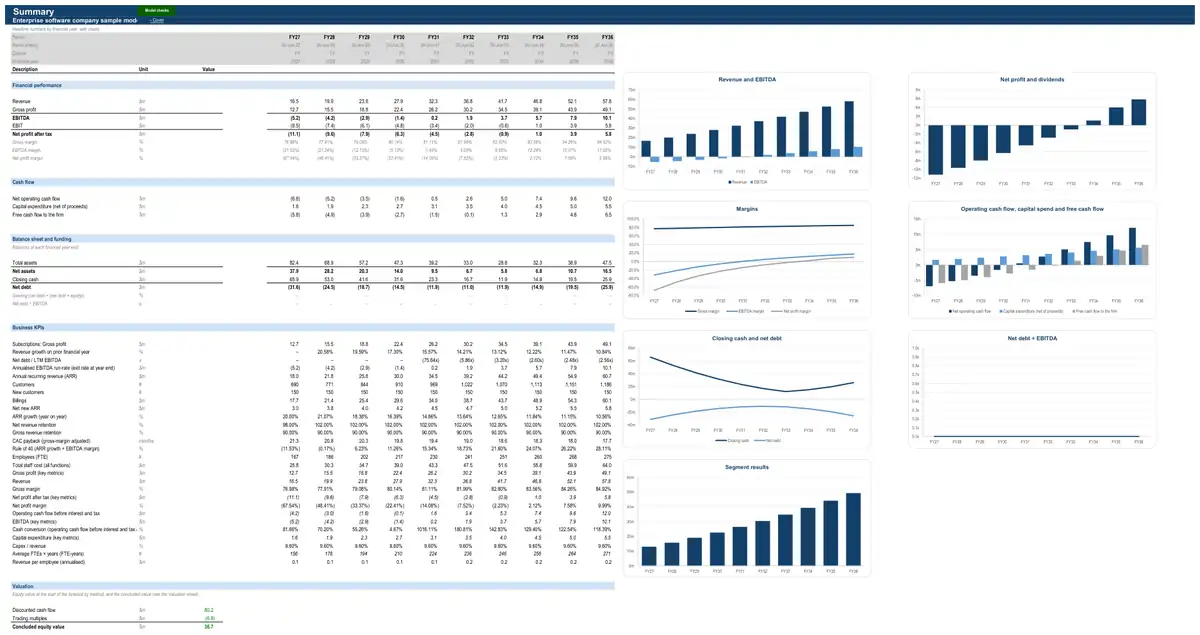
Illustrative figures: the sample describes no real business. The live preview shows values; your model’s Excel file has every formula.
How the model works for an enterprise software company.
- How it earns revenue3 formulasRecurring revenue and ARR · All product plansSubscription revenueOpening ARRClosing ARRshare of the yearRecurring revenue and ARR · All product plansNew customer ARRNew customersfrom new customers and sales and marketingARR per new customerRecurring revenue and ARR · All product plansNet expansion ARRPrice increase on the installed baseUpsell and cross-sell (net of contraction)
- What drives its costs3 formulasCost of revenue · All product plansCost of revenueHosting and infrastructureCustomer support and successFixed platform and support overheadNew customers and sales and marketing · All product plansSales and marketingCustomer acquisition spend (new logos)Account management and renewalsNew customers and sales and marketing · All product plansCustomer acquisition spend (new logos)New customersCustomer acquisition cost (CAC)
- What it invests in3 formulasCorporate fixed assetsCapital expenditureRevenuefrom statementsCapex as % of revenueAdditional planned capexCorporate fixed assetsDepreciationDepreciation of the opening asset baseDepreciation of new capexCorporate fixed assetsClosing net book valueOpening net book valueCapital expenditureDepreciation
- How it is funded3 formulasDebtRepaymentsScheduled repaymentsPrepayments from an equity raise and the cash sweepDebtClosing balanceOpening balanceDrawdownsRepaymentsDebtInterest expenseOpening balanceAll-in interest rateshare of the year
- How profit becomes cash3 formulasBillings and deferred revenue · All product plansClosing deferred revenueClosing ARRfrom recurring revenue and ARRShare of ARR billed in advanceBilling term invoiced in advanceBillings and deferred revenue · All product plansBillingsSubscription revenue (recurring revenue and arr)from recurring revenue and arrClosing deferred revenueOpening deferred revenueWorking capitalTrade receivablesRevenuefrom statementsDebtor daysDays in period
21 parts, each one tested.
Every part is a tested building block with its own checks: yours is put together from the ones your business needs.
- CPI forecastConsensus curve with long-run anchor
- Exchange rate (US dollar)Exchange rate by financial year
- Operating expensesHeadcount build by function
- Working capitalFull working capital
- Income taxCorporate rate with tax losses
- Corporate fixed assetsStraight-line over remaining life
- DebtAmortising term loan
- Equity raisingDistribution reinvestment plan
- Discounted cash flow valuationDCF on free cash flow to the firm
- Multiples valuationEV / EBITDA multiple
- Key-metric summaryLast-twelve-month and run-rate metrics
- Covenant tests and headroomLVR, gearing and ICR for property
- Case selectionStackable stress toggles
- R&D and capitalised developmentGross R&D × capitalisation rateResearch and development expense after capitalisation, with the capitalised software asset and its amortisation.
- SaaS metricsStandard SaaS metricsThe ARR bridge across all plans and the headline SaaS KPIs — net new ARR, ARR growth, NRR, GRR, CAC payback and the Rule of 40.
- Headcount plan by functionHiring plan by functionEmployees and staff cost by function (cost of revenue, sales and marketing, R&D, G&A).
- New customers and sales and marketingNew customers per period × CACNew paying customers (logos, subscribers, gross adds) won each period for a plan, and the sales and marketing spent winning them (acquisition cost) and keeping them (account management). Carrying the spend per plan keeps new customers and the spend that wins them consistent; its roll-up lands in operating expenses.
- Customer base and churnConstant churn rateCustomer roll-forward for a plan — opening customers + new customers − churned customers = closing customers.
- Recurring revenue and ARRARR bridge on ARPA with price increases and net expansionThe ARR bridge for a plan (opening ARR + new-customer ARR + net expansion − churned ARR = closing ARR) and the subscription revenue recognised from it. Pricing (ARPA, seats, tiers, price increases) and net expansion (upsell, cross-sell, contraction) are part of each method.
- Billings and deferred revenueBilled in advance (billing mix) with deferred revenueInvoicing of subscriptions and usage and the deferred revenue that results from billing in advance.
- Cost of revenueCost per customer plus fixed platform costDirect cost of serving a plan's customers — hosting, customer support and success, app-store fees, royalties and (for telcos) wholesale access — so that gross margin can differ by plan. Use this in any model with product plans.
The numbers it tracks.
- 01licence revenue
- 02maintenance base and renewal rate
- 03cloud ARR
- 04subscription mix of bookings
- 05recurring revenue share
- 06EBITDA margin
- 07free cash flow
What it is used for.
- Operating forecastGuide · Financial projections
- ValuationGuide · DCF valuation model
- Leveraged buyout (private equity)Guide · Financial modelling services
- Merger or acquisition (strategic)Guide · Financial modelling services
- Lending and credit analysisGuide · Three-statement model
- Scenarios and sensitivities
More in software and SaaS.
- B2B SaaS financial model
- Vertical SaaS financial model
- Usage-based software and API company financial model
- Subscription app financial model
- Product-led software company financial model
- Cybersecurity vendor financial model
- Data and analytics company financial model
- AI company financial model
- Game studio financial model
Looking for an enterprise software company financial model template? Ours arrives built for your business, with your figures in it.
See a finished model, sheet by sheetThe sample is built on illustrative figures and describes no real business. Models are calculations prepared from the information you provide. They are not financial advice and must be independently verified. See our terms.