Stadium and arena financial model, built free.
A three-statement Excel model for a stadium and arena owner-operator, built from your own figures and checked to balance.
- Free account
- No card
- Usually ready within the hour
We use generative AI in parts of our process, so mistakes can occur. Every model should be checked by a person before it is relied on. Read more
Owns or operates a stadium, arena or convention venue, earning hire fees and ticketing charges from anchor clubs and events, catering, premium seating and suites, naming rights and parking, and funding lifecycle works.
In short
- 01
Three linked statements
Income statement, balance sheet and cash flow, linked in every period.
- 02
Valued two ways
Discounted cash flow and trading multiples, side by side.
- 03
Monthly to annual
Monthly, quarterly, half-yearly or annual periods, for up to 30 years.
- 04
Checked every period
A Checks sheet shows the balance sheet balances and the cash reconciles.
The sample, as Excel draws it.
Built by the same system and checks as yours, on illustrative figures: every sheet as Excel draws it, or live.
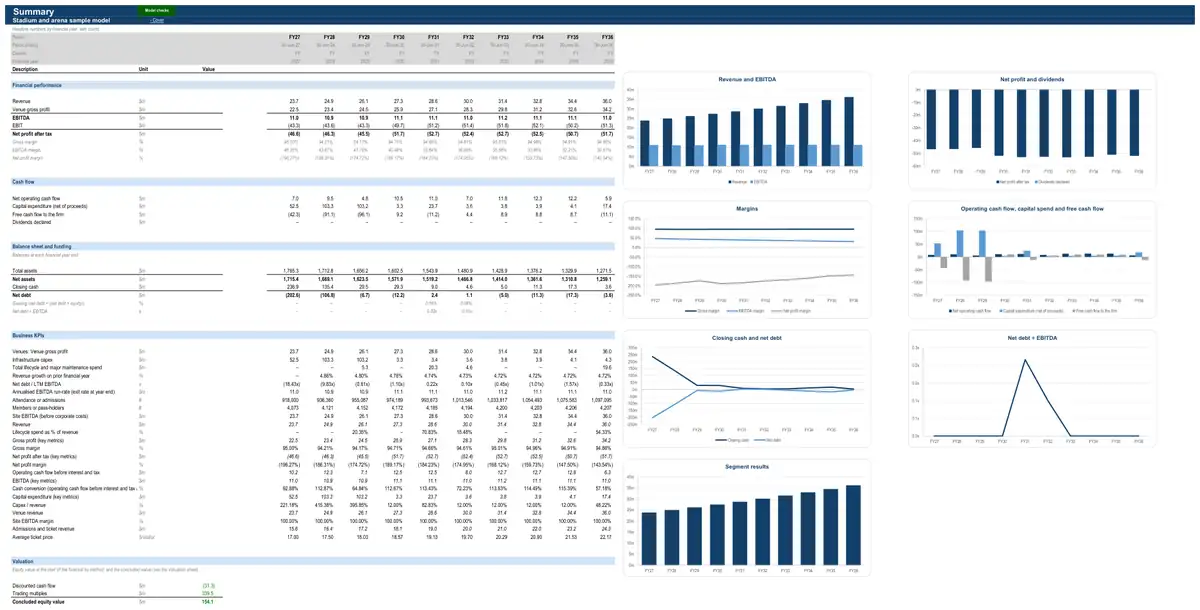
Illustrative figures: the sample describes no real business. The live preview shows values; your model’s Excel file has every formula.
How the model works for a stadium and arena.
- How it earns revenue3 formulasFood, beverage and secondary spend revenue · All venuesTotal coversDaytime coversEvening coversFood, beverage and secondary spend revenue · All venuesFood, beverage and secondary spend revenueDaytime salesEvening salesAdmissions and attendance · All venuesAdmissions and ticket revenueAttendanceAverage ticket price
- What drives its costs3 formulasLifecycle, major maintenance and handback · Across the businessMajor maintenance expense (works plus provision movement)Major maintenance works paidProvision requiredProvision at period startLifecycle, major maintenance and handback · Across the businessProvision at period endProvision at period startMajor maintenance expense (works plus provision movement)Major maintenance works paidLifecycle, major maintenance and handback · Across the businessAmortisation of capitalised lifecycle worksAmortisation of works capitalised before the start dateComponent 1 amortisationComponent 2 amortisationComponent 3 amortisationComponent 4 amortisationComponent 5 amortisation
- What it invests in3 formulasInfrastructure assets and capex programme · Across the businessInfrastructure capexSustaining capexGrowth capexInfrastructure assets and capex programme · Across the businessInfrastructure depreciationDepreciation of existing assetsDepreciation of sustaining additionsProject 1 depreciation (from commissioning)from from commissioningProject 2 depreciation (from commissioning)from from commissioningProject 3 depreciation (from commissioning)from from commissioningInfrastructure assets and capex programme · Across the businessClosing net book valueOpening net book valueInfrastructure capexInfrastructure depreciation
- How it is funded3 formulasDebtRepaymentsScheduled repaymentsPrepayments from an equity raise and the cash sweepDebtClosing balanceOpening balanceDrawdownsRepaymentsDebtInterest expenseOpening balanceAll-in interest rateshare of the year
- How profit becomes cash3 formulasWorking capitalTrade receivablesRevenuefrom statementsDebtor daysDays in periodWorking capitalInventoryDirect costs (positive)from statementsInventory daysDays in periodWorking capitalTrade payablesCash operating costs (positive)from statementsCreditor daysDays in period
20 parts, each one tested.
Every part is a tested building block with its own checks: yours is put together from the ones your business needs.
- CPI forecastConsensus curve with long-run anchor
- Operating expensesHeadcount build by function
- Corporate costsFixed cost base indexed to CPI
- Working capitalFull working capital
- Income taxCorporate rate with tax losses
- DebtAmortising term loan
- Dividends and distributionsPayout of net profit
- Discounted cash flow valuationDCF on free cash flow to the firm
- Multiples valuationEV / EBITDA multiple
- Infrastructure assets and capex programmeSustaining capex plus growth projectsOwned or long-lease infrastructure — runways, terminals, berths, track, rolling stock, stadiums — with its capex programme, depreciation by asset class and optional revaluation.
- LeasesLease register
- Lifecycle, major maintenance and handbackComponent replacement schedulePeriodic renewal of concession and PPP assets (resurfacing, mechanical and electrical replacement), reserves and provisions for it, and works needed to hand the asset back.
- Key-metric summaryLast-twelve-month and run-rate metrics
- Discount rate (WACC)CAPM at target gearing
- Terminal valuePerpetuity growth on normalised cash flow
- Venue registerOpening date, closing date and capacity
- Food, beverage and secondary spend revenueCovers × average spend per head
- Venue revenue and site EBITDA
- Admissions and attendanceAttendance × average ticket price
- Memberships and passesJoins, churn and yield
The numbers it tracks.
- 01event days
- 02attendance
- 03revenue per attendee
- 04contracted income share
- 05EBITDA
- 06lifecycle spend
What it is used for.
- Operating forecastGuide · Financial projections
- Budget and rolling forecastGuide · Cash flow forecast
- ValuationGuide · DCF valuation model
- Lending and credit analysisGuide · Three-statement model
- Project financeGuide · Financial modelling services
- Development feasibilityGuide · Financial modelling services
More in leasing and infrastructure assets.
- Infrastructure fund financial model
- PPP social infrastructure project financial model
- Water treatment PPP financial model
- Telecom tower company financial model
- Smart metering company financial model
- Aircraft leasing company financial model
- Container leasing company financial model
- Rolling stock leasing company financial model
Looking for a stadium and arena financial model template? Ours arrives built for your business, with your figures in it.
See a finished model, sheet by sheetThe sample is built on illustrative figures and describes no real business. Models are calculations prepared from the information you provide. They are not financial advice and must be independently verified. See our terms.