Film and TV production company financial model, built free.
A three-statement Excel model for a film and TV production studio, built from your own figures and checked to balance.
- Free account
- No card
- Usually ready within the hour
We use generative AI in parts of our process, so mistakes can occur. Every model should be checked by a person before it is relied on. Read more
Develops and produces feature films and television series on a slate, financing each title from pre-sales, minimum guarantees, government production incentives, gap and equity finance, and earning licence fees and distribution receipts across release windows and the library.
In short
- 01
Three linked statements
Income statement, balance sheet and cash flow, linked in every period.
- 02
Valued three ways
Discounted cash flow, trading multiples and net asset value, side by side.
- 03
Monthly to annual
Monthly, quarterly, half-yearly or annual periods, for up to 30 years.
- 04
Checked every period
A Checks sheet shows the balance sheet balances and the cash reconciles.
The sample, as Excel draws it.
Built by the same system and checks as yours: its structure and its inputs, ready for your own figures.
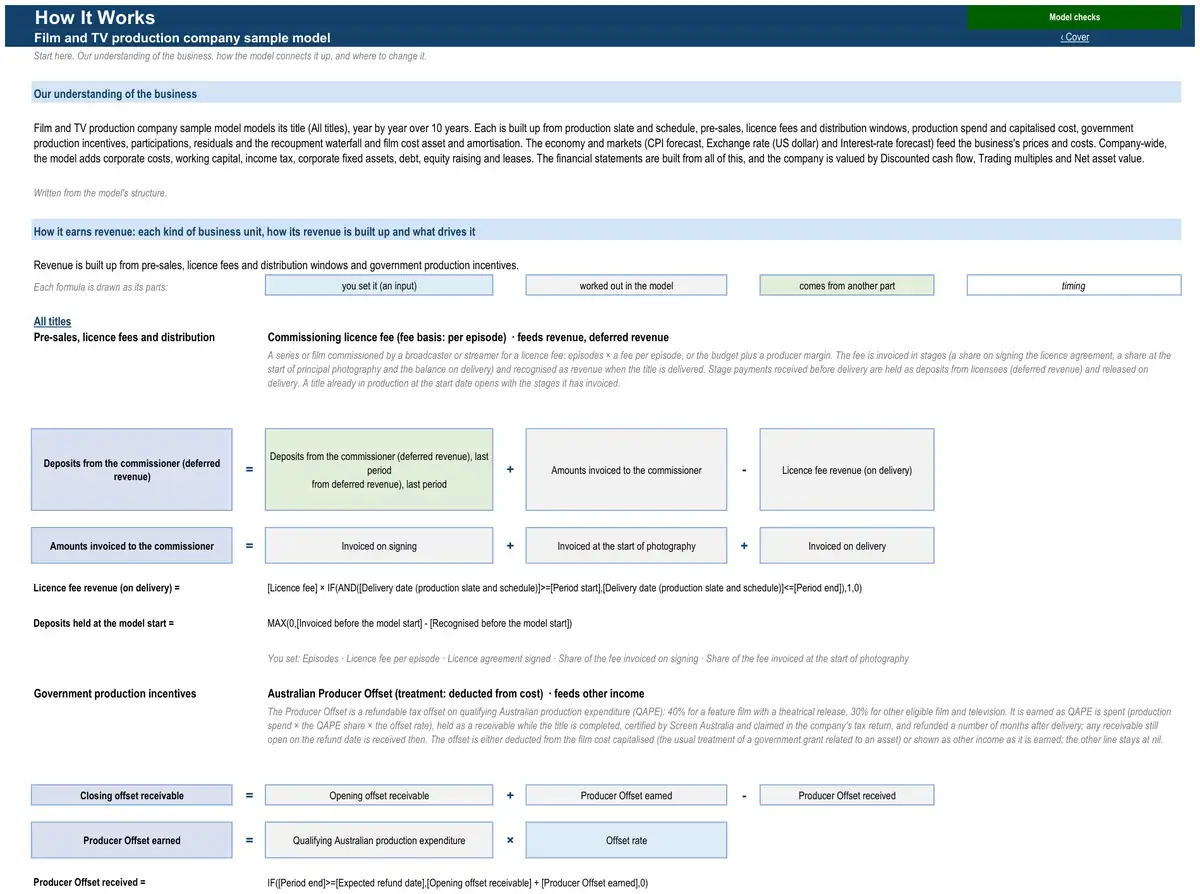
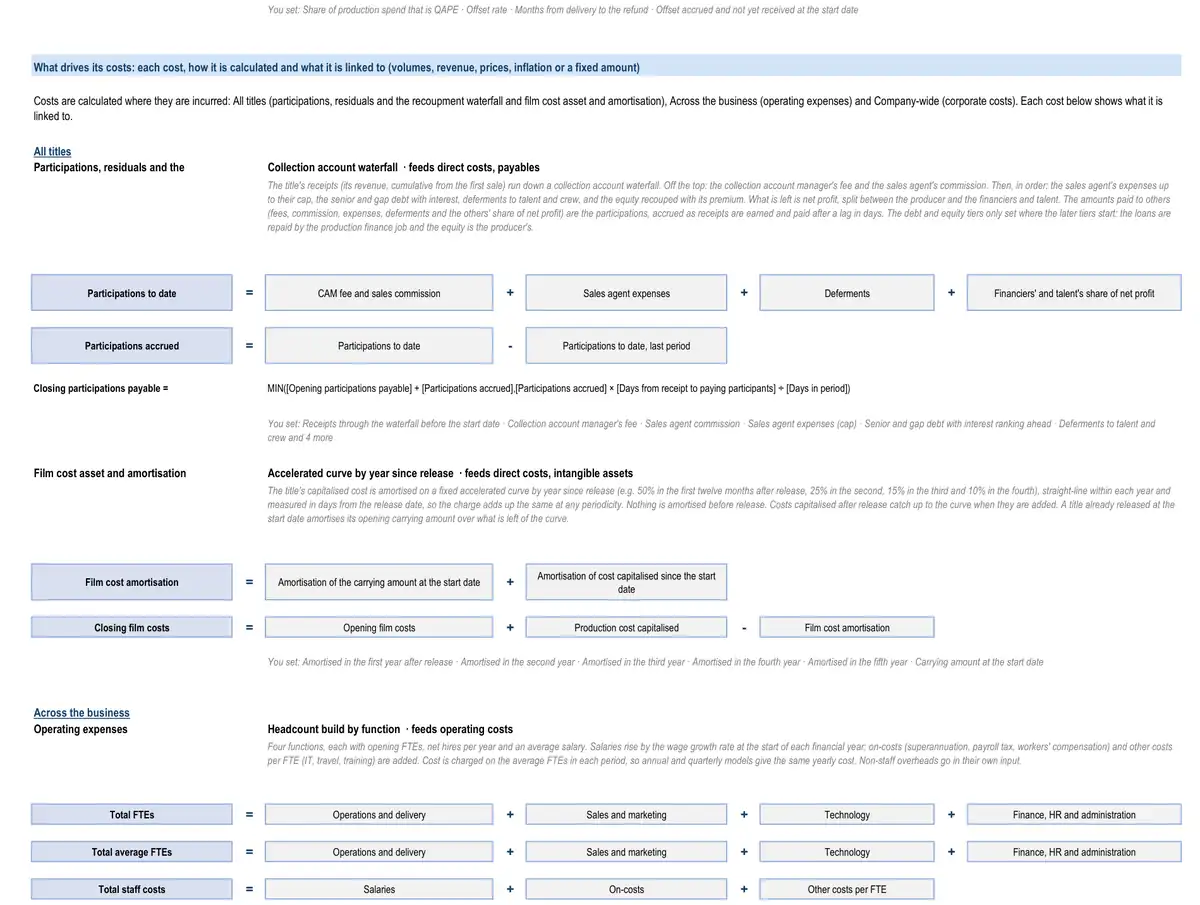
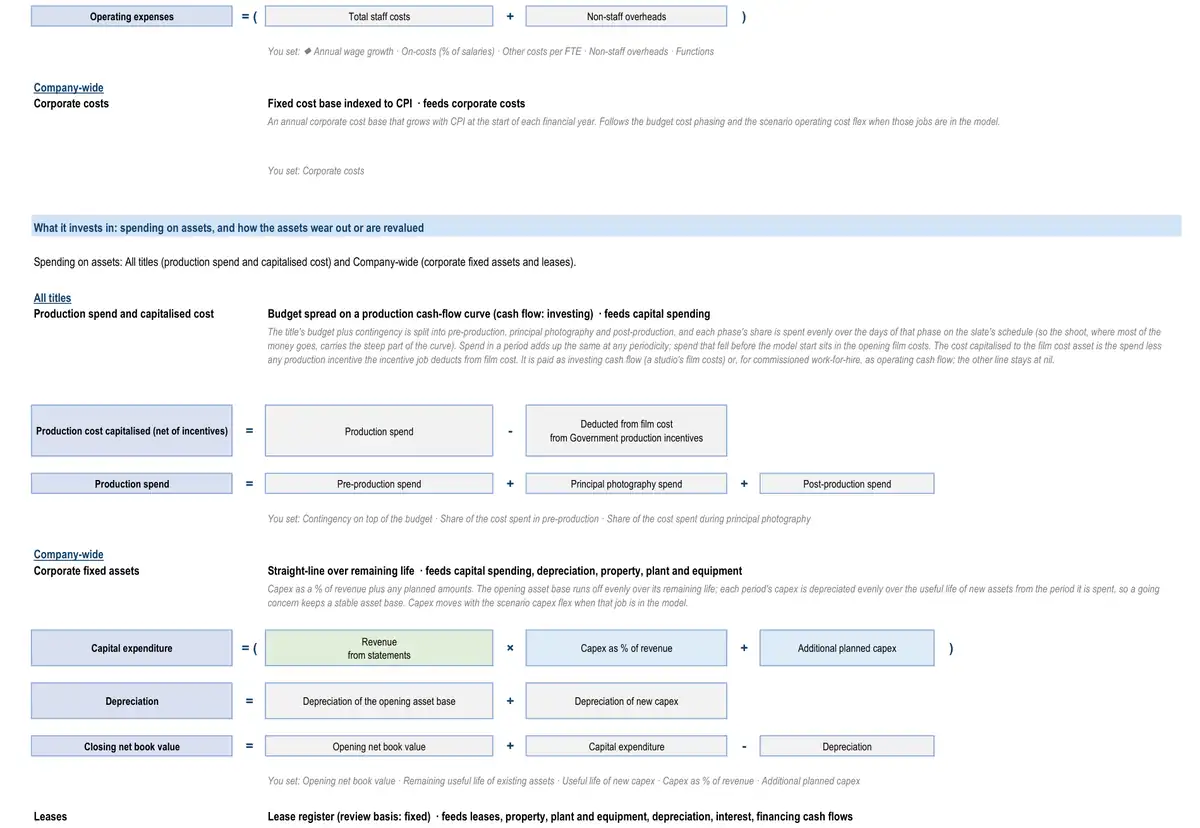
The sample describes no real business. Yours is calibrated to your own figures, so its results are your business’s.
How the model works for a film and TV production company.
- How it earns revenue3 formulasPre-sales, licence fees and distribution windows · All titlesDeposits from the commissioner (deferred revenue)Deposits from the commissioner (deferred revenue), last periodfrom deferred revenue), last periodAmounts invoiced to the commissionerLicence fee revenue (on delivery)Pre-sales, licence fees and distribution windows · All titlesAmounts invoiced to the commissionerInvoiced on signingInvoiced at the start of photographyInvoiced on deliveryGovernment production incentives · All titlesClosing offset receivableOpening offset receivableProducer Offset earnedProducer Offset received
- What drives its costs3 formulasParticipations, residuals and the recoupment waterfall · All titlesParticipations to dateCAM fee and sales commissionSales agent expensesDefermentsFinanciers' and talent's share of net profitParticipations, residuals and the recoupment waterfall · All titlesParticipations accruedParticipations to dateParticipations to date, last periodFilm cost asset and amortisation · All titlesFilm cost amortisationAmortisation of the carrying amount at the start dateAmortisation of cost capitalised since the start date
- What it invests in3 formulasProduction spend and capitalised cost · All titlesProduction cost capitalised (net of incentives)Production spendDeducted from film costfrom government production incentivesProduction spend and capitalised cost · All titlesProduction spendPre-production spendPrincipal photography spendPost-production spendCorporate fixed assetsCapital expenditureRevenuefrom statementsCapex as % of revenueAdditional planned capex
- How it is funded3 formulasProduction financing · All titlesDrawdowns (advances plus fee and interest rolled up)Advances against the incentive earnedEstablishment feeInterest rolled upProduction financing · All titlesClosing loanOpening loanDrawdowns (advances plus fee and interest rolled up)from advances plus fee and interest rolled upRepaid from the incentive refundProduction financing · All titlesInterest and feesInterest rolled upEstablishment fee
- How profit becomes cash3 formulasWorking capitalTrade receivablesRevenuefrom statementsDebtor daysDays in periodWorking capitalInventoryDirect costs (positive)from statementsInventory daysDays in periodWorking capitalTrade payablesCash operating costs (positive)from statementsCreditor daysDays in period
21 parts, each one tested.
Every part is a tested building block with its own checks: yours is put together from the ones your business needs.
- CPI forecastConsensus curve with long-run anchor
- Exchange rate (US dollar)Exchange rate by financial year
- Operating expensesHeadcount build by function
- Corporate costsFixed cost base indexed to CPI
- Working capitalFull working capital
- Income taxCorporate rate with tax losses
- Corporate fixed assetsStraight-line over remaining life
- DebtAmortising term loan
- Equity raisingDistribution reinvestment plan
- Discounted cash flow valuationDCF on free cash flow to the firm
- Multiples valuationEV / EBITDA multiple
- Net asset valueBook net asset value
- LeasesLease register
- Interest-rate forecastMarket forward curve
- Production slate and scheduleTitle with production and delivery datesThe budget of each title and when it is in development, in production, delivered and released.
- Production spend and capitalised costBudget spread on a production cash-flow curveCash spent making each title and the cost capitalised to the film cost asset (net of production incentives).
- Government production incentivesAustralian Producer OffsetProducer offsets, location and post-production rebates and tax credits earned on qualifying spend, the receivable while they are claimed, and the cash when refunded or sold.
- Production financingIncentive (offset) loanLoans that fund each title's production against pre-sales, incentives and sales estimates, their interest and repayment.
- Pre-sales, licence fees and distribution windowsCommissioning licence feeRevenue from licensing each title — commissions, pre-sales and minimum guarantees, and receipts across theatrical, transactional, subscription, free TV and library windows — and deposits received before delivery.
- Participations, residuals and the recoupment waterfallCollection account waterfallShares of each title's receipts owed to financiers, talent and guilds, accrued as receipts come in and paid on statement dates.
- Film cost asset and amortisationAccelerated curve by year since releaseThe capitalised cost of each title carried as an asset and expensed as its revenue is earned, with impairment when ultimates fall.
The numbers it tracks.
- 01titles delivered
- 02production spend
- 03incentive receivable
- 04ultimate revenue by title
- 05film cost asset
- 06gross margin by title
- 07library value
- 08peak production debt
What it is used for.
- Operating forecastGuide · Financial projections
- Budget and rolling forecastGuide · Cash flow forecast
- Project financeGuide · Financial modelling services
- Lending and credit analysisGuide · Three-statement model
- Equity capital raisingGuide · Startup financial model
- ValuationGuide · DCF valuation model
- Scenarios and sensitivities
More in film, music, publishing and broadcasting.
- Streaming service financial model
- Record label and music publisher financial model
- Music royalty investor financial model
- Book publisher financial model
- Radio broadcaster financial model
- Outdoor advertising company financial model
Looking for a film and TV production company financial model template? Ours arrives built for your business, with your figures in it.
See a finished model, sheet by sheetThe sample is built on illustrative figures and describes no real business. Models are calculations prepared from the information you provide. They are not financial advice and must be independently verified. See our terms.