Music royalty investor financial model, built free.
A three-statement Excel model for a music catalogue and royalty investor, built from your own figures and checked to balance.
- Free account
- No card
- Usually ready within the hour
We use generative AI in parts of our process, so mistakes can occur. Every model should be checked by a person before it is relied on. Read more
Buys recorded-music and publishing catalogues (or income-only royalty shares) at a multiple of their net label or publisher share, earns the royalties they collect net of administration, and funds the portfolio with equity and royalty-backed debt.
In short
- 01
Three linked statements
Income statement, balance sheet and cash flow, linked in every period.
- 02
Valued two ways
Discounted cash flow and net asset value, side by side.
- 03
Monthly to annual
Monthly, quarterly, half-yearly or annual periods, for up to 30 years.
- 04
Checked every period
A Checks sheet shows the balance sheet balances and the cash reconciles.
The sample, as Excel draws it.
Built by the same system and checks as yours, on illustrative figures: every sheet as Excel draws it, or live.
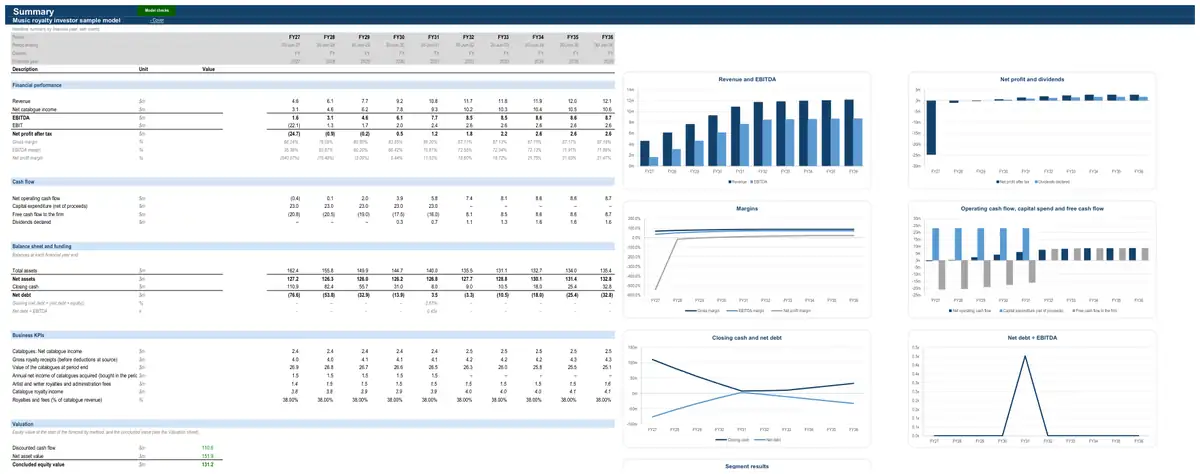
Illustrative figures: the sample describes no real business. The live preview shows values; your model’s Excel file has every formula.
How the model works for a music royalty investor.
- How it earns revenue3 formulasCatalogue royalty income · All cataloguesCatalogue revenueGross royalty receiptsLess deductions at sourceCatalogue acquisitions · Across the businessPayments for catalogue acquisitionsPurchase price (income × multiple)Deal costsCatalogue acquisitions · Across the businessNet income earned from catalogues acquiredAnnual net income at the end of the periodAnnual net income acquiredshare of the year
- What drives its costs2 formulasArtist and songwriter royalties · All cataloguesArtist royaltiesRoyalties on legacy dealsRoyalties on net-receipts dealsArtist share on distribution or licence dealsArtist and songwriter royalties · All cataloguesRoyalties payableArtist royaltiesDays in periodDays of royalties owed at period end
- What it invests in2 formulasCatalogue carrying value · All cataloguesFair value gain / (loss)Catalogue value at period endfrom catalogue valuationOpening carrying valueCatalogue carrying value · All cataloguesClosing carrying valueOpening carrying valueFair value gain / (loss)Amortisation (nil at fair value)
- How it is funded3 formulasDebtRepaymentsScheduled repaymentsPrepayments from an equity raise and the cash sweepDebtClosing balanceOpening balanceDrawdownsRepaymentsDebtInterest expenseOpening balanceAll-in interest rateshare of the year
- How profit becomes cash3 formulasRoyalty collection lag and accrued income · Across the businessAccrued royalty incomeDigital streaming and downloadsPerformance incomeMechanical and synchronisation incomeInternational income through sub-publishersWorking capitalTrade receivablesRevenuefrom statementsDebtor daysDays in periodWorking capitalInventoryDirect costs (positive)from statementsInventory daysDays in period
18 parts, each one tested.
Every part is a tested building block with its own checks: yours is put together from the ones your business needs.
- CPI forecastConsensus curve with long-run anchor
- Exchange rate (US dollar)Exchange rate by financial year
- Corporate costsFixed cost base indexed to CPI
- Working capitalFull working capital
- Income taxCorporate rate with tax losses
- DebtAmortising term loan
- Equity raisingDistribution reinvestment plan
- Dividends and distributionsPayout of net profit
- Discounted cash flow valuationDCF on free cash flow to the firm
- Net asset valueBook net asset value
- Catalogue acquisitionsNet share × purchase multipleCatalogues bought at a multiple of their income, the consideration paid, and the income added from completion.
- Royalty collection lag and accrued incomeMonths of income by typeRoyalty income earned but not yet received — income moves through services, distributors and collecting societies before reaching the owner.
- Interest-rate hedgingHedged share at a fixed rate
- Interest-rate forecastMarket forward curve
- Catalogue royalty incomeAge-based decay curveIncome a catalogue of recordings or compositions earns from streaming, physical, sync, performance, mechanical and neighbouring rights.
- Artist and songwriter royaltiesRoyalty rate by deal typeRoyalties owed to artists and writers on catalogue receipts, administration fees, and the royalties payable balance.
- Catalogue carrying valueFair value through profit or lossThe catalogue held at amortised cost or at fair value, with amortisation, revaluation and impairment.
- Catalogue valuationDCF of decaying incomeThe value of each catalogue from its forecast net income, used for NAV and lending.
The numbers it tracks.
- 01net publisher and label share
- 02catalogue decay
- 03royalty income
- 04capital deployed
- 05acquisition multiple
- 06portfolio fair value
- 07NAV per share
- 08loan to value
- 09dividend cover
What it is used for.
- Asset acquisition
- Closed-end fund, syndicate or trust
- Scenarios and sensitivities
More in film, music, publishing and broadcasting.
- Film and TV production company financial model
- Streaming service financial model
- Record label and music publisher financial model
- Book publisher financial model
- Radio broadcaster financial model
- Outdoor advertising company financial model
Looking for a music royalty investor financial model template? Ours arrives built for your business, with your figures in it.
See a finished model, sheet by sheetThe sample is built on illustrative figures and describes no real business. Models are calculations prepared from the information you provide. They are not financial advice and must be independently verified. See our terms.