Scrap metal recycler financial model, built free.
A three-statement Excel model for a scrap metal recycler, built from your own figures and checked to balance.
- Free account
- No card
- Usually ready within the hour
We use generative AI in parts of our process, so mistakes can occur. Every model should be checked by a person before it is relied on. Read more
Buys ferrous and non-ferrous scrap from industry, demolition and the public through a network of yards, shreds, sorts and processes it, and sells recycled metal to steel mills and smelters at home and for export, earning the spread between the scrap bought and the metal sold. Often also runs e-waste and IT-asset recycling services and holds joint-venture interests in other recyclers (for example Sims Limited, with its North American and Australian metals businesses, Sims Lifecycle Services and its 50% interest in SA Recycling).
In short
- 01
Three linked statements
Income statement, balance sheet and cash flow, linked in every period.
- 02
Valued two ways
Discounted cash flow and trading multiples, side by side.
- 03
Monthly to annual
Monthly, quarterly, half-yearly or annual periods, for up to 30 years.
- 04
Checked every period
A Checks sheet shows the balance sheet balances and the cash reconciles.
The sample, as Excel draws it.
Built by the same system and checks as yours: its structure and its inputs, ready for your own figures.
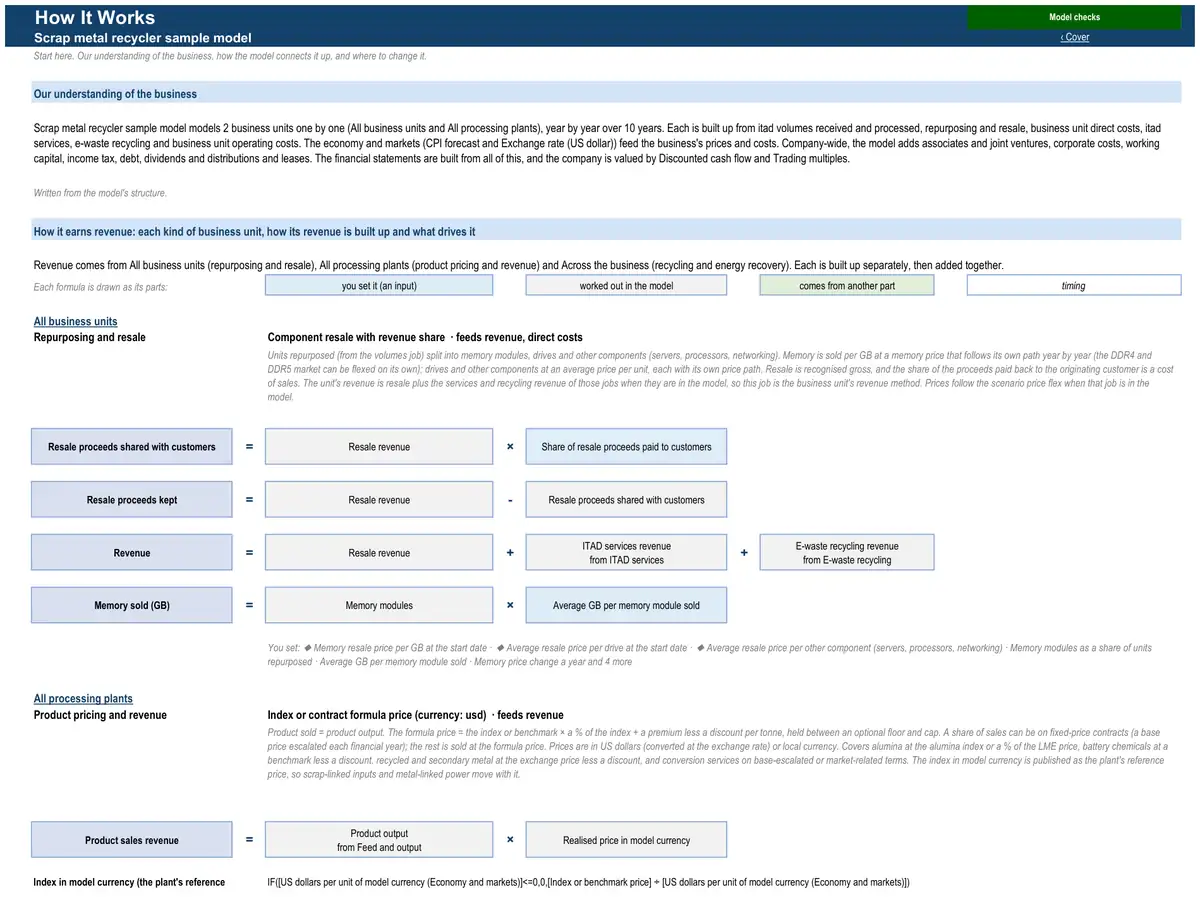
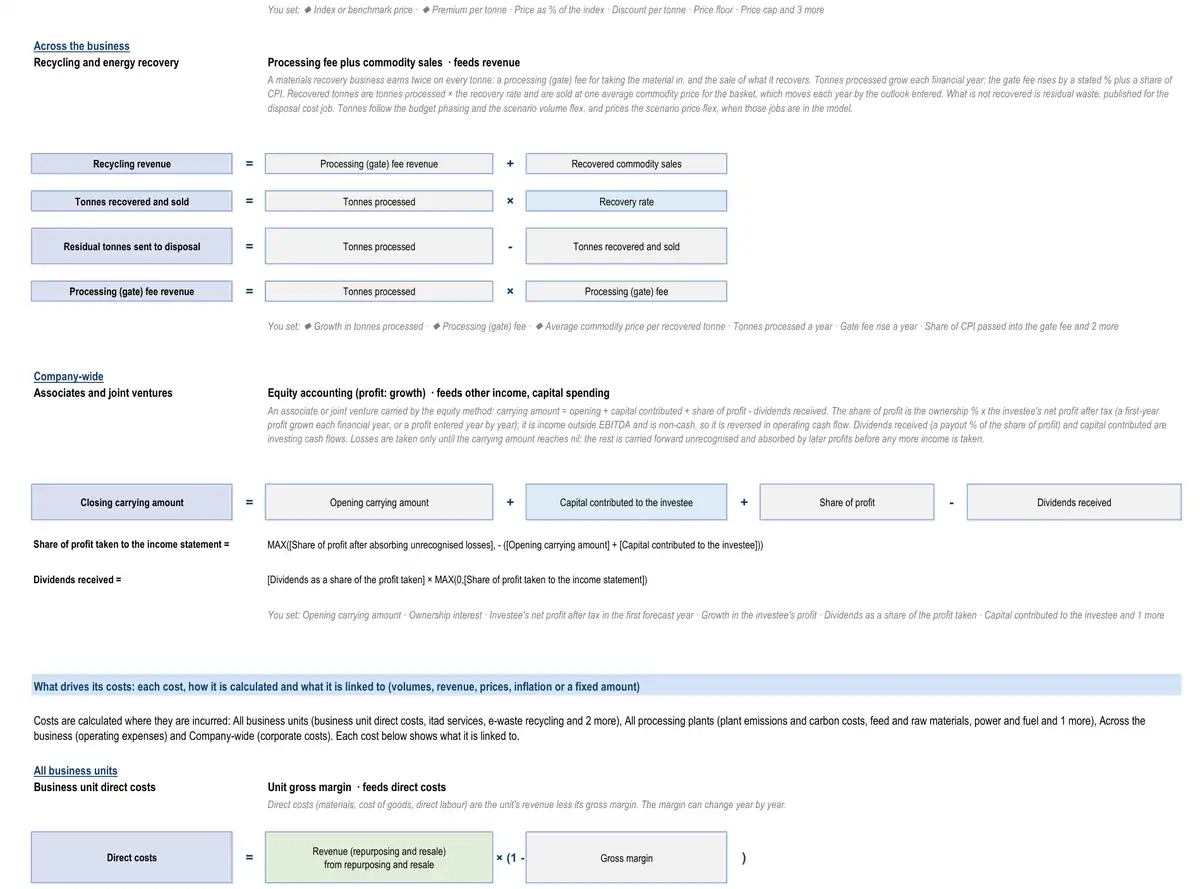
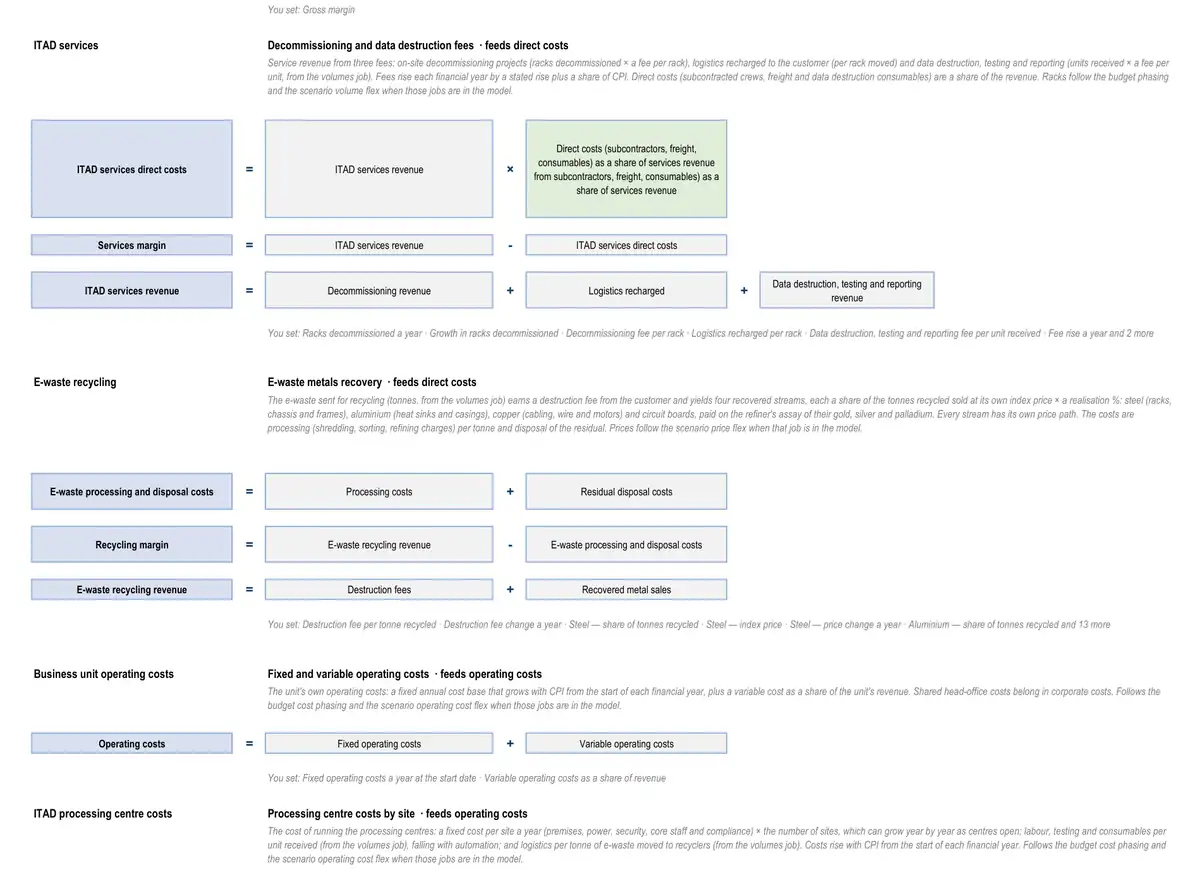
The sample describes no real business. Yours is calibrated to your own figures, so its results are your business’s.
How the model works for a scrap metal recycler.
- How it earns revenue3 formulasRepurposing and resale · All business unitsResale proceeds shared with customersResale revenueShare of resale proceeds paid to customersRepurposing and resale · All business unitsResale proceeds keptResale revenueResale proceeds shared with customersRepurposing and resale · All business unitsRevenueResale revenueITAD services revenuefrom ITAD servicesE-waste recycling revenuefrom e-waste recycling
- What drives its costs3 formulasBusiness unit direct costs · All business unitsDirect costsRevenue (repurposing and resale)from repurposing and resaleGross marginITAD services · All business unitsITAD services direct costsITAD services revenueDirect costs (subcontractors, freight, consumables) as a share of services revenuefrom subcontractors, freight, consumables) as a share of services revenueITAD services · All business unitsServices marginITAD services revenueITAD services direct costs
- What it invests in3 formulasPlant capex, relines and depreciation · All processing plantsPlant capexSustaining capexGrowth or project capexPlant capex, relines and depreciation · All processing plantsClosing net book valueOpening net book valuePlant capexDepreciation (straight line over the remaining life)from straight line over the remaining lifeLeasesPrincipal elements of lease paymentsLease payments (cash)from cashInterest on lease liabilities
- How it is funded3 formulasDebtClosing balanceOpening balanceDrawdowns allocatedRepaid at maturityPlanned repayments and prepayments allocatedDebtOpening drawn balance (all facilities)Facility 1 (revolver) — Opening drawn balancefrom revolver) — Opening drawn balanceFacility 2 (term loan) — Opening drawn balancefrom term loan) — Opening drawn balanceFacility 3 (notes) — Opening drawn balancefrom notes) — Opening drawn balanceDividends and distributionsClosing dividends payableOpening dividends payableDividends declaredDividends paid
- How profit becomes cash3 formulasMetal and raw material inventory · All processing plantsMetal and raw material inventoryRaw materialsMetal in processFinished metalMetal and raw material inventory · All processing plantsOpening metal and raw material inventoryOpening raw materialsOpening metal in processOpening finished metalWorking capitalTrade receivablesRevenuefrom statementsDebtor daysDays in period
31 parts, each one tested.
Every part is a tested building block with its own checks: yours is put together from the ones your business needs.
- CPI forecastCPI glide path
- Exchange rate (US dollar)Flat exchange rate
- Operating expensesHeadcount build by function
- Corporate costsFixed cost base indexed to CPI
- Working capitalDays-based working capital
- Income taxCorporate rate with tax losses
- DebtFacility register with limits and refinancing
- Dividends and distributionsPayout of net profit
- Discounted cash flow valuationDCF on free cash flow to the firm
- Multiples valuationEV / EBITDA multiple
- Associates and joint venturesEquity accounting
- Recycling and energy recoveryProcessing fee plus commodity sales
- LeasesLease register
- Key-metric summaryLast-twelve-month and run-rate metrics
- Discount rate (WACC)CAPM at target gearing
- Business unit direct costsUnit gross margin
- Business unit operating costsFixed and variable operating costs
- ITAD volumes received and processedDecommissioning intake and yieldEquipment received from cloud and enterprise customers, split between units repurposed and e-waste tonnes recycled.
- Repurposing and resaleComponent resale with revenue shareComponents resold at market prices (memory, processors, drives), less the share of proceeds paid to the customer.
- ITAD servicesDecommissioning and data destruction feesDecommissioning, logistics and data destruction charged to customers.
- E-waste recyclingE-waste metals recoveryTonnes of e-waste recycled and the metals recovered, less processing and disposal costs.
- ITAD processing centre costsProcessing centre costs by siteProcessing centres with openings by year, cost per unit and logistics.
- Metal and raw material inventoryDays of costRaw materials, metal in process and finished metal, and price effects on metal held.
- Plant emissions and carbon costsDeclining baseline with credits and surrendersEmissions from smelting, refining and steelmaking and the cost of carbon pricing, baselines and border adjustments.
- Plant registerPlant register (capacity, book value and life)Capacity, book value and remaining life of each processing plant and its main units.
- Feed and outputCapacity × utilisationTonnes fed to the plant and the metal or product it makes.
- Product pricing and revenueIndex or contract formula priceThe price realised for the plant's products, or the fees it earns for processing others' material.
- Feed and raw materialsScrap and metallics at a metal-linked priceThe cost of concentrate, ore, scrap and other raw materials the plant consumes.
- Power and fuelEnergy per tonne × tariffElectricity, gas and other energy consumed by the plant.
- Conversion costsCost lines with driversLabour, maintenance, consumables and overheads of running the plant.
- Plant capex, relines and depreciationSustaining capex, straight-line depreciationSustaining and project capex, relines and rebuilds, depreciation and impairment.
The numbers it tracks.
- 01scrap intake (t)
- 02sales volumes (t)
- 03metal margin per tonne
- 04trading margin
- 05EBIT by segment
- 06share of joint venture profit
- 07EBITDA
What it is used for.
- Operating forecastGuide · Financial projections
- Budget and rolling forecastGuide · Cash flow forecast
- ValuationGuide · DCF valuation model
- Lending and credit analysisGuide · Three-statement model
- Restructuring and liquidityGuide · Financial modelling services
- Listed company valuationGuide · DCF valuation model
- Scenarios and sensitivities
More in processing, smelting and recycling.
- Bauxite and alumina producer financial model
- Aluminium smelter financial model
- Smelter and refinery financial model
- Battery chemicals refiner financial model
- Toll milling operator financial model
- Nuclear fuel services company financial model
Looking for a scrap metal recycler financial model template? Ours arrives built for your business, with your figures in it.
See a finished model, sheet by sheetThe sample is built on illustrative figures and describes no real business. Models are calculations prepared from the information you provide. They are not financial advice and must be independently verified. See our terms.