Smelter and refinery financial model, built free.
A three-statement Excel model for a custom smelter and metal refiner, built from your own figures and checked to balance.
- Free account
- No card
- Usually ready within the hour
We use generative AI in parts of our process, so mistakes can occur. Every model should be checked by a person before it is relied on. Read more
Buys copper, zinc, lead or nickel concentrate (or refines gold and silver doré) from miners, earning treatment and refining charges, free metal from recoveries above payables, and by-products such as sulphuric acid, or tolls metal for a fee without owning it.
In short
- 01
Three linked statements
Income statement, balance sheet and cash flow, linked in every period.
- 02
Valued two ways
Discounted cash flow and trading multiples, side by side.
- 03
Monthly to annual
Monthly, quarterly, half-yearly or annual periods, for up to 30 years.
- 04
Checked every period
A Checks sheet shows the balance sheet balances and the cash reconciles.
The sample, as Excel draws it.
Built by the same system and checks as yours: its structure and its inputs, ready for your own figures.
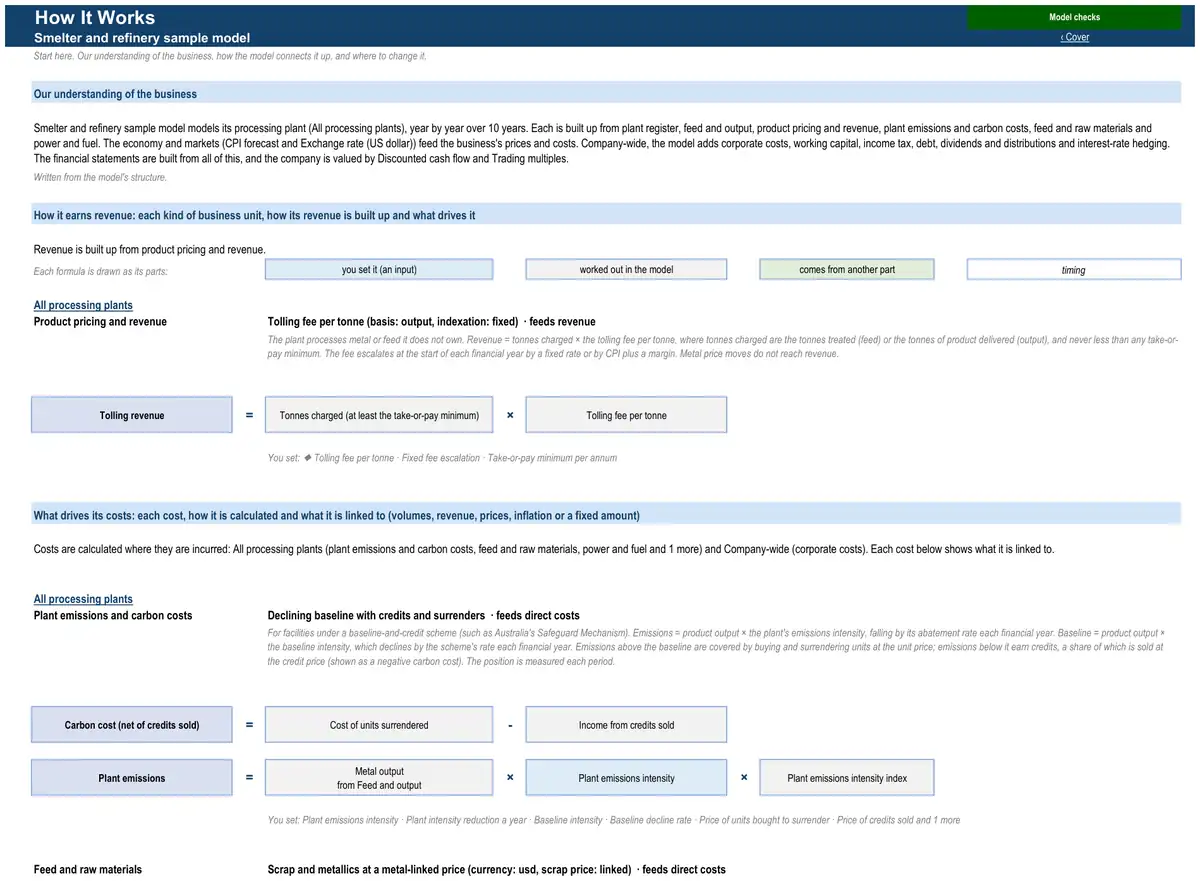
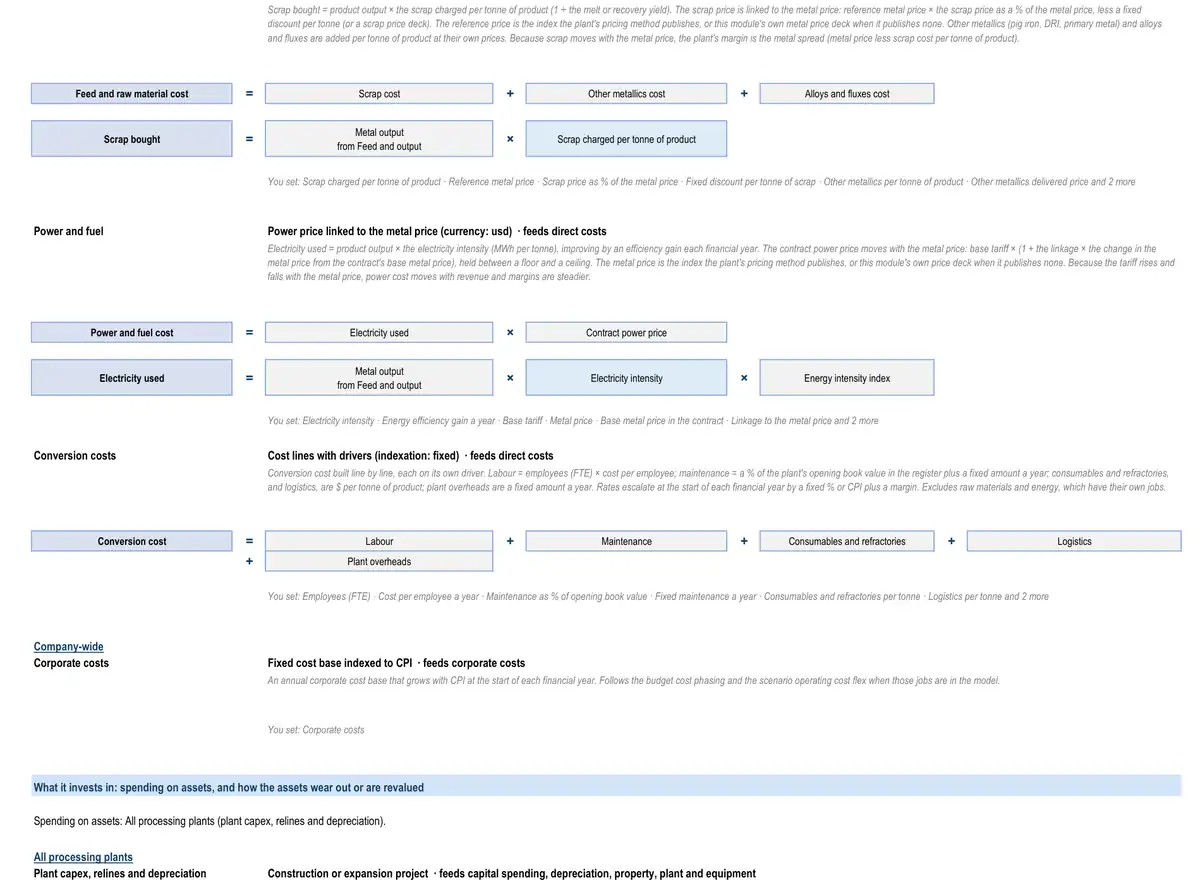
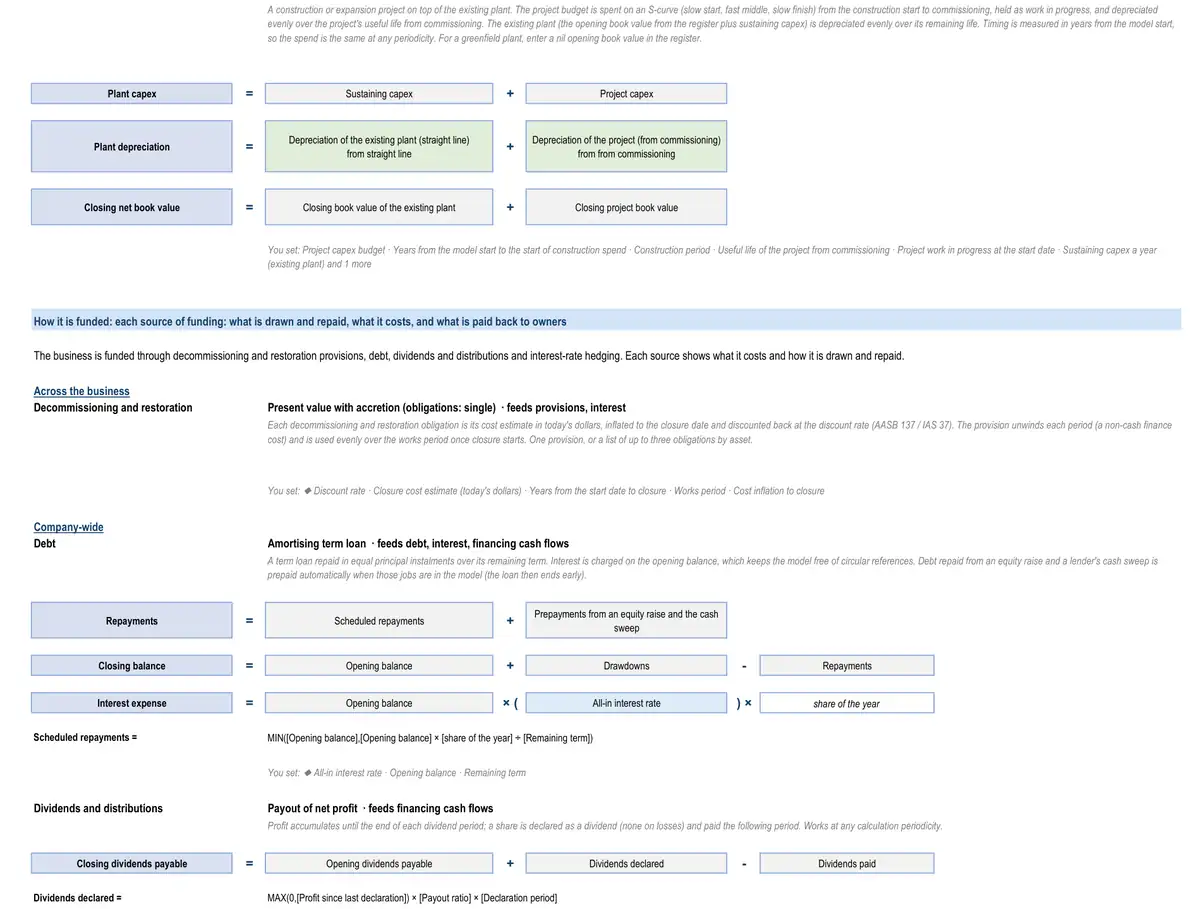
The sample describes no real business. Yours is calibrated to your own figures, so its results are your business’s.
How the model works for a smelter and refinery.
- How it earns revenue1 formulaProduct pricing and revenue · All processing plantsTolling revenueTonnes charged (at least the take-or-pay minimum)Tolling fee per tonne
- What drives its costs3 formulasPlant emissions and carbon costs · All processing plantsCarbon cost (net of credits sold)Cost of units surrenderedIncome from credits soldPlant emissions and carbon costs · All processing plantsPlant emissionsMetal outputfrom feed and outputPlant emissions intensityPlant emissions intensity indexFeed and raw materials · All processing plantsFeed and raw material costScrap costOther metallics costAlloys and fluxes cost
- What it invests in3 formulasPlant capex, relines and depreciation · All processing plantsPlant capexSustaining capexProject capexPlant capex, relines and depreciation · All processing plantsPlant depreciationDepreciation of the existing plant (straight line)from straight lineDepreciation of the project (from commissioning)from from commissioningPlant capex, relines and depreciation · All processing plantsClosing net book valueClosing book value of the existing plantClosing project book value
- How it is funded3 formulasDebtRepaymentsScheduled repaymentsPrepayments from an equity raise and the cash sweepDebtClosing balanceOpening balanceDrawdownsRepaymentsDebtInterest expenseOpening balanceAll-in interest rateshare of the year
- How profit becomes cash3 formulasMetal and raw material inventory · All processing plantsMetal and raw material inventoryRaw materialsMetal in processFinished metalMetal and raw material inventory · All processing plantsOpening metal and raw material inventoryOpening raw materialsOpening metal in processOpening finished metalWorking capitalTrade receivablesRevenuefrom statementsDebtor daysDays in period
22 parts, each one tested.
Every part is a tested building block with its own checks: yours is put together from the ones your business needs.
- CPI forecastConsensus curve with long-run anchor
- Exchange rate (US dollar)Exchange rate by financial year
- Corporate costsFixed cost base indexed to CPI
- Working capitalFull working capital
- Income taxCorporate rate with tax losses
- DebtAmortising term loan
- Dividends and distributionsPayout of net profit
- Discounted cash flow valuationDCF on free cash flow to the firm
- Multiples valuationEV / EBITDA multiple
- Decommissioning and restoration provisionsPresent value with accretion
- Interest-rate hedgingHedged share at a fixed rate
- Key-metric summaryLast-twelve-month and run-rate metrics
- Discount rate (WACC)CAPM at target gearing
- Metal and raw material inventoryDays of costRaw materials, metal in process and finished metal, and price effects on metal held.
- Plant emissions and carbon costsDeclining baseline with credits and surrendersEmissions from smelting, refining and steelmaking and the cost of carbon pricing, baselines and border adjustments.
- Plant registerCapacity by unit (potlines, furnaces, trains)Capacity, book value and remaining life of each processing plant and its main units.
- Feed and outputFeed × metal content × recoveryTonnes fed to the plant and the metal or product it makes.
- Product pricing and revenueTolling fee per tonneThe price realised for the plant's products, or the fees it earns for processing others' material.
- Feed and raw materialsScrap and metallics at a metal-linked priceThe cost of concentrate, ore, scrap and other raw materials the plant consumes.
- Power and fuelPower price linked to the metal priceElectricity, gas and other energy consumed by the plant.
- Conversion costsCost lines with driversLabour, maintenance, consumables and overheads of running the plant.
- Plant capex, relines and depreciationConstruction or expansion projectSustaining and project capex, relines and rebuilds, depreciation and impairment.
The numbers it tracks.
- 01concentrate treated (t)
- 02metal produced
- 03TC/RC income
- 04free metal
- 05by-product credits
- 06conversion cost per tonne
- 07EBITDA
What it is used for.
- Operating forecastGuide · Financial projections
- Budget and rolling forecastGuide · Cash flow forecast
- ValuationGuide · DCF valuation model
- Lending and credit analysisGuide · Three-statement model
- Restructuring and liquidityGuide · Financial modelling services
- Scenarios and sensitivities
More in processing, smelting and recycling.
- Bauxite and alumina producer financial model
- Aluminium smelter financial model
- Battery chemicals refiner financial model
- Toll milling operator financial model
- Nuclear fuel services company financial model
- Scrap metal recycler financial model
Looking for a smelter and refinery financial model template? Ours arrives built for your business, with your figures in it.
See a finished model, sheet by sheetThe sample is built on illustrative figures and describes no real business. Models are calculations prepared from the information you provide. They are not financial advice and must be independently verified. See our terms.