Charity financial model, built free.
A three-statement Excel model for a charity and community service provider, built from your own figures and checked to balance.
- Free account
- No card
- Usually ready within the hour
We use generative AI in parts of our process, so mistakes can occur. Every model should be checked by a person before it is relied on. Read more
A registered charity delivering community services (family support, homelessness, mental health, employment, emergency relief) funded by government grants and contracts, donations and bequests, and trading such as op shops; NDIS and home-care lines use care.services and care.workforce from healthcare.
In short
- 01
Three linked statements
Income statement, balance sheet and cash flow, linked in every period.
- 02
Valued two ways
Discounted cash flow and trading multiples, side by side.
- 03
Monthly to annual
Monthly, quarterly, half-yearly or annual periods, for up to 30 years.
- 04
Checked every period
A Checks sheet shows the balance sheet balances and the cash reconciles.
The sample, as Excel draws it.
Built by the same system and checks as yours, on illustrative figures: every sheet as Excel draws it, or live.
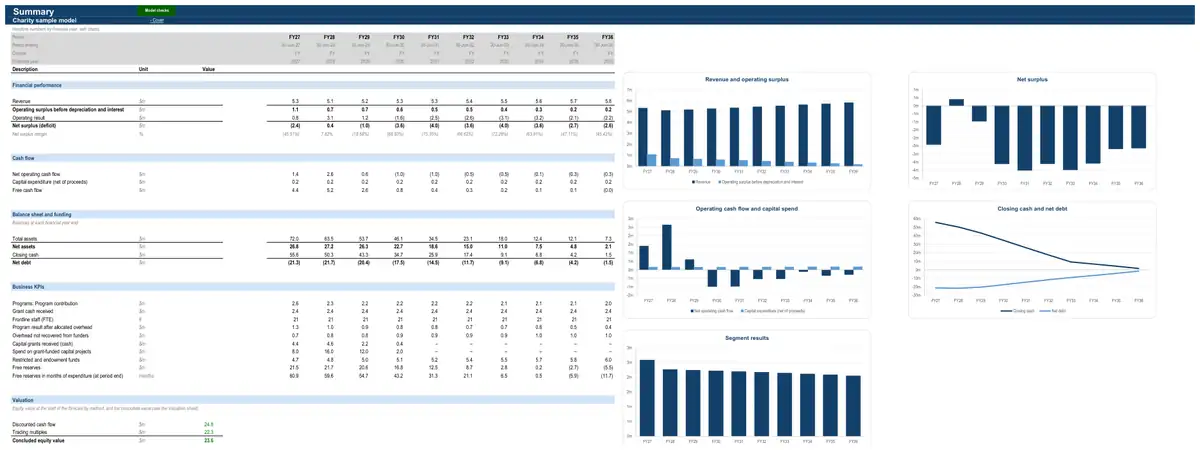
Illustrative figures: the sample describes no real business. The live preview shows values; your model’s Excel file has every formula.
How the model works for a charity.
- How it earns revenue3 formulasGrants and restricted funding · All programsClosing unspent grantsOpening unspent grantsGrant cash receivedGrant revenueUnspent funds refunded at acquittalGovernment service contracts and fee-for-service · All programsService contract revenueClients or outputs deliveredUnit priceCapital grants and contributions · Across the businessClosing unspent capital grantsOpening unspent capital grantsCapital grants received (ahead of spend)Capital grants and contributions (income)
- What drives its costs2 formulasProgram delivery costs · All programsFrontline staff costsSalaries at award ratesOn-costsProgram delivery costs · All programsProgram delivery costsFrontline staff costsBrokerage and client supportProgram operating costs
- What it invests in3 formulasCorporate fixed assetsCapital expenditureRevenuefrom statementsCapex as % of revenueAdditional planned capexCorporate fixed assetsDepreciationDepreciation of the opening asset baseDepreciation of new capexCorporate fixed assetsClosing net book valueOpening net book valueCapital expenditureDepreciation
- How it is funded3 formulasDebtRepaymentsScheduled repaymentsPrepayments from an equity raise and the cash sweepDebtClosing balanceOpening balanceDrawdownsRepaymentsDebtInterest expenseOpening balanceAll-in interest rateshare of the year
- How profit becomes cash3 formulasWorking capitalTrade receivablesRevenuefrom statementsDebtor daysDays in periodWorking capitalInventoryDirect costs (positive)from statementsInventory daysDays in periodWorking capitalTrade payablesCash operating costs (positive)from statementsCreditor daysDays in period
14 parts, each one tested.
Every part is a tested building block with its own checks: yours is put together from the ones your business needs.
- CPI forecastConsensus curve with long-run anchor
- Corporate costsFixed cost base indexed to CPI
- Working capitalFull working capital
- Corporate fixed assetsStraight-line over remaining life
- DebtAmortising term loan
- Discounted cash flow valuationDCF on free cash flow to the firm
- Multiples valuationEV / EBITDA multiple
- Capital grants and contributionsFunding mix by capital projectGrants to build or acquire assets the entity will control, recognised as income as the asset is built (AASB 1058 paragraphs 15–16; a conditional-grant liability under IPSAS 23 and similar standards), with unspent amounts held as a liability and the income kept below the operating result. Used by councils, agencies, health services, charities, clubs and housing providers.
- LeasesLease register
- Reserves policy and restricted fundsFund roll-forwardFund balances by class — restricted, endowment, designated and general (free) reserves — and whether free reserves meet the reserves policy target.
- Grants and restricted fundingDeferred until deliveredGovernment and philanthropic grants funding a program — recognised under AASB 15 where the agreement is enforceable with sufficiently specific performance obligations (deferred until delivered), otherwise on receipt under AASB 1058 — with unspent funds refunded or rolled over on acquittal.
- Government service contracts and fee-for-serviceClients or outputs × unit pricePayments for delivering services to government or clients — per-client or per-output fees, outcome and milestone payments, block payments with KPIs and payment-by-results contracts — recognised as services are delivered (AASB 15).
- Program delivery costsCaseload × staffing ratio × award ratesDirect cost of delivering a program — frontline staff under the relevant award, client support and brokerage, program premises and travel.
- Overhead allocation and full cost recoveryFunded overhead against true costAllocates shared support costs to programs to show each program's full cost, the overhead its funders pay for, its contribution, and the functional expense split (program, fundraising, administration). Allocation only — it does not change entity totals.
The numbers it tracks.
- 01operating result before capital grants
- 02income by source
- 03largest funder share
- 04program expense ratio
- 05cost to raise a dollar
- 06overhead recovery gap
- 07free reserves in months
What it is used for.
- Budget and rolling forecastGuide · Cash flow forecast
- Operating forecastGuide · Financial projections
- Lending and credit analysisGuide · Three-statement model
- Merger or acquisition (strategic)Guide · Financial modelling services
- Startup and venture fundingGuide · Startup financial model
- Scenarios and sensitivities
More in not-for-profits, clubs and member organisations.
- Community housing provider financial model
- Licensed club financial model
- Sporting club financial model
- Industry association financial model
- Co-operative financial model
- Foundation and endowment financial model
- Indigenous corporation financial model
- Religious organisation financial model
Looking for a charity financial model template? Ours arrives built for your business, with your figures in it.
See a finished model, sheet by sheetThe sample is built on illustrative figures and describes no real business. Models are calculations prepared from the information you provide. They are not financial advice and must be independently verified. See our terms.