Licensed club financial model, built free.
A three-statement Excel model for a licensed member club (RSL, leagues, bowls, golf and workers' clubs), built from your own figures and checked to balance.
- Free account
- No card
- Usually ready within the hour
We use generative AI in parts of our process, so mistakes can occur. Every model should be checked by a person before it is relied on. Read more
A member-owned not-for-profit club earning bar, food, gaming and function revenue plus subscriptions, reinvesting surpluses in facilities and community contributions, taxed only on non-member income under mutuality (or exempt), and often growing by amalgamating with smaller clubs or developing surplus land.
In short
- 01
Three linked statements
Income statement, balance sheet and cash flow, linked in every period.
- 02
Valued two ways
Discounted cash flow and trading multiples, side by side.
- 03
Monthly to annual
Monthly, quarterly, half-yearly or annual periods, for up to 30 years.
- 04
Checked every period
A Checks sheet shows the balance sheet balances and the cash reconciles.
The sample, as Excel draws it.
Built by the same system and checks as yours, on illustrative figures: every sheet as Excel draws it, or live.
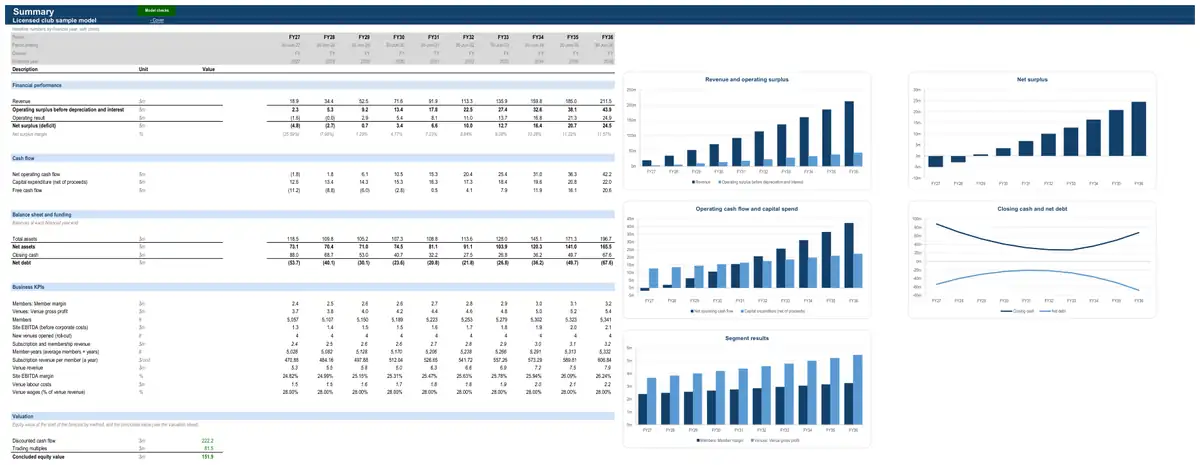
Illustrative figures: the sample describes no real business. The live preview shows values; your model’s Excel file has every formula.
How the model works for a licensed club.
- How it earns revenue3 formulasMemberships and subscriptions · All member segmentsSubscription and membership revenueSubscription revenueJoining feesMemberships and subscriptions · All member segmentsClosing subscriptions received in advanceClosing membersAnnual subscriptionAverage months of subscription unexpired at each period endMemberships and subscriptions · All member segmentsClosing membersOpening membersNew membersMembers lapsed
- What drives its costs3 formulasCost of goods sold and content costs · All venuesCost of goods sold and content costsBeverage cost of salesFood cost of salesMerchandise cost of salesContent costs on admissionsVenue labour costs · All venuesVenue labour costsVenue revenuefrom venue revenue and site EBITDAVenue labour (% of venue revenue)Other venue operating costs · All venuesOther venue operating costsUtilitiesRepairs and maintenanceMarketing and promotionsSecurityCleaningEntertainmentLicences and insurance
- What it invests in3 formulasCorporate fixed assetsCapital expenditureRevenuefrom statementsCapex as % of revenueAdditional planned capexCorporate fixed assetsDepreciationDepreciation of the opening asset baseDepreciation of new capexCorporate fixed assetsClosing net book valueOpening net book valueCapital expenditureDepreciation
- How it is funded3 formulasDebtRepaymentsScheduled repaymentsPrepayments from an equity raise and the cash sweepDebtClosing balanceOpening balanceDrawdownsRepaymentsDebtInterest expenseOpening balanceAll-in interest rateshare of the year
- How profit becomes cash3 formulasWorking capitalTrade receivablesRevenuefrom statementsDebtor daysDays in periodWorking capitalInventoryDirect costs (positive)from statementsInventory daysDays in periodWorking capitalTrade payablesCash operating costs (positive)from statementsCreditor daysDays in period
16 parts, each one tested.
Every part is a tested building block with its own checks: yours is put together from the ones your business needs.
- CPI forecastConsensus curve with long-run anchor
- Corporate costsFixed cost base indexed to CPI
- Working capitalFull working capital
- Corporate fixed assetsStraight-line over remaining life
- DebtAmortising term loan
- Discounted cash flow valuationDCF on free cash flow to the firm
- Multiples valuationEV / EBITDA multiple
- LeasesLease register
- New venues, acquisitions and refurbishments (top-down)Openings schedule with ramp to maturity
- Memberships and subscriptionsRenewals, lapses and new membersMembers by class and the subscriptions, joining (entrance) fees and levies they pay — for clubs, associations, professional bodies and member-based charities — recognised over the membership year, with renewals billed in advance held as deferred revenue.
- Venue registerOpening date, closing date and capacity
- Food, beverage and secondary spend revenueCovers × average spend per head
- Cost of goods sold and content costsMargin by revenue stream
- Venue labour costsWages as % of revenue
- Other venue operating costsCost lines with growth
- Venue revenue and site EBITDA
The numbers it tracks.
- 01members
- 02gaming revenue per machine
- 03bar and food margin
- 04wage ratio
- 05EBITDARD
- 06community contributions
- 07debt to EBITDA
What it is used for.
- Budget and rolling forecastGuide · Cash flow forecast
- Operating forecastGuide · Financial projections
- Lending and credit analysisGuide · Three-statement model
- Merger or acquisition (strategic)Guide · Financial modelling services
- Development feasibilityGuide · Financial modelling services
- Scenarios and sensitivities
More in not-for-profits, clubs and member organisations.
- Charity financial model
- Community housing provider financial model
- Sporting club financial model
- Industry association financial model
- Co-operative financial model
- Foundation and endowment financial model
- Indigenous corporation financial model
- Religious organisation financial model
Looking for a licensed club financial model template? Ours arrives built for your business, with your figures in it.
See a finished model, sheet by sheetThe sample is built on illustrative figures and describes no real business. Models are calculations prepared from the information you provide. They are not financial advice and must be independently verified. See our terms.