Grain trader financial model, built free.
A three-statement Excel model for a grain and commodity trader, built from your own figures and checked to balance.
- Free account
- No card
- Usually ready within the hour
We use generative AI in parts of our process, so mistakes can occur. Every model should be checked by a person before it is relied on. Read more
Buys grain, oilseeds, pulses or cotton from growers at harvest, stores and ships them, and sells to domestic users and export buyers, earning trading margin, basis and carry and holding forward contracts and stock at market value, funded by inventory facilities.
In short
- 01
Three linked statements
Income statement, balance sheet and cash flow, linked in every period.
- 02
Valued two ways
Discounted cash flow and trading multiples, side by side.
- 03
Monthly to annual
Monthly, quarterly, half-yearly or annual periods, for up to 30 years.
- 04
Checked every period
A Checks sheet shows the balance sheet balances and the cash reconciles.
The sample, as Excel draws it.
Built by the same system and checks as yours: its structure and its inputs, ready for your own figures.
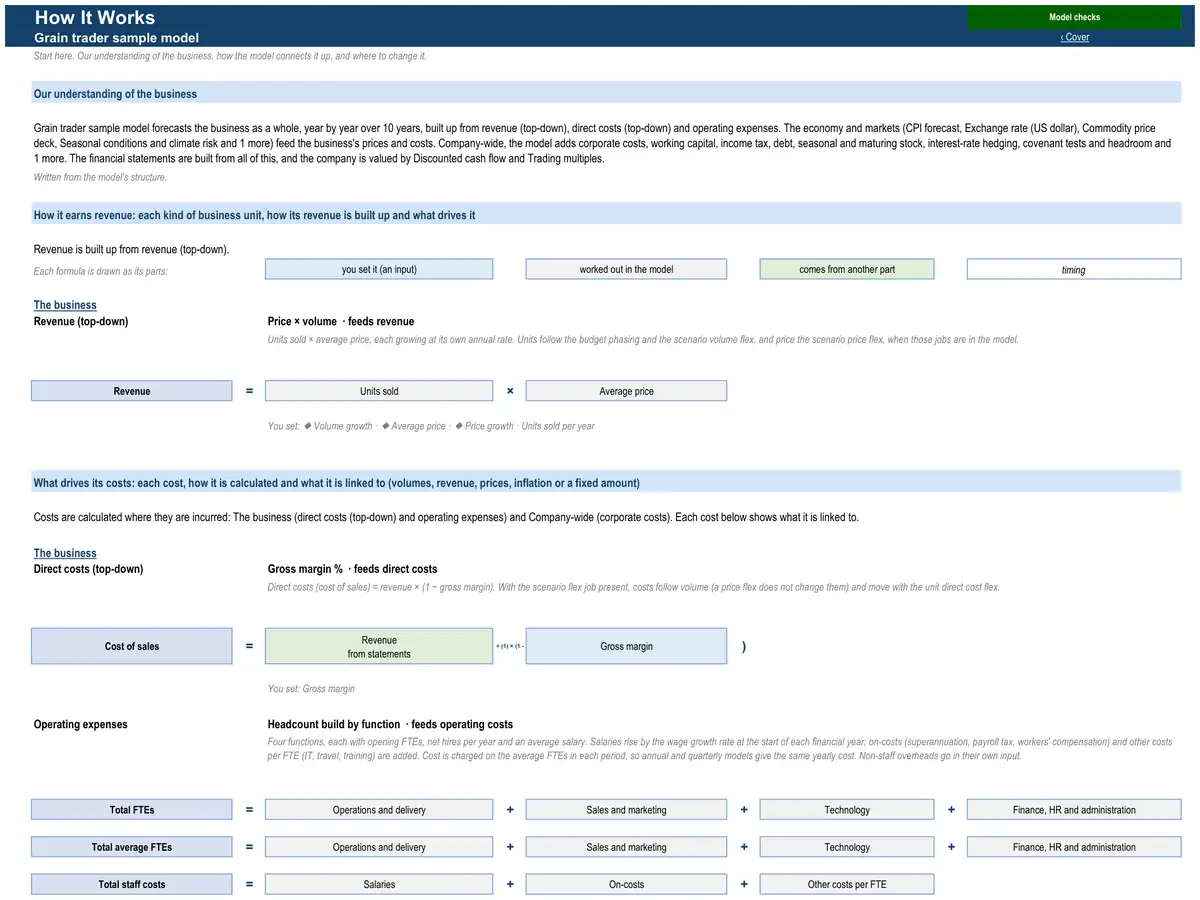
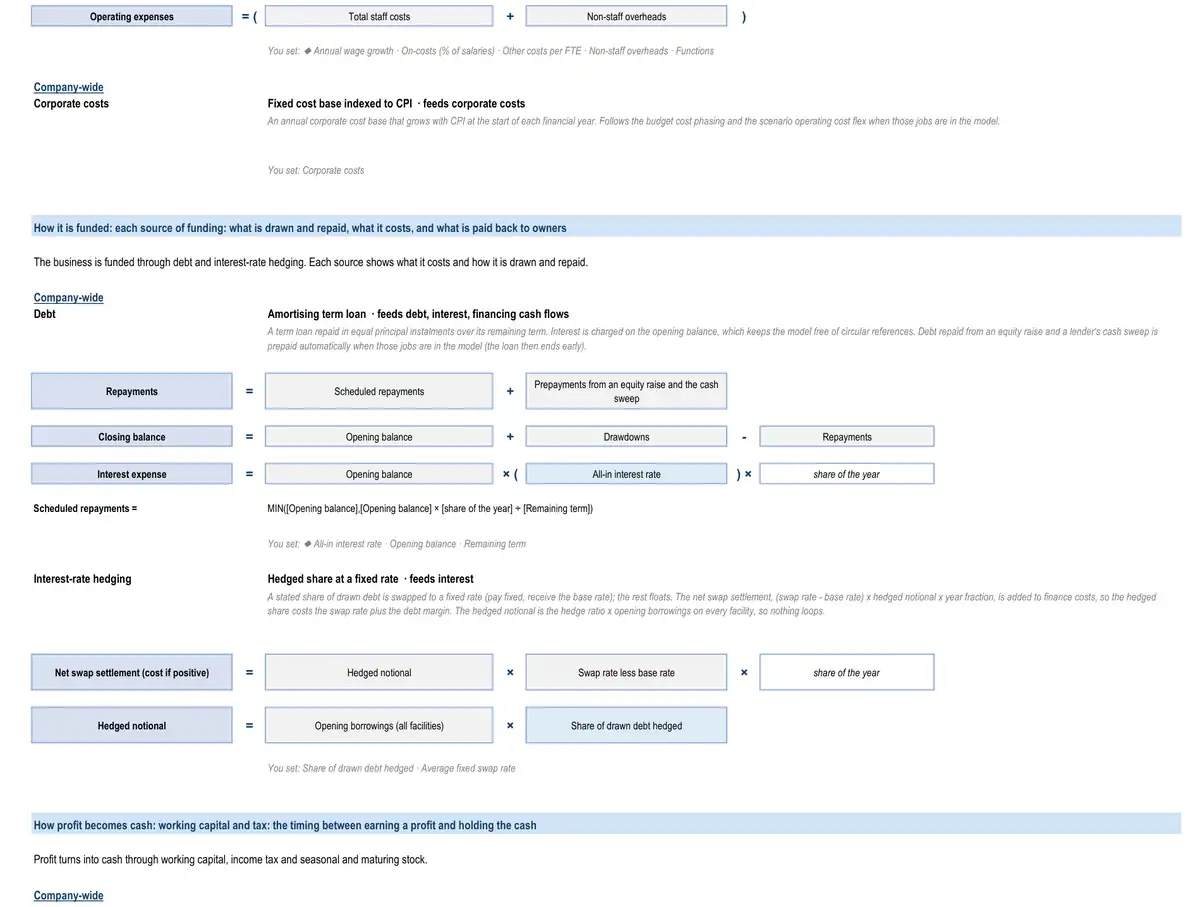
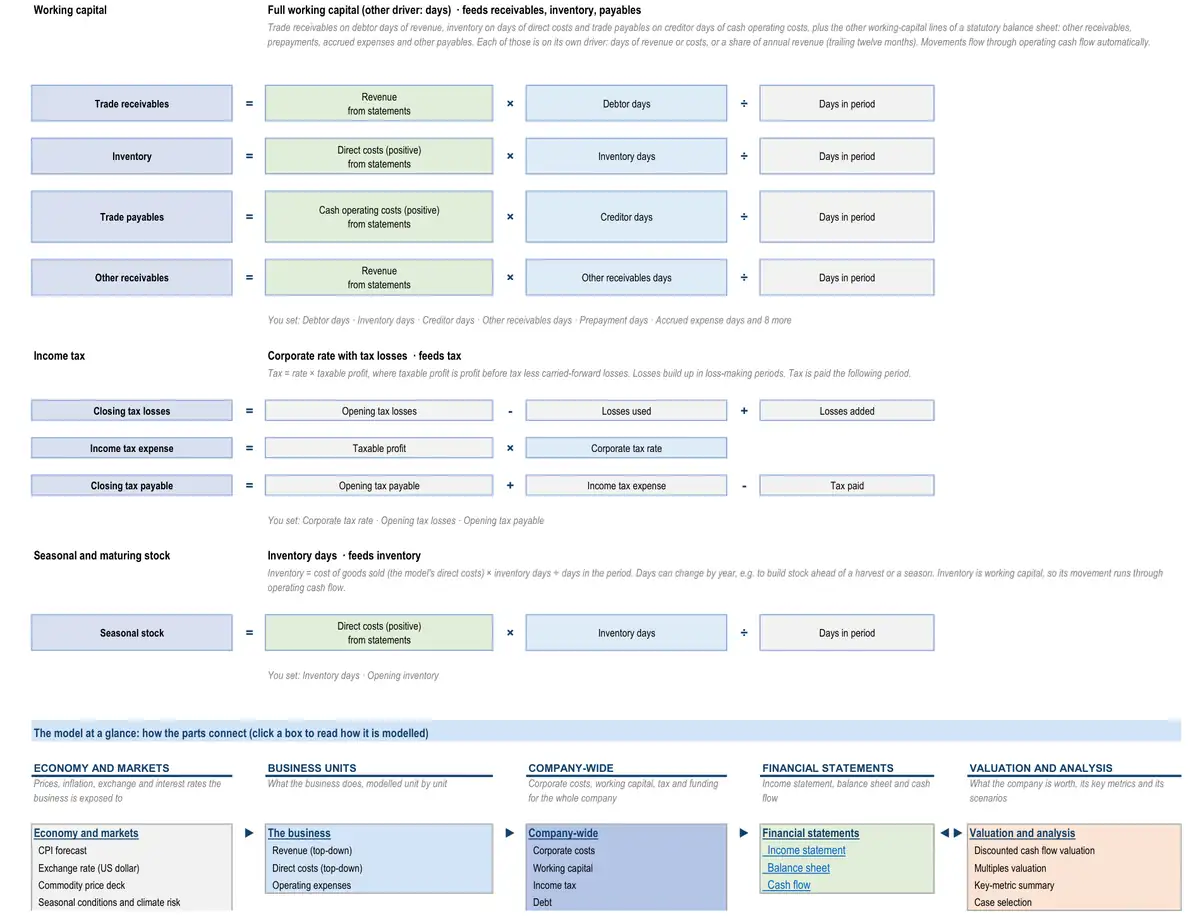
The sample describes no real business. Yours is calibrated to your own figures, so its results are your business’s.
How the model works for a grain trader.
- How it earns revenue1 formulaRevenue (top-down) · The businessRevenueUnits soldAverage price
- What drives its costs3 formulasDirect costs (top-down) · The businessCost of salesRevenuefrom statementsGross marginOperating expenses · The businessTotal FTEsOperations and deliverySales and marketingTechnologyFinance, HR and administrationOperating expenses · The businessTotal average FTEsOperations and deliverySales and marketingTechnologyFinance, HR and administration
- How it is funded3 formulasDebtRepaymentsScheduled repaymentsPrepayments from an equity raise and the cash sweepDebtClosing balanceOpening balanceDrawdownsRepaymentsDebtInterest expenseOpening balanceAll-in interest rateshare of the year
- How profit becomes cash3 formulasWorking capitalTrade receivablesRevenuefrom statementsDebtor daysDays in periodWorking capitalInventoryDirect costs (positive)from statementsInventory daysDays in periodWorking capitalTrade payablesCash operating costs (positive)from statementsCreditor daysDays in period
20 parts, each one tested.
Every part is a tested building block with its own checks: yours is put together from the ones your business needs.
- CPI forecastConsensus curve with long-run anchor
- Exchange rate (US dollar)Exchange rate by financial year
- Revenue (top-down)Price × volume
- Direct costs (top-down)Gross margin %
- Operating expensesHeadcount build by function
- Corporate costsFixed cost base indexed to CPI
- Working capitalFull working capital
- Income taxCorporate rate with tax losses
- DebtAmortising term loan
- Discounted cash flow valuationDCF on free cash flow to the firm
- Multiples valuationEV / EBITDA multiple
- Commodity price deckFlat real pricesPrice paths for the farm, fish and forest commodities in the model — grain, oilseeds, cotton, sugar, beef, lamb, pork, wool, milk, fish, logs, fertiliser and feed — that sales and cost methods read as indices.
- Seasonal conditions and climate riskSeason type by yearA season factor that scales yields, carrying capacity, receivals, input demand (or, for ski resorts, snow and skier visits) for drought, average and good years.
- Seasonal and maturing stockInventory daysFood and beverage stock built up seasonally or held to mature — cheese, wine vintages, spirits in cask, sugar and frozen meat — and the cash it ties up.
- Interest-rate hedgingHedged share at a fixed rate
- Key-metric summaryLast-twelve-month and run-rate metrics
- Covenant tests and headroomLVR, gearing and ICR for property
- Borrowing base and security coverReceivables and inventory borrowing base
- Case selectionStackable stress toggles
- Interest-rate forecastMarket forward curve
The numbers it tracks.
- 01tonnes traded
- 02margin per tonne
- 03stock on hand at balance date
- 04mark-to-market gains
- 05inventory facility use
- 06EBITDA
What it is used for.
- Operating forecastGuide · Financial projections
- Lending and credit analysisGuide · Three-statement model
- Scenarios and sensitivities
More in farmland, agribusiness and rural services.
- Farmland investor financial model
- Farm management company financial model
- Agricultural contractor financial model
- Rural services agency financial model
- Rural supplies distributor financial model
- Farm machinery dealer financial model
- Agtech company financial model
- Grain storage and handling financial model
Looking for a grain trader financial model template? Ours arrives built for your business, with your figures in it.
See a finished model, sheet by sheetThe sample is built on illustrative figures and describes no real business. Models are calculations prepared from the information you provide. They are not financial advice and must be independently verified. See our terms.