Debt collection agency financial model, built free.
A three-statement Excel model for a debt purchaser and collection agency, built from your own figures and checked to balance.
- Free account
- No card
- Usually ready within the hour
We use generative AI in parts of our process, so mistakes can occur. Every model should be checked by a person before it is relied on. Read more
Buys portfolios of defaulted consumer debt at a fraction of face value and collects them over several years, and collects debts for clients on contingency, earning the return on purchased ledgers plus commissions.
In short
- 01
Three linked statements
Income statement, balance sheet and cash flow, linked in every period.
- 02
Valued two ways
Discounted cash flow and trading multiples, side by side.
- 03
Monthly to annual
Monthly, quarterly, half-yearly or annual periods, for up to 30 years.
- 04
Checked every period
A Checks sheet shows the balance sheet balances and the cash reconciles.
The sample, as Excel draws it.
Built by the same system and checks as yours, on illustrative figures: every sheet as Excel draws it, or live.
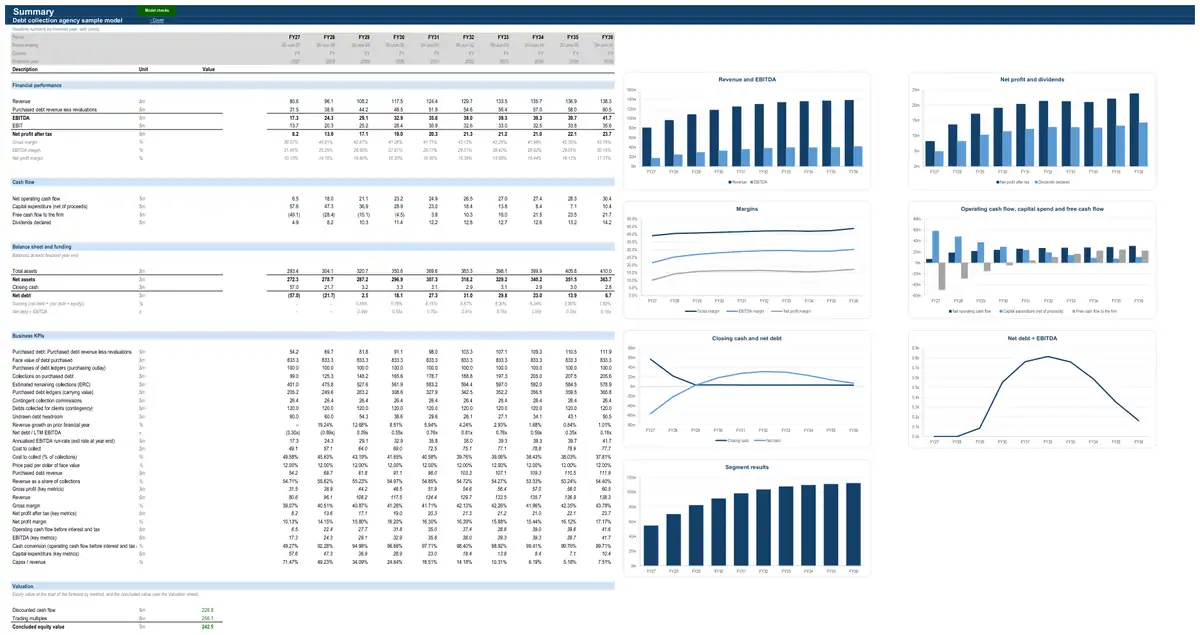
Illustrative figures: the sample describes no real business. The live preview shows values; your model’s Excel file has every formula.
How the model works for a debt collection agency.
- How it earns revenue3 formulasRevenue recognition and carrying value · All purchased debt portfoliosPurchased debt revenueRevenue at the EIR (on opening value and on mid-period flows)Collections on fully amortised ledgers (zero-basis revenue)Revenue recognition and carrying value · All purchased debt portfoliosCollections applied to the carrying valueCollectionsfrom collections curve and remaining collectionsPurchased debt revenueRevenue recognition and carrying value · All purchased debt portfoliosClosing carrying valueOpening carrying valuePurchases of debt ledgers (price paid)from debt ledger purchasesPurchased debt revenueNet revaluation gain or (loss)Collectionsfrom collections curve and remaining collections
- What drives its costs2 formulasOperating expenses · Across the businessOperating expensesStaff costs (annual)Marketing (annual)Occupancy (annual)Administration (annual)share of the yearCost to collectCost to collectCall centre and arrangementsDigitalLegalExternal agenciesContingency collections for clients
- What it invests in3 formulasCorporate fixed assetsCapital expenditureRevenuefrom statementsCapex as % of revenueAdditional planned capexCorporate fixed assetsDepreciationDepreciation of the opening asset baseDepreciation of new capexCorporate fixed assetsClosing net book valueOpening net book valueCapital expenditureDepreciation
- How it is funded3 formulasDebtCash before revolver draws and sweepOpening cashNet operating cash flow (statements)from statementsCapital expenditure (positive, net of proceeds) (statements)from statementsEquity raised (equity raising)from equity raisingDividends paid (dividends and distributions)from dividends and distributionsLess prepayments from an equity raise and the cash sweepLess repayment forced by a lower limitDebtRepaymentsLess repayment forced by a lower limitLess prepayments from an equity raise and the cash sweepRepayments from cash above the minimumDebtClosing balanceOpening balanceDrawdowns to restore the minimum cash balanceRepayments
- How profit becomes cash3 formulasWorking capitalTrade receivablesRevenuefrom statementsDebtor daysDays in periodWorking capitalInventoryDirect costs (positive)from statementsInventory daysDays in periodWorking capitalTrade payablesCash operating costs (positive)from statementsCreditor daysDays in period
21 parts, each one tested.
Every part is a tested building block with its own checks: yours is put together from the ones your business needs.
- CPI forecastConsensus curve with long-run anchor
- Operating expensesOperating expense line items
- Corporate costsFixed cost base indexed to CPI
- Working capitalDays-based working capital
- Income taxCorporate rate with tax losses
- Corporate fixed assetsStraight-line over remaining life
- DebtRevolver with cash sweep
- Equity raisingDistribution reinvestment plan
- Dividends and distributionsPayout of net profit
- Discounted cash flow valuationDCF on free cash flow to the firm
- Multiples valuationEV / EBITDA multiple
- Cost to collectCollections × cost-to-collect ratioCollector, legal, dialler and agency costs of collecting purchased and client debts.
- Contingent collection and agency feesPlacements × liquidation × commissionCommission earned collecting debts on behalf of clients (banks, utilities, government) without buying them.
- LeasesLease register
- Key-metric summaryLast-twelve-month and run-rate metrics
- Covenant tests and headroomFacility-agreement definitions and step-downs
- Borrowing base and security coverReceivables and inventory borrowing base
- Case selectionStackable stress toggles
- Debt ledger purchasesPurchasing budget ÷ priceDefaulted receivables bought, their face value and the price paid.
- Collections curve and remaining collectionsPurchase price × collection multiple over a curveCash collected on each purchased portfolio over time and the estimated remaining collections (ERC).
- Revenue recognition and carrying valueEffective interest rateRevenue from purchased debt, amortisation of its carrying value, and revaluation when collection forecasts change.
The numbers it tracks.
- 01purchasing outlay
- 02collections
- 03estimated remaining collections
- 04cost to collect
- 05return on purchased debt
- 06carrying value
- 07net debt to ERC
What it is used for.
- Operating forecastGuide · Financial projections
- Budget and rolling forecastGuide · Cash flow forecast
- Lending and credit analysisGuide · Three-statement model
- ValuationGuide · DCF valuation model
- Scenarios and sensitivities
More in banking and lending.
- Bank financial model
- Credit union financial model
- Neobank financial model
- Non-bank lender financial model
- Consumer lender financial model
- Buy now pay later provider financial model
- Invoice finance lender financial model
- Equipment and auto finance company financial model
- Mortgage lender financial model
- Mortgage broker financial model
- Mortgage REIT financial model
- Private credit fund financial model
- Pawnbroker and small-amount lender financial model
- Development bank financial model
Looking for a debt collection agency financial model template? Ours arrives built for your business, with your figures in it.
See a finished model, sheet by sheetThe sample is built on illustrative figures and describes no real business. Models are calculations prepared from the information you provide. They are not financial advice and must be independently verified. See our terms.