Equipment and auto finance company financial model, built free.
A three-statement Excel model for an equipment, fleet and auto finance company, built from your own figures and checked to balance.
- Free account
- No card
- Usually ready within the hour
We use generative AI in parts of our process, so mistakes can occur. Every model should be checked by a person before it is relied on. Read more
Finances vehicles and equipment through loans, finance leases, novated leases and operating leases, earning interest and fees plus remarketing results, and carrying residual value risk on leased assets.
In short
- 01
Three linked statements
Income statement, balance sheet and cash flow, linked in every period.
- 02
Valued two ways
Discounted cash flow and trading multiples, side by side.
- 03
Monthly to annual
Monthly, quarterly, half-yearly or annual periods, for up to 30 years.
- 04
Checked every period
A Checks sheet shows the balance sheet balances and the cash reconciles.
The sample, as Excel draws it.
Built by the same system and checks as yours: its structure and its inputs, ready for your own figures.
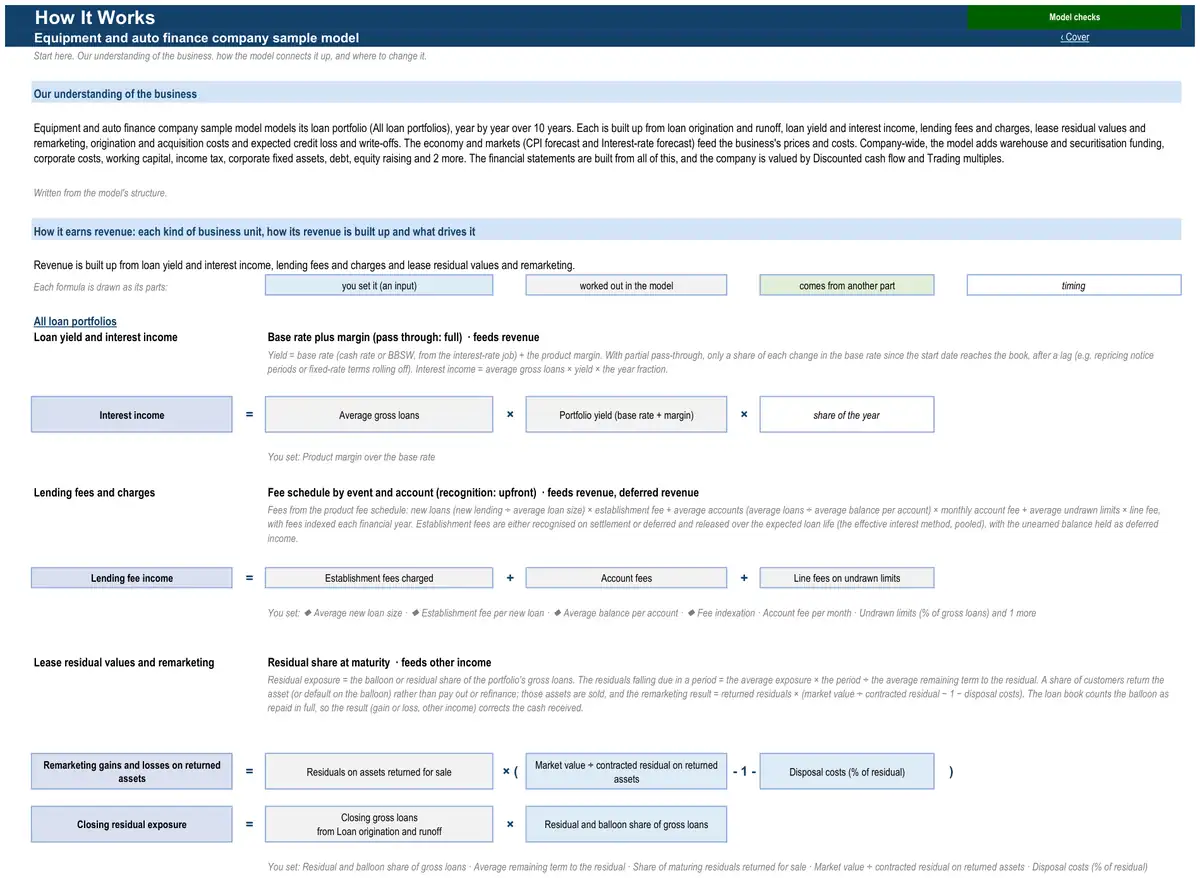
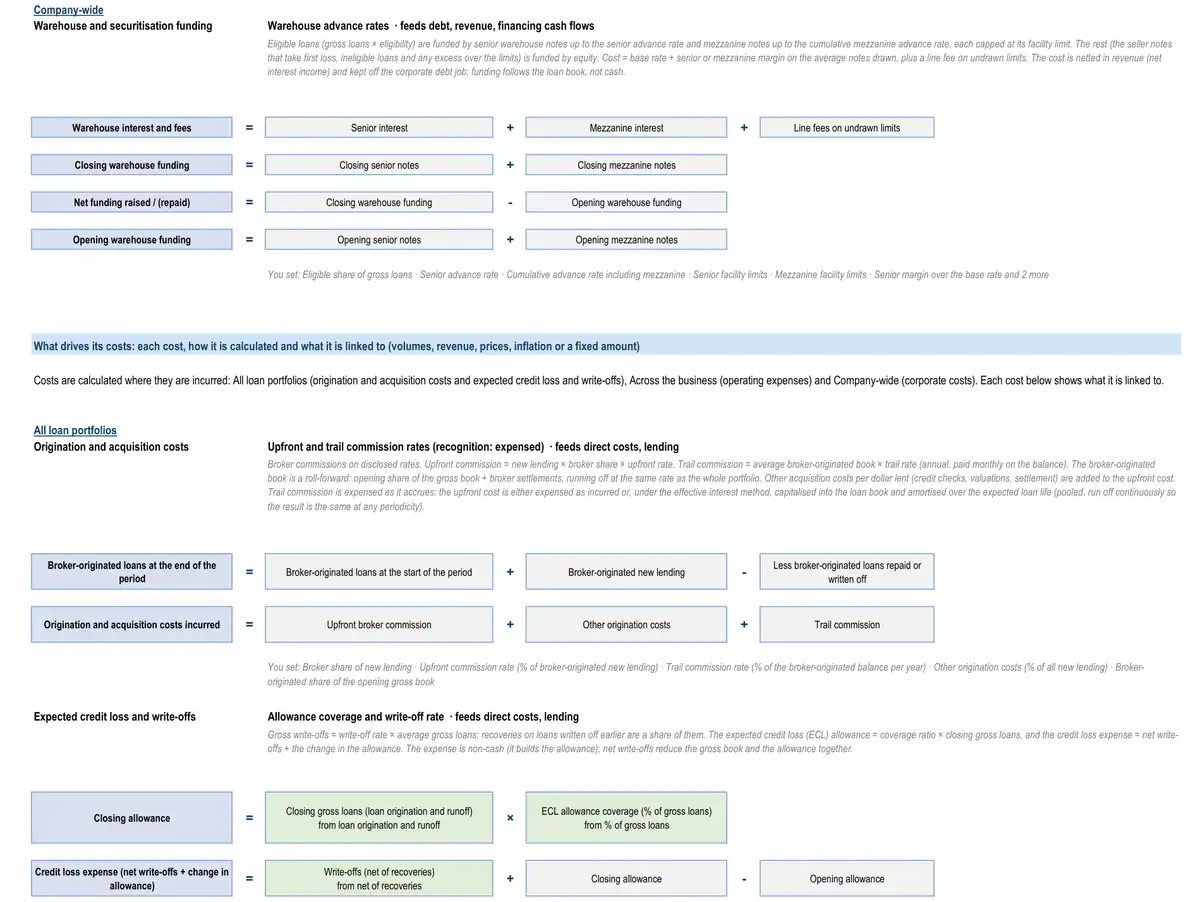
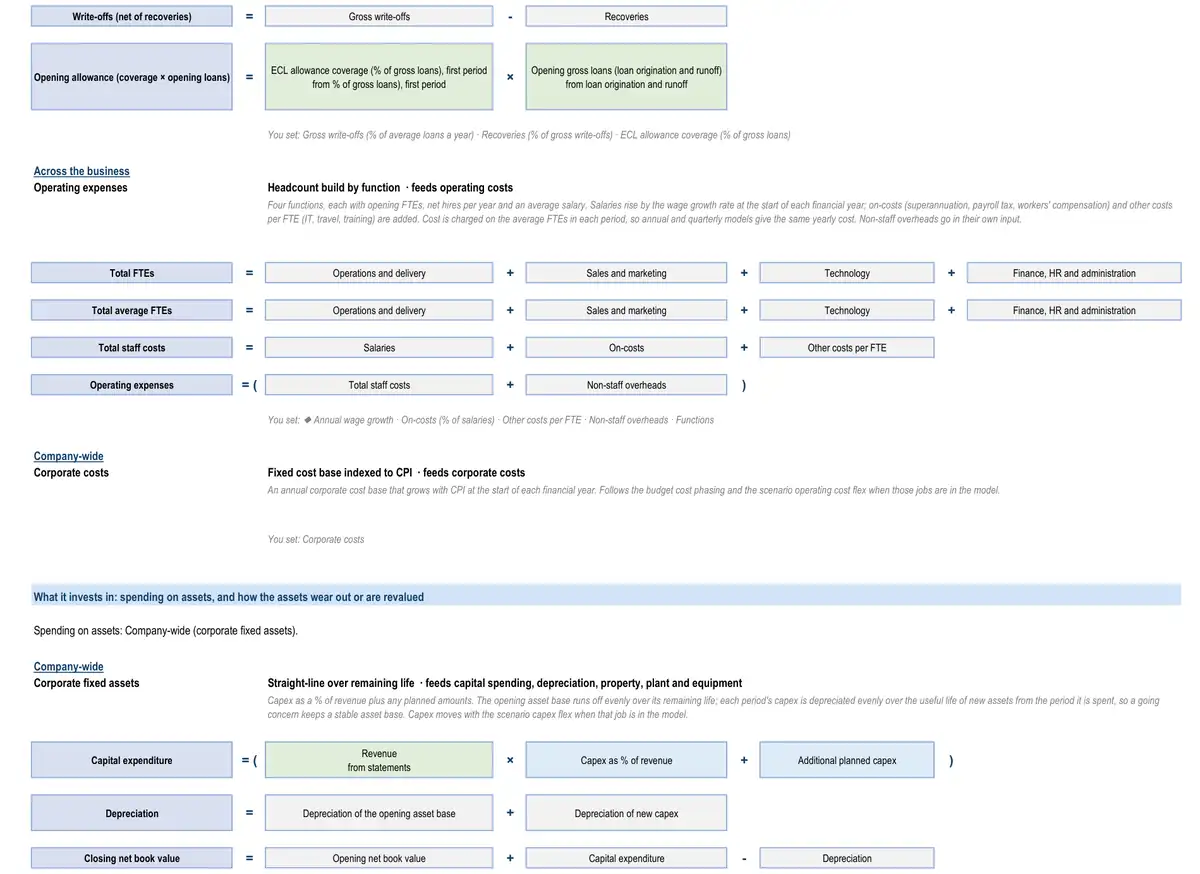
The sample describes no real business. Yours is calibrated to your own figures, so its results are your business’s.
How the model works for an equipment and auto finance company.
- How it earns revenue3 formulasLoan yield and interest income · All loan portfoliosInterest incomeAverage gross loansPortfolio yield (base rate + margin)share of the yearLending fees and charges · All loan portfoliosLending fee incomeEstablishment fees chargedAccount feesLine fees on undrawn limitsLease residual values and remarketing · All loan portfoliosRemarketing gains and losses on returned assetsResiduals on assets returned for saleMarket value ÷ contracted residual on returned assetsDisposal costs (% of residual)
- What drives its costs3 formulasOrigination and acquisition costs · All loan portfoliosBroker-originated loans at the end of the periodBroker-originated loans at the start of the periodBroker-originated new lendingLess broker-originated loans repaid or written offOrigination and acquisition costs · All loan portfoliosOrigination and acquisition costs incurredUpfront broker commissionOther origination costsTrail commissionExpected credit loss and write-offs · All loan portfoliosClosing allowanceClosing gross loans (loan origination and runoff)from loan origination and runoffECL allowance coverage (% of gross loans)from % of gross loans
- What it invests in3 formulasCorporate fixed assetsCapital expenditureRevenuefrom statementsCapex as % of revenueAdditional planned capexCorporate fixed assetsDepreciationDepreciation of the opening asset baseDepreciation of new capexCorporate fixed assetsClosing net book valueOpening net book valueCapital expenditureDepreciation
- How it is funded3 formulasLoan origination and runoff · All loan portfoliosClosing gross loansOpening gross loansNew lending (settlements)Scheduled amortisationPrepayments and other runoff (including loans written off)Loan origination and runoff · All loan portfoliosNet loans advanced (new lending less cash repayments)Closing gross loansOpening gross loansWrite-offs (net of recoveries)from expected credit loss and write-offsDebtRepaymentsScheduled repaymentsPrepayments from an equity raise and the cash sweep
- How profit becomes cash3 formulasWorking capitalTrade receivablesRevenuefrom statementsDebtor daysDays in periodWorking capitalInventoryDirect costs (positive)from statementsInventory daysDays in periodWorking capitalTrade payablesCash operating costs (positive)from statementsCreditor daysDays in period
23 parts, each one tested.
Every part is a tested building block with its own checks: yours is put together from the ones your business needs.
- CPI forecastConsensus curve with long-run anchor
- Operating expensesHeadcount build by function
- Corporate costsFixed cost base indexed to CPI
- Working capitalFull working capital
- Income taxCorporate rate with tax losses
- Corporate fixed assetsStraight-line over remaining life
- DebtAmortising term loan
- Equity raisingDistribution reinvestment plan
- Dividends and distributionsPayout of net profit
- Discounted cash flow valuationDCF on free cash flow to the firm
- Multiples valuationEV / EBITDA multiple
- Warehouse and securitisation fundingWarehouse advance ratesNon-bank funding of the loan book through warehouse facilities, term securitisation and whole-loan sales, and its interest cost.
- Lender and bank key metricsNIM bridge by driverNet interest margin, spread, cost-to-income ratio, loss rate and returns for banks and lenders, and their drivers.
- Key-metric summaryLast-twelve-month and run-rate metrics
- Covenant tests and headroomLVR, gearing and ICR for property
- Case selectionStackable stress toggles
- Interest-rate forecastMarket forward curve
- Lease residual values and remarketingResidual share at maturityResidual value exposure on finance and operating leases (balloons and guaranteed or unguaranteed residuals) and the gains or losses when vehicles and equipment are returned and sold.
- Loan origination and runoffOriginations less runoffGross loans rolled forward from new lending, scheduled repayments, prepayments and write-offs.
- Loan yield and interest incomeBase rate plus marginInterest income earned on each portfolio from its yield, repricing and fees.
- Lending fees and chargesFee schedule by event and accountFee income on a loan portfolio — establishment and application fees, monthly account fees, line and commitment fees on undrawn limits, late and default fees, discount and service fees on invoice finance, and early repayment charges.
- Origination and acquisition costsUpfront and trail commission ratesCosts of winning each loan — broker upfront and trail commissions, dealer incentives, credit bureau, verification, valuation and settlement costs — expensed or deferred into the loan's effective yield.
- Expected credit loss and write-offsAllowance coverage and write-off rateCredit loss expense, the expected credit loss allowance held against loans, and write-offs.
The numbers it tracks.
- 01receivables
- 02originations
- 03yield
- 04residual value exposure
- 05remarketing gains
- 06loss rate
- 07cost of funds
- 08return on equity
What it is used for.
- Operating forecastGuide · Financial projections
- Budget and rolling forecastGuide · Cash flow forecast
- ValuationGuide · DCF valuation model
- Lending and credit analysisGuide · Three-statement model
- Equity capital raisingGuide · Startup financial model
- Scenarios and sensitivities
More in banking and lending.
- Bank financial model
- Credit union financial model
- Neobank financial model
- Non-bank lender financial model
- Consumer lender financial model
- Buy now pay later provider financial model
- Invoice finance lender financial model
- Mortgage lender financial model
- Mortgage broker financial model
- Mortgage REIT financial model
- Private credit fund financial model
- Pawnbroker and small-amount lender financial model
- Debt collection agency financial model
- Development bank financial model
Looking for an equipment and auto finance company financial model template? Ours arrives built for your business, with your figures in it.
See a finished model, sheet by sheetThe sample is built on illustrative figures and describes no real business. Models are calculations prepared from the information you provide. They are not financial advice and must be independently verified. See our terms.