Egg producer financial model, built free.
A three-statement Excel model for an egg producer, built from your own figures and checked to balance.
- Free account
- No card
- Usually ready within the hour
We use generative AI in parts of our process, so mistakes can occur. Every model should be checked by a person before it is relied on. Read more
Keeps laying hens in cage, barn or free-range systems, replacing flocks on a laying cycle, and sells graded eggs and egg products to supermarkets and food manufacturers, with feed the main cost and cage-free conversion the main capital program.
In short
- 01
Three linked statements
Income statement, balance sheet and cash flow, linked in every period.
- 02
Valued two ways
Discounted cash flow and trading multiples, side by side.
- 03
Monthly to annual
Monthly, quarterly, half-yearly or annual periods, for up to 30 years.
- 04
Checked every period
A Checks sheet shows the balance sheet balances and the cash reconciles.
The sample, as Excel draws it.
Built by the same system and checks as yours: its structure and its inputs, ready for your own figures.
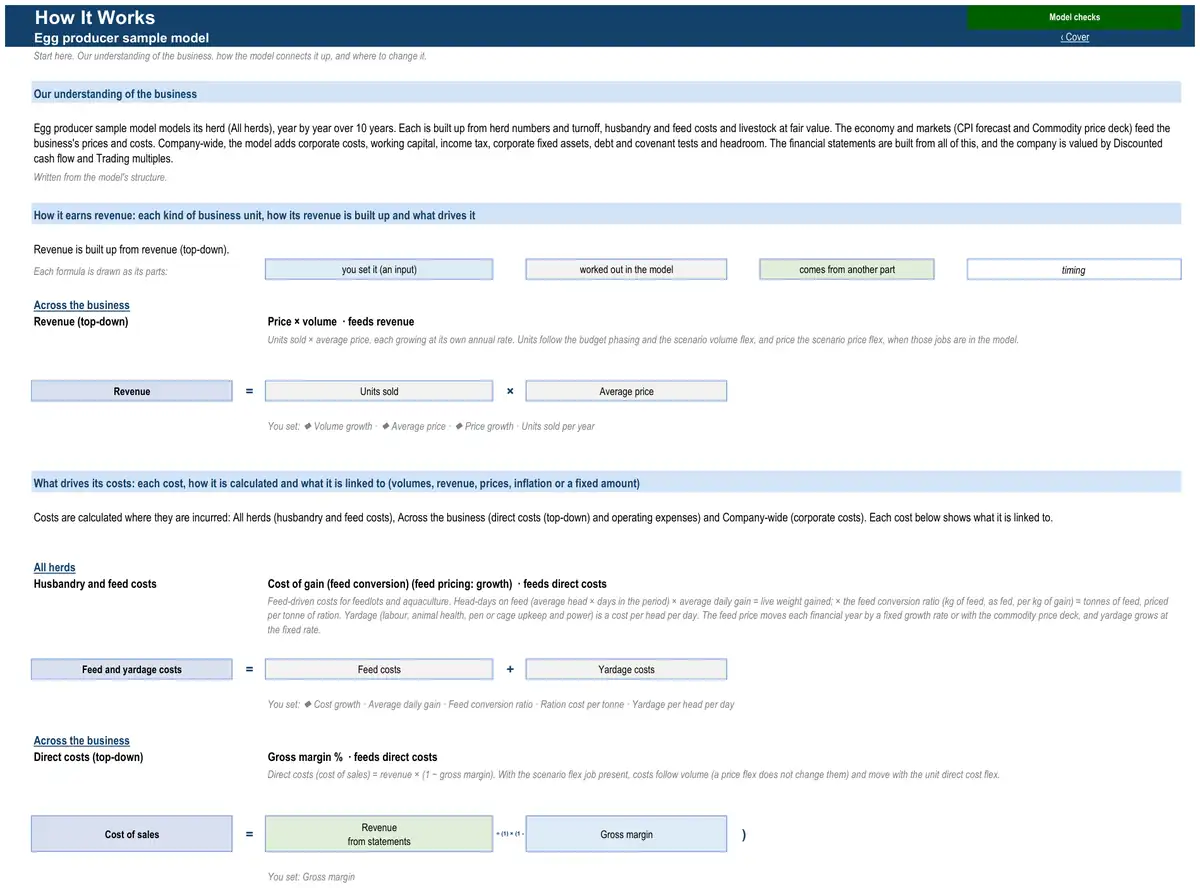
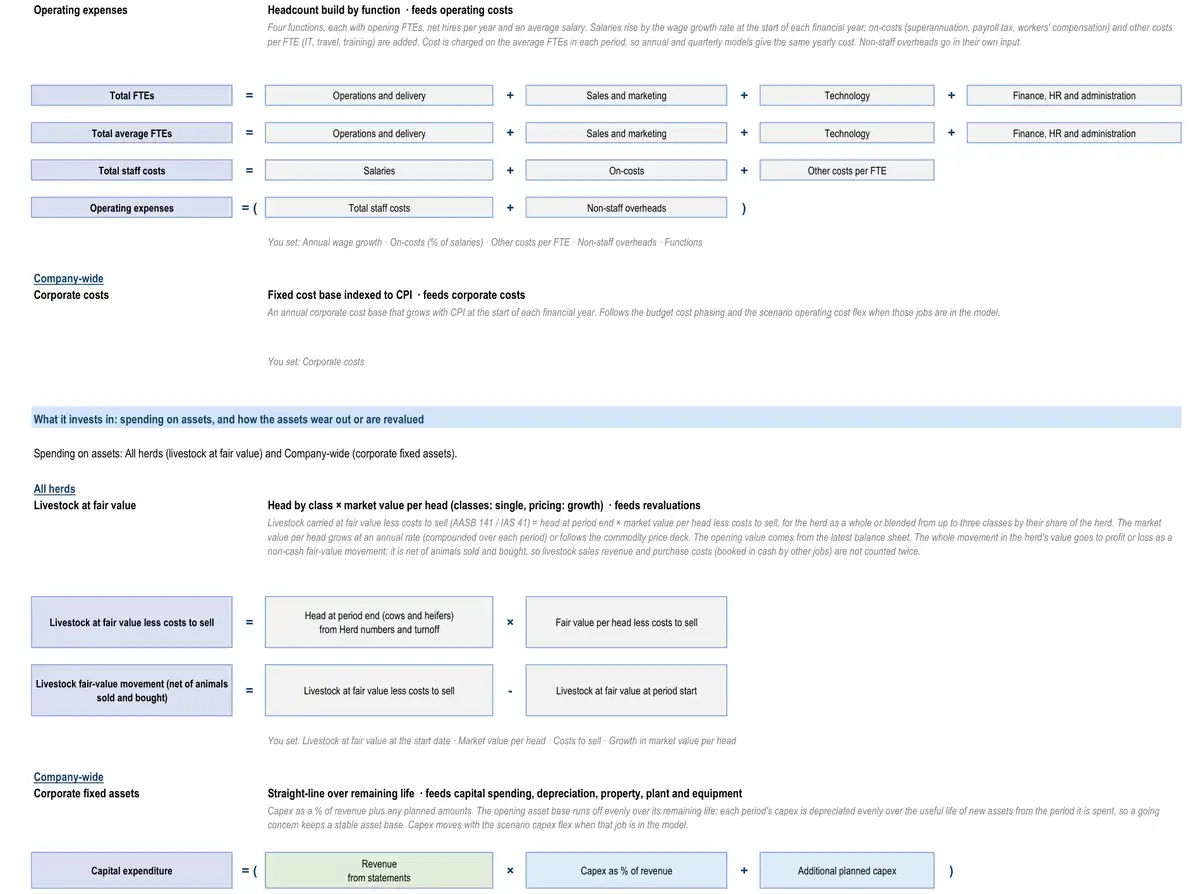
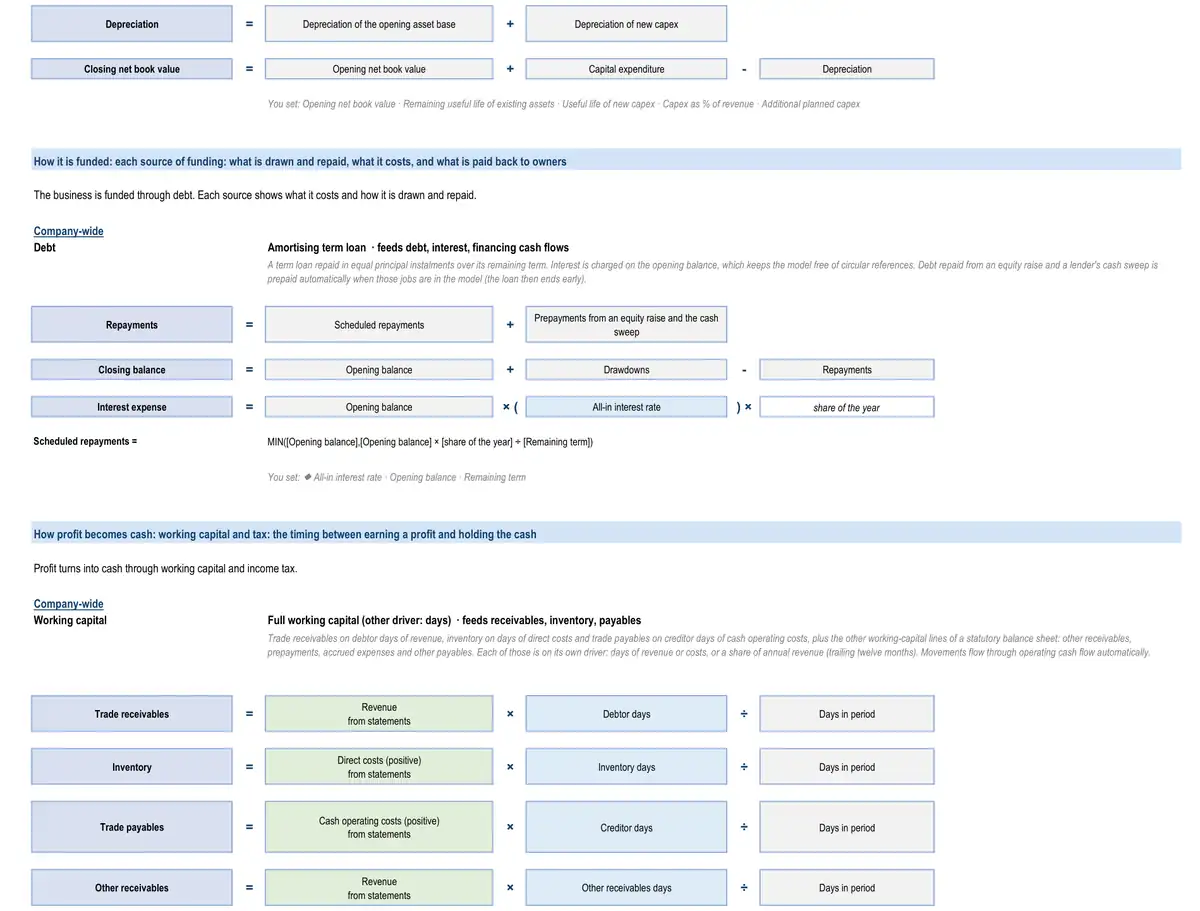
The sample describes no real business. Yours is calibrated to your own figures, so its results are your business’s.
How the model works for an egg producer.
- How it earns revenue1 formulaRevenue (top-down) · Across the businessRevenueUnits soldAverage price
- What drives its costs3 formulasHusbandry and feed costs · All herdsFeed and yardage costsFeed costsYardage costsDirect costs (top-down) · Across the businessCost of salesRevenuefrom statementsGross marginOperating expenses · Across the businessTotal FTEsOperations and deliverySales and marketingTechnologyFinance, HR and administration
- What it invests in3 formulasLivestock at fair value · All herdsLivestock at fair value less costs to sellHead at period end (cows and heifers)from herd numbers and turnoffFair value per head less costs to sellLivestock at fair value · All herdsLivestock fair-value movement (net of animals sold and bought)Livestock at fair value less costs to sellLivestock at fair value at period startCorporate fixed assetsCapital expenditureRevenuefrom statementsCapex as % of revenueAdditional planned capex
- How it is funded3 formulasDebtRepaymentsScheduled repaymentsPrepayments from an equity raise and the cash sweepDebtClosing balanceOpening balanceDrawdownsRepaymentsDebtInterest expenseOpening balanceAll-in interest rateshare of the year
- How profit becomes cash3 formulasWorking capitalTrade receivablesRevenuefrom statementsDebtor daysDays in periodWorking capitalInventoryDirect costs (positive)from statementsInventory daysDays in periodWorking capitalTrade payablesCash operating costs (positive)from statementsCreditor daysDays in period
19 parts, each one tested.
Every part is a tested building block with its own checks: yours is put together from the ones your business needs.
- CPI forecastConsensus curve with long-run anchor
- Revenue (top-down)Price × volume
- Direct costs (top-down)Gross margin %
- Operating expensesHeadcount build by function
- Corporate costsFixed cost base indexed to CPI
- Working capitalFull working capital
- Income taxCorporate rate with tax losses
- Corporate fixed assetsStraight-line over remaining life
- DebtAmortising term loan
- Discounted cash flow valuationDCF on free cash flow to the firm
- Multiples valuationEV / EBITDA multiple
- Commodity price deckFlat real pricesPrice paths for the farm, fish and forest commodities in the model — grain, oilseeds, cotton, sugar, beef, lamb, pork, wool, milk, fish, logs, fertiliser and feed — that sales and cost methods read as indices.
- Key-metric summaryLast-twelve-month and run-rate metrics
- Covenant tests and headroomLVR, gearing and ICR for property
- Feasibility metricsCash-flow returns
- Completed valueCapitalised income
- Herd numbers and turnoffDairy herdHead of livestock (or fish) through the year — births, deaths, purchases, sales and moves between classes.
- Husbandry and feed costsCost of gain (feed conversion)Costs of running the herd — feed, animal health, breeding, shearing, freight, selling costs and agistment.
- Livestock at fair valueHead by class × market value per headValue of livestock (or fish biomass) on hand at fair value less costs to sell, and the fair-value movement taken to profit (AASB 141), net of the value of animals sold so sales are not counted twice.
The numbers it tracks.
- 01hens housed
- 02eggs per hen housed
- 03price per dozen by system
- 04feed cost per dozen
- 05EBITDA
More in farming, fishing and forestry.
- Broadacre cropping farm financial model
- Beef and sheep farm financial model
- Dairy farm financial model
- Orchard and vineyard financial model
- Greenhouse grower financial model
- Aquaculture farm financial model
- Cattle feedlot financial model
- Chicken meat producer financial model
- Pork producer financial model
- Vegetable grower financial model
- Plant nursery and turf grower financial model
- Medicinal cannabis producer financial model
- Fishing company financial model
- Timber plantation financial model
Looking for an egg producer financial model template? Ours arrives built for your business, with your figures in it.
See a finished model, sheet by sheetThe sample is built on illustrative figures and describes no real business. Models are calculations prepared from the information you provide. They are not financial advice and must be independently verified. See our terms.